
Avianca Dog Travel Policy
The first time I considered flying Avianca with my dog, I thought I had it all figured out. I read a few forum posts, skimmed the airline website, and confidently booked my ticket.
A week before departure, I decided to double-check one small detail: cabin weight limits. That’s when everything unraveled.
Conflicting answers, unclear charts, and people online saying “it depends” way too casually. I wasn’t panicking, but I definitely realized I didn’t understand the avianca dog policy as well as I thought I did.
So I went down the rabbit hole. I called Avianca, talked to airport staff, compared routes, aircraft types, and real traveler experiences.
What I learned is that the avianca dog policy isn’t impossible, but it is very specific, sometimes inconsistent, and easy to misinterpret if you’re not prepared.
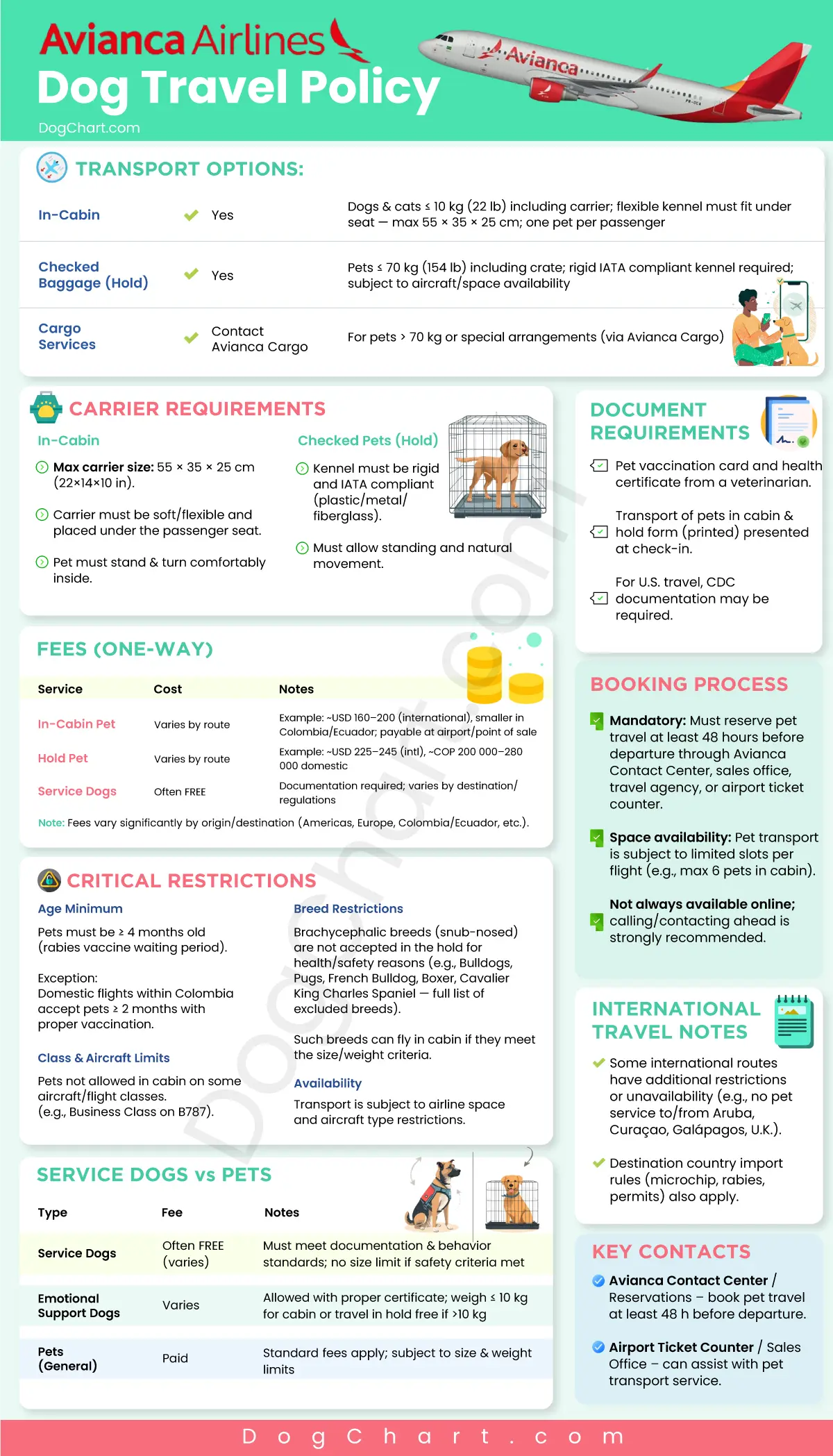
Table of Contents
Avianca Dog Policy Explained
Before getting into weight limits, carriers, or routes, it’s important to understand how Avianca approaches pets overall.
The avianca dog policy explained in simple terms is this: pets are allowed, but only within tightly controlled limits, and enforcement depends heavily on route, aircraft, and even airport staff.
Avianca treats pets as either cabin pets or transported animals (hold or cargo). There is no middle ground, and emotional support animals are not treated as a special category anymore.
Approval does not guarantee boarding, and that’s something many dog owners learn too late. This policy structure is why so many people feel confused.
The rules exist, but how they’re applied can vary, which is why preparation matters more than assumptions.
TRANSPORT OPTIONS
| Option | Available? | Key Details |
| In-Cabin | ✅ Yes | Dogs & cats ≤ 10 kg (22 lb) including carrier; flexible kennel must fit under seat — max 55 × 35 × 25 cm; one pet per passenger |
| Checked Baggage (Hold) | ✅ Yes | Pets ≤ 70 kg (154 lb) including crate; rigid IATA compliant kennel required; subject to aircraft/space availability |
| Cargo Services | 🐶 Contact Avianca Cargo | For pets > 70 kg or special arrangements (via Avianca Cargo) |
CARRIER REQUIREMENTS
In-Cabin
- Max carrier size: 55 × 35 × 25 cm (22×14×10 in)
- Carrier must be soft/flexible and placed under the passenger seat
- Pet must stand & turn comfortably inside
Checked Pets (Hold)
- Kennel must be rigid and IATA compliant (plastic/metal/fiberglass)
- Must allow standing and natural movement
FEES (ONE-WAY)
| Service | Cost | Notes |
| In-Cabin Pet | Varies by route | Example: ~USD 160–200 (international), smaller in Colombia/Ecuador; payable at airport/point of sale |
| Hold Pet | Varies by route | Example: ~USD 225–245 (intl), ~COP 200 000–280 000 domestic |
| Service Dogs | Often FREE | Documentation required; varies by destination/regulations |
Note: Fees vary significantly by origin/destination (Americas, Europe, Colombia/Ecuador, etc.).
BOOKING PROCESS
- Mandatory: Must reserve pet travel at least 48 hours before departure through Avianca Contact Center, sales office, travel agency, or airport ticket counter.
- Space availability: Pet transport is subject to limited slots per flight (e.g., max 6 pets in cabin).
- Not always available online; calling/contacting ahead is strongly recommended.
CRITICAL RESTRICTIONS
Age Minimum
- Pets must be ≥ 4 months old (rabies vaccine waiting period).
- Exception: Domestic flights within Colombia accept pets ≥ 2 months with proper vaccination.
Breed Restrictions
- Brachycephalic breeds (snub-nosed) are not accepted in the hold for health/safety reasons (e.g., Bulldogs, Pugs, French Bulldog, Boxer, Cavalier King Charles Spaniel — full list of excluded breeds).
- Such breeds can fly in the cabin if they meet the size/weight criteria.
Class & Aircraft Limits
- Pets not allowed in the cabin on some aircraft/flight classes (e.g., Business Class on B787).
Availability
- Transport is subject to airline space and aircraft type restrictions.
DOCUMENT REQUIREMENTS
- Pet vaccination card and health certificate from a veterinarian.
- Transport of pets in cabin & hold form (printed) presented at check-in.
- For U.S. travel, CDC documentation may be required.
SERVICE DOGS vs PETS
| Type | Fee | Notes |
| Service Dogs | Often FREE (varies) | Must meet documentation & behavior standards; no size limit if safety criteria met |
| Emotional Support Dogs | Varies | Allowed with proper certificate; weigh ≤ 10 kg for cabin or travel in hold free if >10 kg |
| Pets (General) | Paid | Standard fees apply; subject to size & weight limits |
PRE-FLIGHT CHECKLIST
- Book pet service ≥ 48 hours before flight.
- Measure pet + carrier to ensure compliance.
- Obtain a health certificate + vaccination card.
- Complete pet transport form and bring printed copy.
- Check destination documentation (e.g., CDC rules for U.S.).
INTERNATIONAL TRAVEL NOTES
- Some international routes have additional restrictions or unavailability (e.g., no pet service to/from Aruba, Curaçao, Galápagos, U.K.).
- Destination country import rules (microchip, rabies, permits) also apply.
KEY CONTACTS
- Avianca Contact Center / Reservations – book pet travel at least 48 h before departure.
- Airport Ticket Counter / Sales Office – can assist with pet transport service.
AVIANGA UNIQUE FEATURES
- Advance booking required 48 h prior; pet space limited.
- Flexible carrier size max 55×35×25 cm under seat.
- Brachycephalic breeds are banned in cargo for safety.
- Different fee tables depending on region and route.
10 kg Cabin Cutoff
The 10 kg rule is one of the most talked-about parts of the avianca dog policy, and for good reason.
Avianca allows dogs in the cabin only if the combined weight of the dog and the carrier does not exceed 10 kg. Not approximately. Not close enough. Ten means ten.
This cutoff includes everything: your dog, the carrier, padding, and any built-in structure. Many people weigh only their dog at home and forget the carrier adds another 2 to 3 kg.
Now imagine your dog gains half a kilo, or the scale at the airport reads slightly higher. That’s how people get denied. Avianca staff will weigh the full setup at check-in if they choose to enforce it.
| Item | Average Weight (kg) |
| Small dog | 6.5 |
| Soft carrier | 2.5 |
| Pad or blanket | 0.5 |
| Total | 9.5 |
Soft Carrier Enforcement
Avianca requires soft-sided carriers for cabin pets. Hard carriers are almost always rejected, even if they technically fit under the seat.
Soft carrier enforcement is stricter than many travelers expect because Avianca wants flexibility under-seat.
The carrier must fully close, allow the dog to stand and turn around, and compress slightly to fit under the seat. Zippers, ventilation panels, and base stiffness all matter.
One issue dog owners face is that different airports measure carriers differently. Some staff physically push the carrier under a seat mockup, others eyeball it. This inconsistency makes soft carrier choice critical.
| Requirement | Avianca Expectation |
| Carrier type | Soft-sided only |
| Ventilation | Mesh on multiple sides |
| Closure | Fully zippered |
| Flexibility | Compressible edges |
| Size | Fits under seat fully |
Hold vs Cargo Split
Many people think the hold and cargo are the same. Under the avianca dog policy, they are not. The hold is for pets traveling on the same flight as you, while cargo is a separate logistics process.
Hold transport is limited, aircraft-dependent, and often restricted for certain breeds. Cargo is more expensive but sometimes the only option for larger dogs.
| Category | Hold | Cargo |
| Same flight | Yes | No |
| Size limits | Medium | Larger |
| Booking | Passenger service | Cargo department |
| Temperature control | Aircraft dependent | Regulated |
| Breed restrictions | Stricter | Still applies |
Snub-Nose Breed Limits
Snub-nosed breeds are one of the most sensitive areas of the avianca dog policy. Breeds like Bulldogs, Pugs, Shih Tzus, and Boxers face increased risk during air travel due to breathing issues.
Avianca often blocks these breeds from traveling in the hold entirely, especially on longer routes or warmer climates. Some routes allow them in the cabin only if they meet the weight limit.
| Breed Type | Cabin Allowed | Hold Allowed |
| Pug | Yes (under 10 kg) | Often no |
| French Bulldog | Rarely | No |
| Shih Tzu | Yes | Route-dependent |
| Boxer | No | No |
| Boston Terrier | Sometimes | Usually no |
Route-Specific Rules
This is where things get tricky. Route-specific rules mean that even if your dog flew fine on one Avianca route, the same setup might be denied on another.
Domestic flights in Colombia often have more flexibility than international routes. Flights to the US, Europe, or certain Caribbean destinations have stricter enforcement due to local regulations.
| Route Type | Cabin Pets | Hold Pets |
| Domestic Colombia | Common | Limited |
| Latin America | Limited | Route-based |
| US Routes | Very limited | Strict |
| Europe | Rare | Highly regulated |
| Caribbean | Inconsistent | Weather-based |
ESA vs Pet Confusion
Many travelers still assume emotional support animals are treated differently. Under the current avianca dog policy, ESAs are treated as regular pets, not service animals.
This change caught many people off guard, especially those who flew pre-2021 when ESA policies were more flexible. Documentation alone does not override cabin pet rules.
| Category | Cabin Access | Extra Fees |
| Service dog | Yes | No |
| ESA | No special access | Yes |
| Pet dog | Weight-based | Yes |
| Psychiatric ESA | Treated as pet | Yes |
| Therapy dog | Treated as pet | Yes |
Business Class Limits
This one surprises people. Business Class does not guarantee cabin pet acceptance. In fact, some Business Class seats cannot accommodate under-seat carriers at all.
Avianca may reject cabin pets in Business Class due to seat design, even if Economy allows them. Always check seat configuration before upgrading.
| Cabin Type | Under-Seat Space | Pet Allowed |
| Economy | Yes | Yes |
| Premium Economy | Limited | Sometimes |
| Business | Often none | Often no |
| Lie-flat seats | No | No |
| Bulkhead rows | No | No |
Pet Slot Shortages
Avianca limits the number of pets per cabin per flight. These pet slots sell out fast, especially on popular routes. Booking early is not optional if you want a cabin spot.
| Flight Type | Average Pet Slots |
| Short domestic | 4 |
| Regional international | 2 to 3 |
| Long-haul | 1 to 2 |
| Business-heavy routes | 0 to 1 |
| Holiday flights | Often zero |
Aircraft Change Issues
Aircraft changes are one of the most stressful parts of flying with dogs. Even with approval, a change in aircraft can invalidate your pet booking. Always re-confirm after schedule changes.
| Change Type | Impact on Pet |
| Smaller aircraft | Pet slot removed |
| Seat layout change | Carrier won’t fit |
| Temperature limits | Hold blocked |
| Route reassignment | New rules apply |
| Last-minute swap | High denial risk |
Check-In Denial Triggers
Even with confirmation, denial at check-in happens. Understanding the common triggers helps you avoid them. Preparation is your best defense.
| Trigger | Reason |
| Overweight by 0.5 kg | Strict cutoff |
| Carrier too rigid | Under-seat fit |
| Aggressive behavior | Safety |
| Missing health docs | Regulation |
| Staff discretion | Policy ambiguity |
FAQs
How strict is Avianca with the 10 kg pet + carrier limit?
Very strict when enforced. Even small overages can result in denial.
Why are some routes allowing cabin pets while others don’t?
Local regulations, aircraft type, and climate all affect approval.
Can my dog be refused if the carrier barely fits under the seat?
Yes. If staff believes it restricts safety or space, they can deny boarding.
What happens if my flight changes aircraft after booking my dog?
Your pet approval may be canceled, and re-approval is not guaranteed.
Why do Avianca agents check carrier size differently at each airport?
Training and enforcement vary by station and local management.
Are snub-nosed dogs always blocked from flying in the hold?
Most of the time, yes, especially on long or warm routes.
Can emotional support dogs fly in cabin on all Avianca routes?
No. ESAs are treated as regular pets under current rules.
Why does Business Class sometimes reject cabin pets?
Seat designs often lack under-seat storage space.
What causes cabin pet spots to sell out so fast on Avianca flights?
Very limited slots combined with high demand.
Can my dog be denied boarding even with advance approval?
Yes. Final approval always happens at check-in.