
Dog Heat Cycle Chart: Stages, Signs, Timing & When to Call the Vet
Quick Answer: How Long Do Dogs Stay in Heat?
Visible heat lasts 2 to 4 weeks.
That visible window is made up of two stages:
- Proestrus: about 7–10 days, swelling, bloody discharge, males interested, female not yet receptive
- Estrus: about 5–9 days, discharge lightens, female becomes receptive, ovulation occurs
After that, the full reproductive cycle is much longer. Diestrus lasts about 60–90 days, then anestrus, the resting phase, lasts several months. Most dogs cycle about every 6–7 months, but the full range is roughly every 4–12 months depending on breed, size, and the individual dog.
The most important mistake to avoid: do not relax supervision when bleeding lightens. Lighter discharge often means peak fertility, not the end of risk.
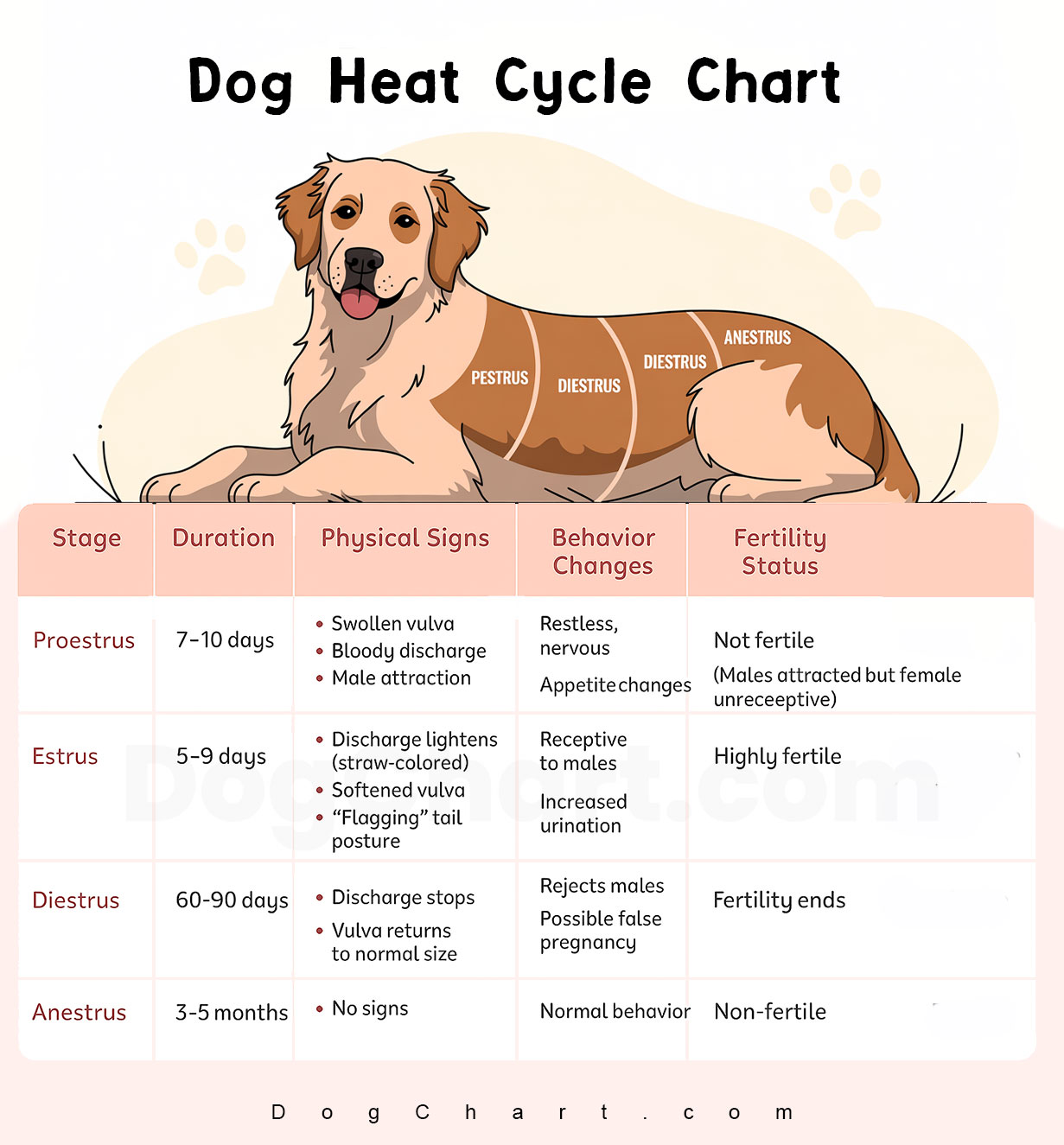
Table of Contents
Dog Heat Cycle Chart: The 4 Stages
Use the “typical” column for planning, and the “range” column to understand why your dog may not match the chart exactly. Individual variation is normal.
| Stage | Typical duration | Possible range | What you will see | Is she fertile? |
|---|---|---|---|---|
| Proestrus | 7–10 days | 3–17 days | Swollen vulva, bloody discharge, frequent urination, clingy or restless behaviour, licking the genital area. Males are attracted, but she usually refuses mating. | No, not yet receptive |
| Estrus | 5–9 days | 3–21 days | Discharge lightens to pink or straw-coloured, vulva softens, tail “flagging” to the side, stands for males. Ovulation occurs in this stage. | Yes, peak fertility |
| Diestrus | 60–90 days | About 2–3 months | Discharge ends, vulva returns to normal size, she rejects males. Hormones stay elevated whether or not she is pregnant. False pregnancy can occur here. | No |
| Anestrus | 4–5 months is common | 4–12 months in some dogs | No heat signs, normal behaviour. This is the resting and recovery phase before the next cycle. | No |
Total cycle: from the start of one heat to the start of the next is typically 6–12 months.
A note on discharge colour
Discharge colour is a clue, not a test. Many dogs go from bloody to pink/straw-coloured as they move from proestrus into estrus, but some bleed lightly throughout, and some barely spot at all. Never use colour alone to decide she is safe around intact males. If breeding timing matters, use veterinary testing, not colour.
Dog Heat Cycle by Week: Corrected Timeline
The old version of this article wrongly suggested anestrus starts in “Week 4.” It does not. Here is the corrected version:
Weeks 1–2: Visible heat
- Week 1 is usually proestrus: swelling begins, bloody discharge appears, male dogs show interest, but she is not ready to mate.
- Week 2 is usually estrus: the fertile stage. Discharge lightens, she may flag her tail and accept males. This is the highest pregnancy-risk period.
Weeks 3–12: Diestrus
- Fertility ends and behaviour normalises, but hormones remain high.
- The uterus is still under the influence of progesterone. This is also when false pregnancy and, later, pyometra risk need watching — see below.
- Do not treat the end of bleeding as the end of the cycle.
Months 3–6+: Anestrus
- A true rest period. No heat signs, no fertility.
- This is usually the best window to discuss spaying with your vet, once hormones have settled.
Tracker tip: Write down the first day you notice swelling or discharge, not just the first day of bleeding. That date is your anchor for predicting the next cycle and for telling your vet exactly how long a stage lasted.
Dog Heat Cycle by Age and Breed Size
There is no single “first heat” date. Use these as typical ranges, not rules.
| Size | Typical first heat | Typical frequency |
|---|---|---|
| Toy / small breeds | 6–12 months, often earlier than large breeds | Often every 6 months; some small breeds cycle more often |
| Medium breeds | 6–14 months | Usually about every 6–7 months |
| Large breeds | 12–18 months | Usually about every 6–7 months |
| Giant breeds | 12–24 months | Sometimes only once a year |
Other age facts worth knowing:
- Most dogs have their first heat between 6 and 15 months, with giant breeds sometimes not until 18–24 months.
- Dogs do not go through menopause. An older unspayed female can still cycle, although fertility and egg quality decline with age.
- The first one or two cycles in a young dog are often irregular. That does not automatically mean something is wrong, but persistent irregularity should be checked.
How to Tell Which Stage She Is In
Look at the combination, not one sign alone:
- Proestrus: swelling + bloody discharge + male interest + she turns males away.
- Estrus: lighter discharge + softened vulva + flagging + she stands still for males.
- Diestrus: discharge gone + vulva back to normal + she rejects males + behaviour back to normal, or false-pregnancy behaviour.
- Anestrus: nothing to see, and that is normal.
If you need to know for breeding, do not guess from behaviour alone. See “Progesterone Testing” below.
Understanding the Dog Breeding Cycle and Fertility
Ovulation does not happen the day bleeding starts. It usually happens several days into estrus, after the discharge has started to lighten.
That is why timing matters so much for breeders: mating too early or too late can mean a failed attempt or a smaller litter.
Progesterone testing
Progesterone blood testing is the most useful tool for timing mating, but it is not a single “exact day” test:
- Vets usually run serial tests, repeated blood tests over several days, and interpret the rising pattern.
- Results help pinpoint ovulation and the fertile window, but the vet interprets them together with behaviour, vaginal cytology, and the dog’s history.
- A cheaper, common alternative is vaginal cytology, a simple swab test your vet can use to help stage the cycle.
- Ask your vet about same-day availability and cost before you assume one test will give you a final answer.
Once pregnancy is confirmed, gestation is typically about 63 days from ovulation. From mating, the range is wider, so your vet’s dating, not the mating date alone, is the reliable guide.
If you are not planning to breed: the safest assumption is that any intact male access during weeks 1–3 of visible heat is a pregnancy risk. Do not rely on “she seemed past it” or “the bleeding stopped.”
How to Care for a Dog in Heat
Preventing accidental mating
- Keep her leashed on every walk, even in a familiar area.
- Never leave her unsupervised outside, including in a fenced yard. Determined males can be persistent, and fences are not always enough.
- Avoid dog parks, daycare, and off-leash areas for the full 3–4 weeks of visible heat.
- Separate intact males and females inside the home too, including overnight. Closed doors, crates, and supervision are not overkill during estrus.
- Remember: males can detect a female in heat from a long distance by scent, and they may become vocal, restless, mark more, or try to escape.
Comfort and hygiene
- Washable or disposable dog diapers help indoors, but change them frequently. Do not leave a diaper on all day, check for irritation, keep the area clean, and watch for urinary discomfort.
- Clean her gently without over-bathing. A quick wipe is usually enough.
- Give her a quiet resting place, extra reassurance, and calm enrichment if she is clingy, restless, or moody.
- Appetite changes are common. Offer normal food unless your vet advises otherwise, and watch for a complete refusal to eat. That is different from pickiness.
What to Do After Accidental Mating
Stay calm, and contact your vet promptly, the same day if possible. Do not try home remedies, human emergency contraception, or anything you read on a forum.
Your vet can discuss:
- Whether mating actually occurred and when
- What options exist, and their risks
- Why timing matters. Options become more limited and more complicated with time
- Follow-up checks, including pregnancy testing and health monitoring
This is a veterinary decision, not a home decision. The earlier you call, the more options you are likely to have.
Pyometra: The Post-Heat Risk Every Owner Should Know
Pyometra is a serious, potentially life-threatening uterine infection in unspayed females. It is not a heat-stage symptom. It usually develops after heat.
When it typically appears: about 4–8 weeks after heat, during diestrus, when progesterone is elevated.
Lifetime risk: about 25% of unspayed female dogs develop pyometra before age 10. Risk rises with age and with repeated cycles.
Warning signs: seek veterinary care urgently if you see these weeks after heat:
- Increased thirst and urination
- Lethargy, loss of appetite, or vomiting
- Abdominal discomfort or swelling
- Foul-smelling, pus-like, or cloudy vaginal discharge
- No discharge at all does not rule it out. In “closed” pyometra, pus cannot drain, and the dog can become very ill without visible discharge.
Pyometra is an emergency. Do not wait to see if it improves on its own. Spaying prevents pyometra, which is one reason vets discuss spay timing so carefully.
False Pregnancy: Common, Usually Temporary, Sometimes Needs a Vet
False pregnancy, also called pseudopregnancy, happens during diestrus, when hormones stay high even though the dog is not pregnant.
Common signs, weeks after estrus:
- Nesting behaviour
- Mothering toys or other objects
- Mammary swelling or milk production
- Clinginess, restlessness, or appetite changes
Most cases settle on their own in 2–3 weeks. Contact your vet if:
- Signs are severe or last longer than a few weeks
- Mammary glands become hot, painful, or infected-looking
- She stops eating, vomits, or becomes lethargic
- You are unsure whether she could actually be pregnant
Do not try to express milk or give hormonal medication at home. Your vet can advise whether monitoring, behaviour changes, or treatment is needed.
Silent Heat and Abnormal Cycles
Not every cycle is obvious. In a silent heat, a female ovulates with little or no visible bleeding or swelling, so it is easy to miss, and easy to underestimate pregnancy risk.
Cycles can also be irregular, especially in young dogs during their first year or two.
See your vet if you notice:
- Heat cycles closer together than every 4 months
- Cycles that never seem to end, or bleeding lasting longer than 3 weeks
- Very heavy bleeding
- Heavy, foul-smelling, or pus-like discharge
- Fever, lethargy, vomiting, or abdominal pain at any stage
- No cycle at all by 18–24 months
- A discharge that returns weeks after heat ended, especially with increased thirst or lethargy. This can be pyometra, not a new heat
Split heats, where signs start, stop, then start again weeks later, also deserve a vet check rather than guesswork.
When to Spay Around the Heat Cycle
Vets generally avoid spaying during proestrus and estrus, because the reproductive organs are engorged with blood and surgery carries more bleeding risk.
The usual recommendation is to wait until anestrus, when hormones have settled, commonly about 2–3 months after visible heat ends, which places the dog in the resting phase. Your vet will confirm timing based on examination, not just the calendar.
Ideal age for a first spay varies by breed and size, so discuss timing with your vet. For some large and giant breeds, vets may discuss waiting until after skeletal maturity or after a first heat. For other dogs, earlier spaying may be recommended. There is no single age that fits every dog, and the decision should weigh pyometra and mammary tumour risk, orthopaedic development, behaviour, and your household situation.
Spaying also prevents unwanted pregnancy and eliminates pyometra risk. It does not automatically fix every behaviour issue, and it has its own surgical risks. Another reason to plan it with your vet rather than rushing it around a heat.
Printable Dog Heat Cycle Tracker
Copy this into your notes app or print it for the fridge:
- Dog name / breed / size:
- First day of swelling or discharge:
- Discharge: bloody / pink / straw-coloured / none, date changed:
- Behaviour: clingy / restless / flagging / rejecting males, dates:
- Male interest noticed: yes / no, dates:
- Vet visits / progesterone tests: dates and results:
- Diapers / hygiene notes:
- Any warning signs: heavy bleeding, foul discharge, lethargy, vomiting, increased thirst:
- Expected next cycle: about 6–7 months later, adjusted for your dog’s own pattern
Tracking two or three cycles is far more useful than any generic chart, because your dog’s normal pattern is what lets you spot an abnormal one.
FAQs
How often do dogs go into heat?
Most dogs go into heat about every 6–7 months, or about twice a year. Smaller breeds may cycle more often, while giant breeds may only have one heat per year. Track your own dog’s pattern. The average is a starting point, not a promise.
How long do dogs stay in heat?
Visible heat lasts 2–4 weeks: about 7–10 days of proestrus, then about 5–9 days of fertile estrus. The full cycle, including diestrus and anestrus, lasts months longer.
At what age does a dog start her heat cycle?
Most dogs have their first heat between 6 and 15 months. Small breeds often start earlier, and large or giant breeds may take up to 18–24 months.
Can male dogs sense a female in heat?
Yes. Males detect heat scent from a long distance and may become obsessed, vocal, restless, or try to escape to find her. Keep a female in heat leashed, supervised, and separated from intact males.
Is there a difference between the heat cycle and the breeding cycle?
Yes. The heat cycle is the full hormonal process: proestrus, estrus, diestrus, and anestrus. The breeding cycle is the fertile window inside it, during estrus, when ovulation occurs and mating can result in pregnancy.
How long does a dog bleed in heat?
Bleeding is usually heaviest in proestrus, the first 7–10 days, and often lightens in estrus. Some dogs spot lightly throughout, and some barely bleed at all. Bleeding lasting longer than 3 weeks, very heavy bleeding, or foul-smelling discharge should be checked by a vet.
What is a silent heat?
A silent heat is a cycle with little or no visible bleeding or swelling, even though ovulation occurs. It is more common in young dogs and first cycles, and it still carries pregnancy risk.
When should I call the vet urgently?
Call promptly for heavy or prolonged bleeding, foul or pus-like discharge, fever, vomiting, lethargy, abdominal pain, excessive thirst and urination weeks after heat, or any sign that could be pyometra. Do not wait for it to pass.
When is the best time to spay?
Usually during anestrus, about 2–3 months after visible heat ends, when hormones have settled. The ideal age varies by breed and size, so confirm timing with your vet.
This guide is educational and not a substitute for veterinary care. If you are planning to breed, if mating may have occurred accidentally, or if you notice anything unusual during or after your dog’s cycle, consult your veterinarian promptly.