
Newfoundland Dog Colors – Complete Coat Color Guide
The first time I got a close look at Newfoundland dogs at a show, I was surprised. I expected all black. Instead, I saw browns, grays, and striking black-and-white patterns walking the ring.
Most people picture this breed as a solid black dog. But there are several recognized coat color options. Each newf looks different. Some colors are common. Others are rare and hard to find.
This Newfoundland dog colors guide covers every official and unofficial color. I’ve included which colors are black, brown, gray, or patterned.
Color does not affect temperament. A brown Newfoundland has the same gentle personality as a black one.
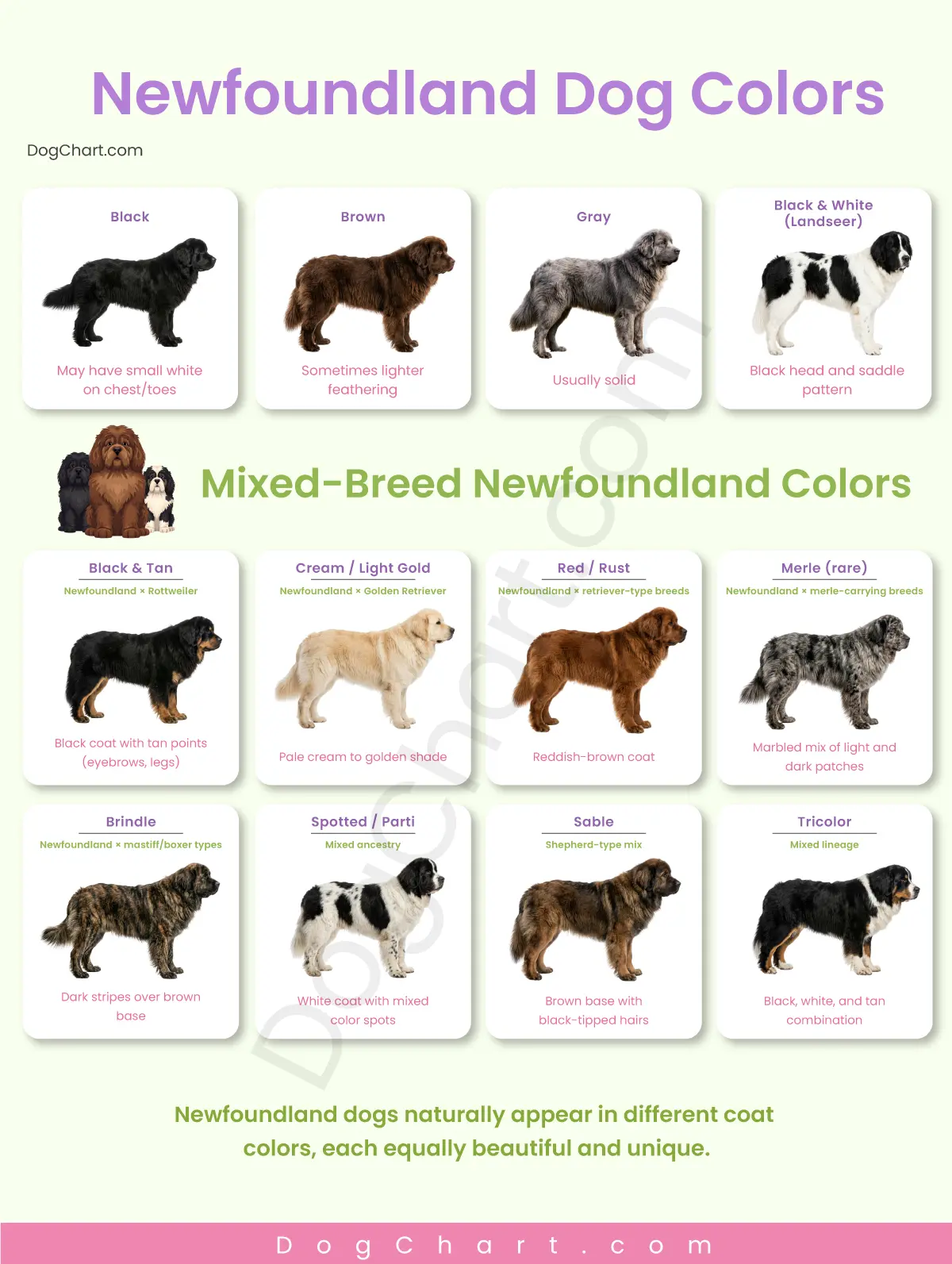
Table of Contents
Common Newfoundland Dog Colors
The American Kennel Club and the Newfoundland Club of America recognize four official colors. These are the acceptable color options for conformation and dog shows. The breed standard lists them as:
| Color | Description | Rarity | Show Ring |
| Black | Solid black, classic look | Very Common | Yes |
| Brown | Chocolate to dark mahogany | Common | Yes |
| Gray | Charcoal to silver | Less Common | Yes |
| Black & White (Landseer) | White base, black markings | Common | Yes |
All four colors can compete in the show ring. Color is secondary to type and soundness in judging. A well-built dog of any acceptable color can win.
Mixed-Breed Newfoundland Colors
| Color Type | Description | Markings | Common Mix Influence |
| Black & Tan | Black coat with tan points (eyebrows, legs) | Rottweiler-like pattern | Newfoundland × Rottweiler |
| Cream / Light Gold | Pale cream to golden shade | Usually solid | Newfoundland × Golden Retriever |
| Red / Rust | Reddish-brown coat | May have white markings | Newfoundland × retriever-type breeds |
| Merle (rare) | Marbled mix of light and dark patches | Irregular pattern | Newfoundland × merle-carrying breeds |
| Brindle | Dark stripes over brown base | Tiger-stripe look | Newfoundland × mastiff/boxer types |
| Spotted / Parti | White coat with mixed color spots | Random patches | Mixed ancestry |
| Sable | Brown base with black-tipped hairs | Shaded look | Shepherd-type mix |
| Tricolor | Black, white, and tan combination | Multi-point markings | Mixed lineage |
Black Newfoundlands
This is the classic. When people picture a Newfoundland, they see a big black dog. It’s the most common color at breeders and in rescue.
The base color is solid black. Some black dogs show a slight brown tint in direct sunlight. This is normal. It doesn’t mean the dog carries the brown gene visibly. True blacks stay solid indoors.
Small white markings on the chest, toes, or chin are allowed under the breed standard. These don’t disqualify a dog from the show ring.
Brown Newfoundlands
A brown Newfoundland ranges from light chocolate to deep mahogany. The shade can change as the dog ages. A puppy is often darker than the adult.
A brown dog sometimes has lighter eyes than a black one. This is tied to the brown gene. It’s normal and accepted by judges.
Brown newfies are popular with families who want something different from the classic black. They’re easy to find from reputable breeders.
Gray Newfoundlands
A grey Newfoundland (also spelled gray) is the rarest of the four standard colors. It ranges from dark charcoal to lighter silver.
Gray is a dilute version of black. A genetic modifier lightens the black pigment. The dilute gene is recessive, so both parents must carry it to produce gray pups.
Expect to pay more for a gray. Fewer breeders produce them. Wait times are longer.
Landseer (Black and White) Newfoundlands
The Landseer pattern is a white with black markings design. The head is usually black with a white blaze. The body is mostly white with black markings on the saddle and rump.
The name comes from Sir Edwin Landseer, a painter who famously depicted black and white Newfoundlands in the 1800s. His paintings made this color famous worldwide.
In Europe, some kennel clubs register the black and white Landseer as a separate breed. In North America, the AKC treats Landseers as a color variety within the Newfoundland community.
White and black Newfoundlands are striking. They stand out in any crowd. Black and white Newfoundlands have the same gentle personality as solid-color dogs.
Brown and White Newfoundlands
A brown and white Newfoundland has the same pattern as a Landseer but in brown instead of black. White base coat with brown patches.
Brown and white Newfoundlands are not recognized by the AKC for conformation. They can still compete in performance events like obedience and water trials.
These color dogs are less common but not impossible to find. Some breeders specialize in this marking pattern.
Popular Newfoundland Dog Colors
Among newfie owners, black is the most popular by far. It’s the classic look. Most breed photos show black dogs.
Landseer is the second most popular. The black-and-white pattern is eye-catching. Many newfies in movies and media are Landseers.
Brown ranks third. It’s growing in popularity, especially among families who want a Newfoundland that looks different from the crowd.
Gray is the least common choice. Not because it’s less desirable, but because fewer breeders work with the dilute gene line.
Rare Newfoundland Dog Colors
Some Newfoundlands appear in colors outside the standard four. These are uncommon and can’t compete in AKC conformation, but they make perfectly healthy pets.
| Rare Color | Description | AKC Status |
| Beige | Light tan, dilute of brown | Not recognized |
| Beige and White | Landseer pattern in beige | Not recognized |
| Grey and Beige | Mixed dilute shades | Not recognized |
| Black and Tan | Black with tan markings | Not recognized |
| Irish Spotted | Solid color with white on chest, paws, blaze | Accepted in moderation |
| Brindle | Striped pattern, very rare | Not recognized |
Beige Newfoundlands are a dilute version of brown. The beige and white Newfoundland follows the same pattern as a Landseer but in lighter shades.
Black and tan Newfoundlands are rare. The tan markings appear above the eyes, on the cheeks, and under the tail. This color in the United States is uncommon.
The Irish spot pattern (piebald) shows white on the chest, paws, and sometimes a blaze on the face. Small Irish spot markings are accepted on solid-color dogs.
White Newfoundlands (all white dog) are extremely rare and not recognized by any major kennel club.
Newfoundland Color Genetics
Understanding color genetics helps explain why certain colors appear. Here’s a simplified breakdown of the genetics behind Newfoundland colors:
Black is dominant. A dog only needs one copy of the black gene to appear black. Most Newfoundlands carry this gene.
Brown is recessive. Both parents must carry the brown gene (bb) to produce a brown puppy. Two black parents can produce brown pups if they both carry recessive genes.
Gray is a dilute of black. The dilute gene lightens black pigment to gray. It’s also recessive.
Beige is a dilute of brown. When both the brown and dilute genes combine, you get beige.
When breeding Newfoundlands, pairing two dogs together that carry dilute genes can produce gray or beige puppies even from two black parents. Colour genetics in this breed is well understood by experienced breeders.
Does Color Affect Price?
| Color | Average Price (USA) | Availability |
| Black | $1,500–$2,500 | Easy to find |
| Brown | $1,800–$3,000 | Moderate |
| Gray | $2,000–$3,500 | Limited |
| Landseer | $2,000–$3,500 | Moderate |
| Beige | $2,500–$4,000 | Very limited |
Black newfs are cheapest because they’re most common. Rare colors like gray and beige cost more due to limited supply. Always buy from reputable breeders who health-test their dogs regardless of color.
A puppy from a responsible breeder includes health clearances for hips, heart, and eyes. Color should never be the only reason to choose a breeder.
Does Color Affect Shedding?
All colors shed the same amount. The thick double coat drops fur year-round regardless of shade. Black coats show less dirt but shed hairs that are visible on light furniture. Brown, gray and white coats show dirt faster.
Grooming needs are identical across all colors. For shedding details, the Newfoundland shedding guide covers seasonal blowouts. For weight tracking by age, the Newfoundland weight chart is helpful.
FAQs
What is the most common Newfoundland color?
Black. It’s the original and most widely bred color. Most puppy litters from black parents will be mostly black.
Are gray Newfoundlands rare?
Yes. Gray is the rarest of the four AKC-recognized colors. The dilute gene is recessive, so both parents must carry it.
Does coat color affect health or temperament?
No. All colors face the same health risks and have the same gentle personality. Color is cosmetic only. For lifespan details, see the Newfoundland lifespan page.
Can two black Newfoundlands have a brown puppy?
Yes. If both parents carry the recessive brown gene (bb), about 25% of pups could be brown. Genetic testing reveals carrier status.
Is Landseer a separate breed?
In some European countries, yes. In the USA, the AKC treats Landseer as a color variety within the Newfoundland breed. For size comparison across giant breeds, the biggest dog breeds chart ranks them all.
Can rare-color Newfoundlands compete in dog shows?
Not in AKC conformation. They can compete in obedience, agility, water rescue, and other performance events. Only the four standard colors are allowed in the dog shows breed ring.
What is an Irish spot on a Newfoundland?
A small white marking on the chest, toes, or chin of a solid-color dog. Minor Irish spotting is accepted under the breed standard. Large white patches on a solid-color dog are less desirable in the show ring.
Where can I find a beige or gray Newfoundland?
Search for breeders who specifically work with dilute color lines. The Newfoundland Club of America maintains a breeder directory. Expect longer wait times and higher prices for rare colors. For naming ideas for your new pup, the Newfoundland names guide has 150+ options.