
Pit Bull Service Dog – Can Pit Bulls Be Service Dogs?
The first time I saw a pit bull service dog in action was at a grocery store in Austin. Big red-nose boy, calm as a lake, walking next to a woman using a cane.
A guy behind me muttered something about it not being a ‘real’ service dog. He was wrong.
Pit bulls can absolutely be service dogs. Federal law does not restrict the role by dog breed, and these dogs make daily rounds as mobility, psychiatric, and medical alert service animals.
A well-trained service dog is a legal service animal regardless of what breed it is.
This guide covers whether a pittie can be a service dog, which pit bull breeds make the best service dog candidates, how service dog training works, the difference between a service dog and an ESA, and a full pit bull service dog chart with the tasks these dogs are trained to perform.
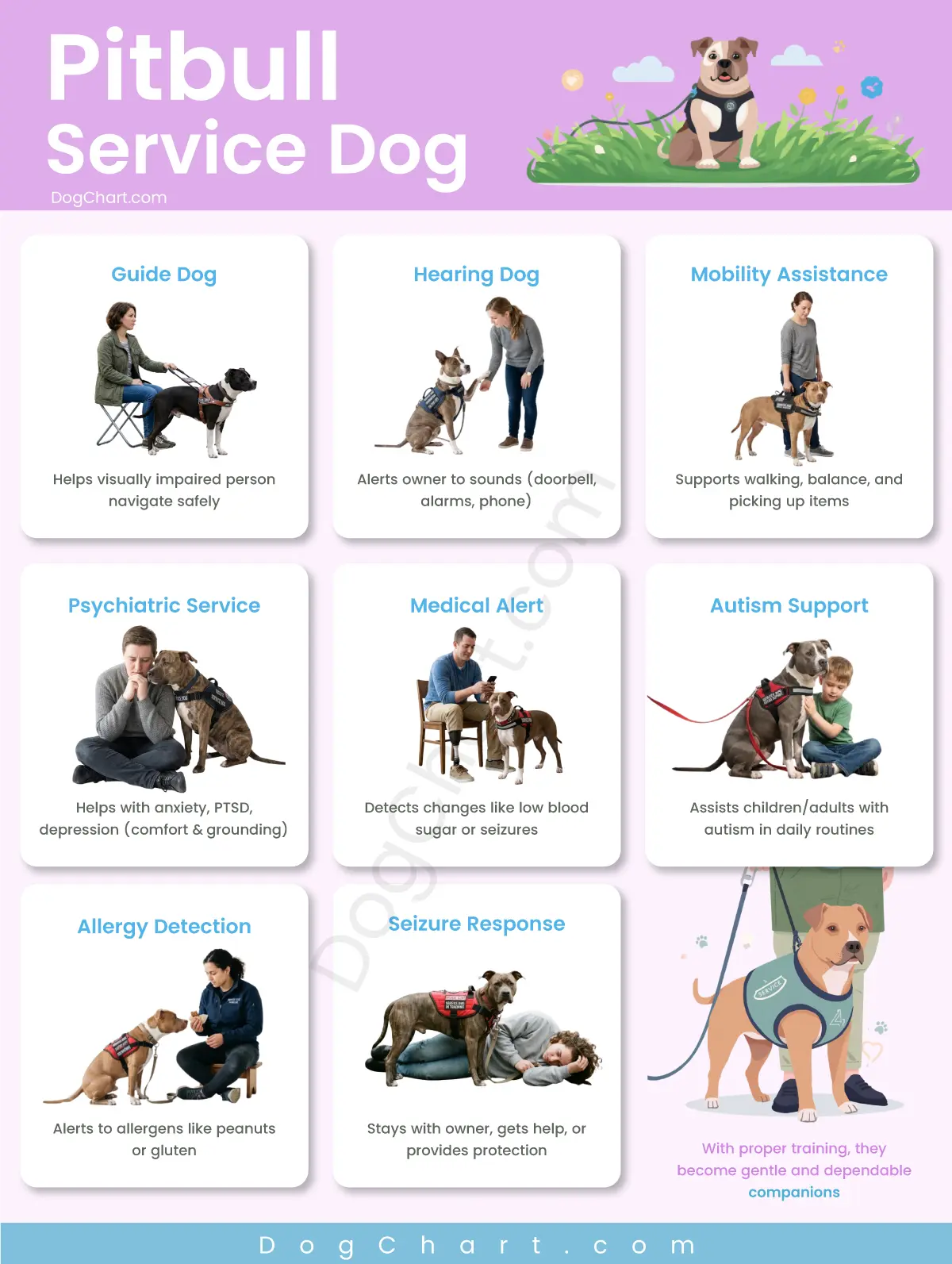
Table of Contents
Can a Pit Bull Be a Service Dog?
Yes. Under the Americans with Disabilities Act, a service dog is defined by the task it performs, not the breed.
According to the ADA, a service animal is any dog individually trained to perform tasks for people with disabilities. There is no breed list, no approved registry, and no rule that rules pit bull-type dogs out.
Pit bulls tend to do well on the traits that matter for service work. They bond hard to one handler, they are intelligent, and they have the pain tolerance that mobility tasks demand
The American Pit Bull Terrier, American Staffordshire Terrier, and Staffordshire Bull Terrier all show up as working as service dogs, and mixes do too. Staffordshire Bull Terrier is one of the smaller options among bull terriers, which some handlers prefer.
The pushback on using a pittie as a service dog usually comes from two places: the breed’s public image as fighting dogs, and city-level breed-specific legislation.
Both are real obstacles. Neither changes whether a pit bull can be a service dog under the law.
Pit Bull Service Dog Chart
Here is the full list of service types these dogs are trained for. Some are more common than others, but every one has a documented working pit bull behind it.
| Service Type | What the Dog Does |
|---|---|
| Guide Dog | Helps a visually impaired handler navigate safely |
| Hearing Dog | Alerts the handler to sounds like doorbells, alarms, and phones |
| Mobility Assistance | Supports walking and balance, picks up dropped items |
| Psychiatric Service | Grounds the handler during anxiety, PTSD, or depression episodes |
| Medical Alert | Detects low blood sugar or oncoming seizures |
| Autism Support | Assists children and adults with autism in daily routines |
| Allergy Detection | Alerts to allergens like peanuts or gluten |
| Seizure Response | Stays with the handler, fetches help, or provides protection during a seizure |
Mobility work and psychiatric service dogs are where these dogs show up most. Their build suits brace work, and the same loyalty that makes them clingy house pets makes them excellent at grounding someone through a panic attack.
Pitties also make great service dogs for autism support, where the handler often needs a calm constant presence more than high-complexity task work.
Why Pit Bulls Make Good Service Dogs
People expect me to say something about ‘heart’ here. I will not. The real reasons pitbulls make good service dogs are practical.
These are good dogs to train because they are food-motivated. They have a short coat, which keeps grooming low for a handler already managing a lot.
They are medium-sized dog, so they fit under a restaurant table but still have the mass for brace and counterbalance work. Smaller pit bulls suit psychiatric work, while larger ones handle the physical side.
They also tend to be velcro dogs. A pit bull that has bonded to its handler will not wander. For a person with PTSD or autism, that constant physical presence is often the whole point of selecting a dog for service work in the first place.
Service dogs accompany their handlers through hard days, and pitties lock in on that job.
Not every pittie is cut out for the work. Service dogs need a steady temperament, neutral reactions around other dogs, tolerance for noise, and focus on the handler.
Most dogs of any breed wash out of a training program when they train for service work, and pitbulls are no exception. The ones that become service dogs end up being some of the best in the field. The pitties that finish training can match any lab, once selected carefully.
The Stereotype Problem
Here is the harder part. These dogs carry an image problem that other service breeds do not. A lab or golden retriever in a vest gets smiles. A pittie in a vest gets questions, and sometimes staff asking to kick the handler out.
Federal law protects public access regardless of breed, so a business cannot legally ask you to leave because of what your dog looks like.
According to the ADA, staff can only ask two questions: is the dog a service animal required because of a disability, and what work has the dog been trained to do. They cannot ask for papers, demand a demo, or refuse based on breed.
If you want to understand where the stereotype actually comes from and where these dogs really land among aggressive dog breeds, the data is less dramatic than the reputation suggests.
Breed Bans, Housing, and Air Travel
A handful of US cities and several countries have breed-specific legislation that restricts certain breeds. Federal law overrides local laws for service dogs in public spaces.
The Fair Housing Act also protects service dogs and ESAs from breed restrictions in most rentals, even where pit bull-type dogs are otherwise banned.
Airlines are a separate headache. Under the Air Carrier Access Act, airlines only have to accept a trained service dog, not an ESA.
They can require DOT forms filed 48 hours in advance. A few carriers have pushed back on larger pitties in cabin. File the paperwork early and bring printed copies.
Before you begin training a pittie as a service animal, check your city code, your state law, and if you rent, your lease. Then check them again in writing.
Training a Pittie for Service Work
Service dog training is not a weekend project. Most working dogs go through 1 to 2 years of specialized training before placement, and the washout rate runs around 50% even among certain breeds that have been used as service dogs for decades. For pitties the rate is similar, not worse.
Training a service dog runs in three phases: obedience training, public access, and task training. Task training is the part that legally qualifies the dog.
A pittie that only provides comfort without being individually trained to perform tasks is an emotional support dog, not a legal service animal. The protections are different. Service dogs must perform a trained task tied to a handler’s disability.
You can train a dog yourself in the US. Federal law does not require a professional training program or certification. Self-training is legal and common.
A good middle path is a trainer who specializes in this work and has placed pitties before. If you want a dog to become a full working partner, expect to invest serious time. No shortcut makes good service dogs.
Pit bulls are powerful, so equipment matters more than with a lab. Handlers doing mobility work usually use a rigid harness rated for the dog’s weight. Our working dog breeds page has more on the kind of load these dogs are built to handle.
Service Dog vs Emotional Support Animal vs Therapy Dog
These three categories get mixed up constantly, and the difference between a service dog and the other two matters legally. Service dogs provide trained task work. ESAs and therapy animals provide comfort. That is the short version.
A service dog is individually trained to perform tasks for a handler with a disability. Full public access under federal law.
An ESA provides comfort through presence but does not perform trained tasks. An ESA letter from a licensed mental health professional gives protections under the Fair Housing Act, but not public access. Service dogs and emotional support dogs are legally different categories.
A therapy dog visits hospitals, schools, and nursing homes to comfort other people, not its handler.
Therapy dogs have no special legal access at all. Pitties work well in all three roles, but service dog status is the only one with full public access, so the need for a service title matters if you want to bring your dog into public spaces.
FAQs
Do pit bulls make the best service dogs?
For the right handler, yes. These dogs often do well at mobility, psychiatric, and medical alert work.
They are less common as guide dogs, mostly because the big guide dog schools already run established labrador and golden retrievers breeding programs. That is a supply issue, not a capability issue.
Pit bulls make the best service dogs in certain roles when matched to the right handler.
Are pit bull service dogs legal?
Yes. Federal law does not allow breed restrictions on trained service animals. State and local rules cannot override this for public access. Private housing is usually also covered under the Fair Housing Act, and air travel under the Air Carrier Access Act. People with disabilities keep these rights regardless of what their dog looks like.
Can I train my pit bull as a service dog myself?
Yes. US federal law does not require a professional to train a dog for service work. Self-training is legal.
The dog still has to meet public access standards and perform a trained task related to your disability, or it is not legally a service dog.
Make sure to ensure that your service dog can hold focus in busy environments before you count it as ready.
What is the difference between a service dog and an emotional support animal?
A service dog performs specific trained tasks for a handler’s condition and has full public access rights. ESAs provide comfort by being present and do not need special training.
They get housing rights under the Fair Housing Act but no public access rights. That is the core difference.
Can a business ask me to leave with my pit bull terrier service dog?
No, not because of breed. According to the ADA, staff can only ask two questions, and breed is not one of them.
A business can ask you to leave only if the dog is out of control or not housebroken. This applies whether your dog is a pit bull terrier or any other breed. Staff who ask you to leave for any other reason are breaking the law.
Can a pit bull be a psychiatric service dog for PTSD?
Yes, and this is one of the most common roles pitties fill. Psychiatric service dogs are trained to interrupt panic attacks, ground the handler during flashbacks, wake the handler from nightmares, and perform deep pressure therapy.
Pit bulls as service dogs for PTSD suit this because they bond closely and stay focused.
Final Thoughts
A pit bull as a service animal is not a statement. It is a dog doing a job. The breed is legal, the training works, and the dogs that make it through a service training program are as reliable as any lab in a vest.
These dogs come from a long line of working dogs, and the right one handles the job.
If you are considering training a pit bull as a service dog, start with a dog with the right build and drive from a line that already has working dogs in it.
Rescues can work, and I have seen them work beautifully, but the odds improve when you know what you are starting with. Not every rescue is a fit, and not every puppy from a working line is either.
Allowing animals to be service partners is about matching the job to the individual, not the label. Compare across the dog breeds chart before you pick.