
Dog Identification Chart | How to Identify Any Dog Breed by Physical Traits
A friend of mine adopted a scruffy brown mutt from a shelter last winter. The shelter guessed “Terrier mix” on the paperwork. A DNA test three months later came back 41% Schnauzer, 28% Yorkshire Terrier, and 31% everything else.
The shelter was in the right ballpark, but a closer look at the coat, beard, and eyebrows would have narrowed it down without a $100 test.
A dog identification chart helps you identify any dog breed by working through physical traits in order: size, coat, ears, snout, and color.
Over 200 breeds of dogs are recognized by the AKC and many more exist worldwide, so a visual guide is faster than flipping through breed lists or photos one by one.
The AKC and other kennel club bodies grouped dog breeds by original purpose, which also gives you shortcuts when two breeds look similar.
This guide walks through each trait with a chart and example breeds, covers the seven main breed groups, shows what to look for in mixed breeds, and compares visual identification with DNA testing.
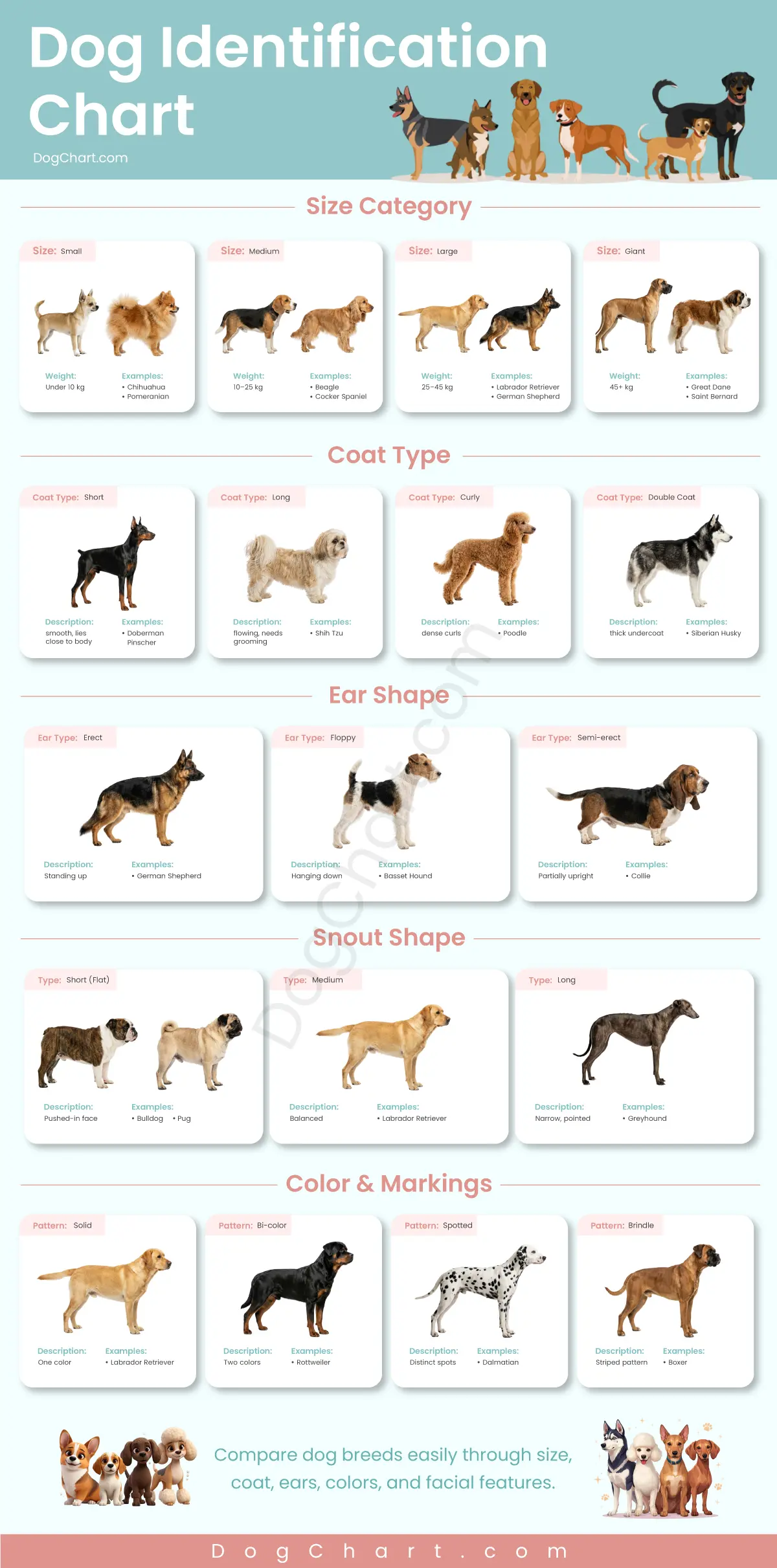
Table of Contents
Dog Breed Identification Chart
| Attribute | Details |
| Total AKC-recognized breeds | 201 as of 2025 |
| Main physical traits to check | Size, coat, ears, snout, color |
| Size categories | Toy, small, medium, large, giant |
| Main coat types | Short, long, curly, double, wire |
| Breed groups | Sporting, Hound, Working, Herding, Terrier, Toy, Non-Sporting |
| DNA kit accuracy | 94-97% for common breeds |
| Visual identification accuracy | Around 25% for mixed breeds without DNA |
| Use this chart for | Shelter dogs, strays, park encounters |
Dog Identification Chart by Physical Traits
Start with size, then work down to coat, ears, snout, and color. Most dog breeds narrow to a short list within a minute when you follow this order. Use the charts below as your visual reference.
1. Size Category
| Size | Weight | Examples |
| Small | Under 10 kg | Chihuahua, Pomeranian |
| Medium | 10–25 kg | Beagle, Cocker Spaniel |
| Large | 25–45 kg | Labrador Retriever, German Shepherd |
| Giant | 45+ kg | Great Dane, Saint Bernard |
Size narrows the field fastest. A dog under 10 kg is nearly always a toy or small breed. The 10 to 25 kg band covers most medium breeds, where Beagles, Cocker Spaniels, and a lot of working mixes live.
Large breeds at 25 to 45 kg are where most family dogs sit: Labradors, German Shepherds, Golden Retrievers. Giant breeds over 45 kg are rarer but easy to spot. See our dog size chart for the full breakdown and the biggest dog breeds list for the giants.
2. Coat Type
| Coat Type | Description | Examples |
| Short | Smooth, lies close to body | Doberman Pinscher |
| Long | Flowing, needs grooming | Shih Tzu |
| Curly | Dense curls | Poodle |
| Double Coat | Thick undercoat | Siberian Husky |
| Wire | Rough texture | Fox Terrier |
Coat type splits dog breeds into five main buckets. A short coat sits close to the body and needs little grooming, the look of the Doberman Pinscher and most pointing dogs. A long coat flows and mats fast without regular brushing, which is why a Shih Tzu needs a groomer every 6 to 8 weeks.
A curly coat is the Poodle’s calling card and the base for most doodle crosses. A double coat layers a thick undercoat below a top coat, common in spitz-type and northern breeds. Wire coats are rough and bristly, the trademark of most Terrier breeds.
3. Ear Shape
| Ear Type | Description | Examples |
| Erect | Standing up | German Shepherd |
| Floppy | Hanging down | Basset Hound |
| Semi-erect | Partially upright | Collie |
Ear shape is the quickest visual giveaway for a breed group. Erect ears stand straight up and mark spitz-type dogs, shepherds, and some terriers. The pointed triangular ear on a German Shepherd or Husky is hard to mistake.
Floppy ears hang down, the classic hound look on a Basset Hound, Bloodhound, or Beagle. Semi-erect ears stand partly up and fold at the tip, seen on Collies, Shelties, and some Fox Terriers. Ear shape alone won’t name a breed, but paired with size and coat it narrows the list fast.
4. Snout Shape
| Type | Description | Examples |
| Short (Flat) | Pushed-in face | Bulldog, Pug |
| Medium | Balanced | Labrador Retriever |
| Long | Narrow, pointed | Greyhound |
Snout length groups dog breeds into three shapes. A short or flat snout, called brachycephalic, belongs to Bulldogs, Pugs, Boxers, and other pushed-in faces. These breeds often have breathing trouble and need extra care in hot weather.
A medium snout is balanced and the most common, seen on Labradors, Golden Retrievers, and most mixed breeds. A long, narrow snout marks sight hounds like the Greyhound and Borzoi, along with Collies and some herding breeds.
5. Color and Markings
| Pattern | Description | Examples |
| Solid | One color | Labrador Retriever |
| Bi-color | Two colors | Rottweiler |
| Spotted | Distinct spots | Dalmatian |
| Brindle | Striped pattern | Boxer |
Color and markings seldom identify a breed on their own, since most breeds come in several colors. But a distinct pattern, the Dalmatian’s spots, the Rottweiler’s black-and-tan, the Boxer’s brindle, can confirm a guess you already have from size and coat.
A solid color is the most common and the least helpful for identification. Watch the markings on the face, chest, and legs. A tan muzzle on a black body points toward Rottweiler, Doberman, or Miniature Pinscher ancestry. See the dog breeds chart for color examples across breeds.
AKC Breed Groups and What They Tell You
The AKC sorts dog breeds into seven groups by original purpose. Knowing the group tells you a lot about a dog’s temperament and energy level. Dogs were bred over centuries for specific jobs, and those instincts still show up today.
| Group | Original Purpose | Example Breeds |
| Sporting | Hunting with hunters | Labrador, Golden Retriever, Irish Setter |
| Hound | Scent or sight hunting | Beagle, Greyhound, Irish Wolfhound |
| Working | Guarding, pulling, assistance | Rottweiler, Saint Bernard, Siberian Husky |
| Herding | Moving sheep and cattle | Border Collie, Australian Cattle Dog, German Shepherd |
| Terrier | Vermin hunting | Fox Terrier, Bull Terrier, Irish Terrier |
| Toy | Companionship | Chihuahua, Pomeranian, Maltese |
| Non-Sporting | Varied origins | Bulldog, Dalmatian, Poodle |
The Sporting group covers retrievers, spaniels, setters, and pointers, all bred to help a hunter find and bring back birds. An Irish Setter and a Labrador both land here despite looking nothing alike.
The Hound group splits into sight hounds and scent hounds, different builds with shared hunting roots.
The Working group holds breeds built for guarding, pulling, and assistance. Many service dogs come from the Working or Sporting groups.
The Herding group stayed part of Working until 1983, when the AKC split off breeds bred to move sheep and cattle. The Australian Cattle Dog and Border Collie are the classic examples.
Terriers were bred to hunt vermin below ground, which is why they dig and carry a strong prey drive. Toy breeds were bred for companionship and lap time. The Non-Sporting group is a catch-all for breeds that don’t fit elsewhere, the Bulldog and Dalmatian among them. The working dog breeds page has more on the working category.
How to Identify Mixed Breed Dogs
Mixed breeds are harder to identify than purebreds. In studies where shelter staff guessed and DNA confirmed, visual identification of mixes was right about 25% of the time. The better approach is to read breed-group signatures instead of naming two specific parents.
| Sign | What It Suggests |
| Curled tail + thick coat | Spitz group mix (Husky, Samoyed, Pom) |
| Long body + short legs | Dachshund or Corgi ancestry |
| Blocky head + short snout | Bulldog or Boxer in the mix |
| Feathered tail and legs | Sporting or Setter breed |
| Wire coat and eyebrows | Terrier group or Schnauzer mix |
| Floppy ears + droopy face | Hound group ancestry |
| Blue merle or speckled | Herding group (Collie, Aussie, Cattle Dog) |
| Giant size + calm temperament | Mastiff or Great Dane mix |
A curled tail and thick double coat? Think spitz group first. A long body on short legs points to Dachshund or Corgi heritage. A blocky head nearly always means Bulldog or Boxer in the mix. These patterns hold across most shelter mutts.
Puppies are the hardest, because adult proportions haven’t set in. A 3-month-old with oversized paws is almost certainly a large breed. At that age, coat length and ear shape beat overall size as clues.
DNA Testing vs Visual Identification
A DNA test is the most reliable way to identify a mixed breed dog. Kits from Embark and Wisdom Panel cost $70 to $200 and test against databases of 250 to 350 breeds. Results come back in 2 to 4 weeks with a percentage breakdown plus health markers.
A visual check using a dog breed chart gets you close for purebreds but falls apart for mixes past the first generation. If the dog’s history matters for training, health, or insurance, DNA is worth the cost. For casual curiosity, the charts above plus a photo against online breed lists tell you enough.
A breeder or veterinarian can also help, especially for traits tied to specific health issues. A Cavalier King Charles shape means watching the heart, while a Dachshund body type means watching the spine. Browse the dog life expectancy chart for breed-specific longevity.
Temperament and Behavior Clues
Physical traits get you to a breed group. Temperament and behavior confirm it. A dog that circles and nips at heels almost certainly carries herd instincts from a herding breed. A dog that digs holes with focus has terrier blood.
Hunting-group dogs freeze or point when they spot birds or squirrels. Working-group dogs are alert and wary of strangers at first. Toy breeds cling to one person and get vocal around new faces. These patterns held across centuries of selective breeding and still sort most dogs into their groups.
The best family dog comes down to matching breed temperament with your home. High-energy herding and sporting breeds need a job or a solid hour of exercise a day. A Bulldog or a Pomeranian fits apartment life. Pinterest boards and breed-matching quizzes are fun, but a real temperament test at the shelter beats picture research.
Frequently Asked Questions
How do I identify my dog’s breed?
Start with size, then check coat type, ears, snout, and color. Match the combination against a dog breed chart or photo guide. For mixed breeds, a DNA kit like Embark is the only accurate way to confirm ancestry. Visual identification alone is right only about 25% of the time for mixes.
What are the physical traits used to identify dog breeds?
The five main traits are size, coat type, ear shape, snout shape, and color or markings. Size gives the broadest category, and each trait after it narrows the list. Temperament and behavior confirm the breed group once the physical traits point you in a direction.
How accurate is a DNA test for dog breed identification?
Modern DNA kits are 94 to 97% accurate for common breeds. Accuracy drops for rare or regional breeds that are thin in the database. Embark tests against 350+ breeds, Wisdom Panel against 250+. Both beat visual identification for mixed breed dogs by a wide margin.
How many dog breeds are there?
The AKC recognizes 201 breeds as of 2025. The FCI (world kennel club) recognizes about 350. Counting unrecognized breeds and regional varieties, the total is closer to 400. For ideas on breed selection, browse our dog breeds chart.
Can you identify a puppy’s breed?
Puppies are harder to identify because adult proportions aren’t set. Paw size hints at adult weight, coat texture hints at coat type, and ear shape is usually set by 8 weeks. For a confident result, wait until the puppy is 6 months old or run a DNA test, which works at any age. See our dog size chart and the dog life expectancy chart for breed-specific sizing and health data.