
Dog Life Expectancy Chart by Breed, Size & Weight
Select your dog’s size and enter their current age to estimate their typical lifespan.
Let’s be real: one of the hardest parts of having a dog is knowing that our time with them is never quite long enough. If you’re anything like me, you’ve probably looked at your dog sleeping beside you and wished, even just for a second, that they could stay with us forever.
Sadly, we can’t stop the clock, but we can understand what affects a dog’s lifespan and give them the best chance at a long, happy life.
You’ve probably heard the old saying that one dog year equals seven human years. It’s easy to remember, but it isn’t really that simple.
Dogs age at different rates depending on their breed, size, genetics, health, and even their individual lifestyle.
A tiny Chihuahua and a giant Great Dane don’t age in quite the same way. In fact, smaller dogs generally live considerably longer than larger dogs.
So, whether you’re raising a playful puppy or caring for a senior companion, understanding your dog’s expected lifespan can help you plan their care and, most importantly, appreciate all those years together.
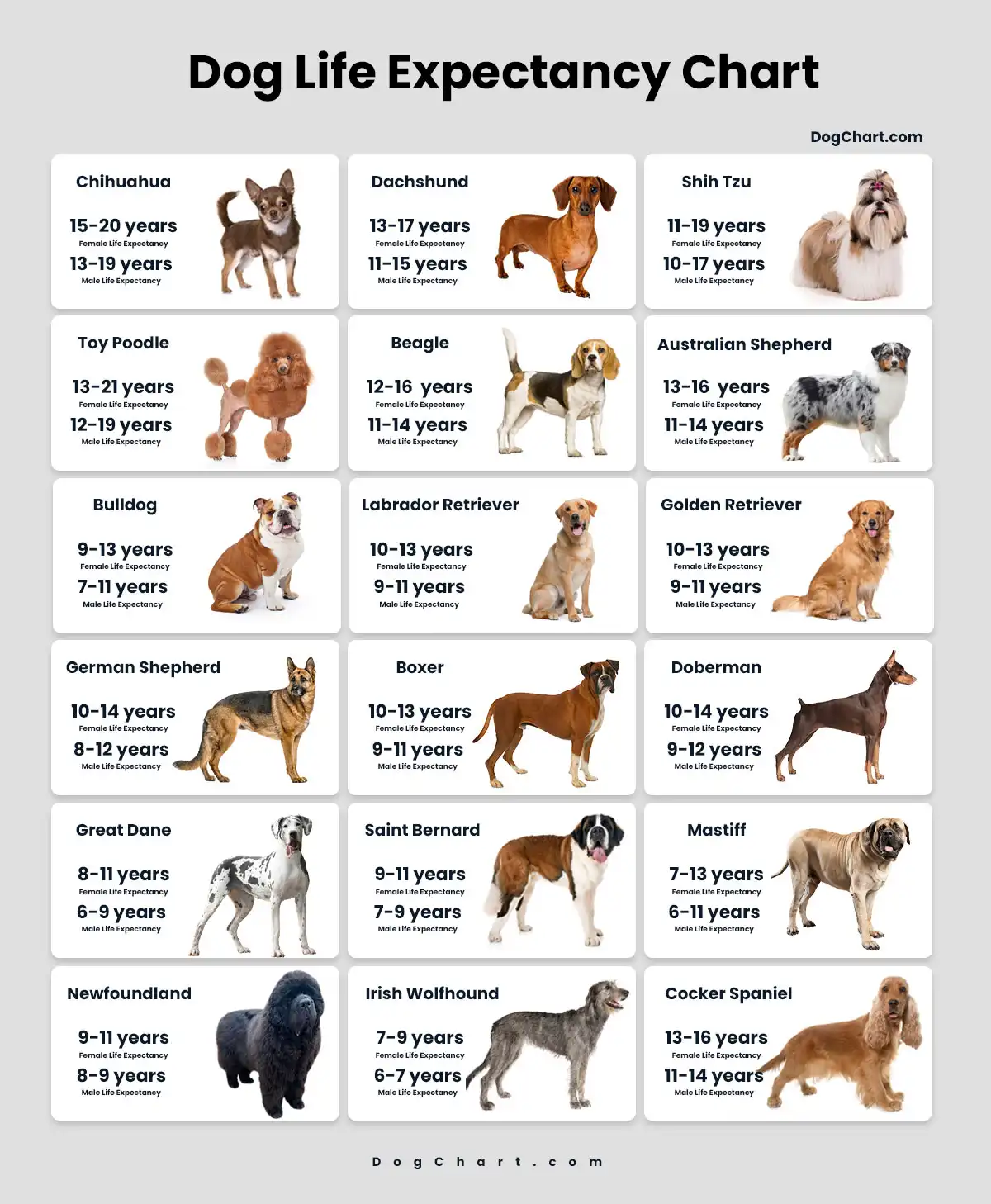
Table of Contents
How Long Do Dogs Live?
On average, dogs live somewhere around 10 to 13 years, although that number can vary quite a bit from one dog to another. Small and toy breeds can often reach their mid-to-late teens, while giant breeds may have considerably shorter lives.
Your dog’s breed and size are important, but they aren’t the whole story. Genetics, nutrition, exercise, weight, dental care, preventative veterinary care, and underlying health conditions can all influence how long a dog lives.
And honestly, there’s no perfect countdown clock for our dogs. Two dogs of the same breed can have completely different lifespans. The best thing we can do is focus less on the exact number and more on keeping our dogs healthy and comfortable throughout the years we have with them.
Dog Life Expectancy Chart
Not every dog breed has the same expected lifespan. Generally, small dog life expectancy is higher than large dog life expectancy, with toy breeds often living well into their teens. Individual dogs can, of course, fall outside these ranges.
Here’s a general dog breed lifespan chart to give you an idea of how long some popular breeds may live:
| Dog Breed | Overall Life Expectancy | Female Life Expectancy | Male Life Expectancy |
| Chihuahua | 14-20 years | 15-20 years | 13-19 years |
| Dachshund | 12-16 years | 13-17 years | 11-15 years |
| Pomeranian | 12-16 years | 13-17 years | 11-15 years |
| Shih Tzu | 10-18 years | 11-19 years | 10-17 years |
| Toy Poodle | 12-20 years | 13-21 years | 12-19 years |
| Beagle | 12-15 years | 12-16 years | 11-14 years |
| Border Collie | 12-15 years | 12-16 years | 11-14 years |
| Cocker Spaniel | 12-15 years | 13-16 years | 11-14 years |
| Australian Shepherd | 12-15 years | 13-16 years | 11-14 years |
| Bulldog | 8-12 years | 9-13 years | 7-11 years |
| Labrador Retriever | 10-12 years | 10-13 years | 9-11 years |
| Golden Retriever | 10-12 years | 10-13 years | 9-11 years |
| German Shepherd | 9-13 years | 10-14 years | 8-12 years |
| Boxer | 10-12 years | 10-13 years | 9-11 years |
| Doberman | 10-13 years | 10-14 years | 9-12 years |
| Great Dane | 7-10 years | 8-11 years | 6-9 years |
| Saint Bernard | 8-10 years | 9-11 years | 7-9 years |
| Mastiff | 6-12 years | 7-13 years | 6-11 years |
| Newfoundland | 9-10 years | 9-11 years | 8-9 years |
| Irish Wolfhound | 6-8 years | 7-9 years | 6-7 years |
Toy breeds such as Chihuahuas can have impressively long lives, with some reaching 15 years or more. Toy Poodles and other small breeds can also enjoy many years with their families.
Medium-sized breeds generally fall somewhere in the middle. Beagles, Border Collies, and Cocker Spaniels can often give their families 10–15 years of companionship.
Unfortunately, larger dogs tend to have shorter lifespans. Labrador and Golden Retrievers commonly live around 10–12 years, while giant breeds such as Great Danes and Mastiffs may have considerably fewer years. This is one of the reasons their health, weight, and preventative care deserve extra attention.
Dog Life Expectancy by Size
Size is one of the biggest factors when we talk about dog life expectancy. While there are exceptions to every rule, small dogs generally live longer than large and giant breeds.
Toy and small dogs often mature more slowly and may stay healthy well into their teenage years. Medium-sized dogs tend to have a moderate lifespan, while large and giant breeds age faster and are more likely to experience certain age-related problems earlier.
That doesn’t mean a large dog can’t have a long life. Plenty of Labradors, Golden Retrievers, and other big dogs happily reach their senior years. It simply means their expected lifespan is usually shorter compared with a Chihuahua, Maltese, or Toy Poodle.
| Dog Size | Average Life Expectancy |
| Toy / Very Small | 13–16 years |
| Small | 12–15 years |
| Medium | 10–14 years |
| Large | 9–12 years |
| Very Large | 8–11 years |
| Giant | 7–10 years |
Pet Dog vs. Street Dog Lifespan
A dog’s environment can make a huge difference too. Dogs living in safe homes generally have better access to nutritious food, clean water, vaccinations, parasite prevention, veterinary treatment, and protection from accidents.
Street dogs often face very different challenges. Injuries, infectious diseases, parasites, poor nutrition, extreme weather, traffic accidents, and limited access to veterinary care can all affect survival and quality of life.
That doesn’t mean every street dog has a short life or every pet dog will live a long one. Genetics and individual health still matter. However, having a safe environment and consistent healthcare gives dogs a much better opportunity to stay healthy for as long as possible.
| Factor | Pet Dog | Street Dog |
| Average Lifespan | 10–15 years | 3–7 years |
| Puppy Survival | Higher | Lower |
| Food & Nutrition | Regular, balanced meals | Often inconsistent |
| Veterinary Care | Regular vaccinations & treatment | Limited or unavailable |
| Parasite Control | Usually treated | Often untreated |
| Injuries & Accidents | Lower risk | Higher risk |
| Exposure to Disease | Generally lower | Generally higher |
| Weather Protection | Usually available | Often exposed |
| Sterilization | More common | Less common |
| Overall Survival | Higher | Lower |
Dog Breed Lifespan Chart by Weight
Weight is another useful way to look at lifespan. In general, smaller dogs tend to live longer, while larger dogs tend to have shorter expected lifespans.
| Weight Category | Average Weight | Life Expectancy |
| Toy Breeds | Under 10 lbs (4.5 kg) | 12-20 years |
| Small Breeds | 10-25 lbs (4.5-11 kg) | 12-18 years |
| Medium Breeds | 25-50 lbs (11-23 kg) | 10-15 years |
| Large Breeds | 50-100 lbs (23-45 kg) | 8-12 years |
| Giant Breeds | Over 100 lbs (45+ kg) | 6-10 years |
Toy breeds weighing under 10 pounds often have some of the longest lifespans, sometimes reaching their late teens. Small breeds can also live well into their teenage years.
Medium-sized dogs commonly live around 10–15 years, depending on breed and individual health. Large dogs tend to have shorter lifespans, while giant breeds usually have the shortest expected lifespan.
Weight itself isn’t necessarily the problem. Maintaining a healthy body condition is much more important. An overweight dog of any size can face additional strain on their joints, heart, and other organs.
Mixed Breed Dog Life Expectancy
Mixed-breed dogs can have a wide range of lifespans because it depends on which breeds are in their background. You may have a tiny mixed breed that reaches its late teens or a large mixed breed with a shorter expected lifespan.
You may also hear that mixed-breed dogs always live longer than purebred dogs. That’s a little too simplistic. A broader genetic background can sometimes reduce the chance of certain inherited conditions, but mixed-breed dogs can still inherit health problems from their parent breeds.
For example, a Labradoodle (Labrador Retriever + Poodle) or Goldendoodle (Golden Retriever + Poodle) may live around 10–15 years. Smaller mixes such as a Maltipoo (Maltese + Poodle) or Cockapoo (Cocker Spaniel + Poodle) can often live into their teens.
Larger mixes can have shorter expected lifespans, depending on their size and genetics. A Shepsky (German Shepherd + Husky), for example, may live around 10–14 years, while a Bernedoodle can have a lifespan influenced by its size and the health of both parent breeds.
For a broader overview, you can use a mixed-breed dog lifespan chart to compare common combinations.
| Mixed Breed Name | Parent Breeds | Estimated Life Expectancy |
| Labradoodle | Labrador Retriever + Poodle | 12-15 years |
| Goldendoodle | Golden Retriever + Poodle | 12-15 years |
| Cockapoo | Cocker Spaniel + Poodle | 12-16 years |
| Maltipoo | Maltese + Poodle | 12-16 years |
| Schnoodle | Schnauzer + Poodle | 12-16 years |
| Yorkiepoo | Yorkshire Terrier + Poodle | 12-15 years |
| Pomsky | Pomeranian + Husky | 12-15 years |
| Chorkie | Chihuahua + Yorkshire Terrier | 12-16 years |
| Chiweenie | Chihuahua + Dachshund | 12-16 years |
| Dorgi | Dachshund + Corgi | 12-15 years |
| Puggle | Pug + Beagle | 10-15 years |
| Bulldog Mixes | Various Bulldogs + Other Breeds | 8-12 years |
| Shepsky | German Shepherd + Husky | 10-14 years |
| Horgi | Husky + Corgi | 10-14 years |
| Boxador | Boxer + Labrador Retriever | 10-12 years |
| Bernedoodle | Bernese Mountain Dog + Poodle | 12-15 years |
| Shih-Poo | Shih Tzu + Poodle | 12-16 years |
| Cavapoo | Cavalier King Charles Spaniel + Poodle | 12-15 years |
| Morkie | Maltese + Yorkshire Terrier | 12-16 years |
Mixed Breed Dog Life Expectancy Calculator
Select your dog's two parent breeds to get an estimated lifespan range.
This is a general estimate, not a prediction of how long an individual dog will live. Genetics, size, weight, health, diet, exercise and veterinary care can all affect lifespan.
If you have a mixed-breed dog, estimating their lifespan can be a little trickier than looking up a single breed. One useful starting point is considering the expected lifespans of both parent breeds, along with your dog’s current size, weight, and overall health.
For example, a Morkie (Maltese + Yorkshire Terrier) may have a relatively long expected lifespan because both parent breeds are small. A Boxador (Boxer + Labrador Retriever) may have a shorter expected lifespan because both parent breeds are larger.
Just remember that a calculator can only give you an estimate. It can’t predict exactly how long your individual dog will live. Genetics, preventative healthcare, nutrition, weight, exercise, and medical history all matter.
Dog Life Expectancy With Kidney Disease
Kidney disease can affect a dog’s lifespan, but there isn’t one number that applies to every dog. The outlook depends on the underlying cause, how early the condition is detected, how advanced it is, and how well your dog responds to treatment.
Some dogs with chronic kidney disease can continue enjoying a good quality of life for years with appropriate veterinary care, while more advanced cases may progress faster.
If your dog has kidney disease, regular veterinary monitoring is especially important. Your veterinarian may recommend changes to diet, hydration, medications, and other supportive treatments depending on your dog’s condition. Rather than focusing only on the number of years left, it’s also important to pay attention to appetite, energy, comfort, and overall quality of life.
Dog Life Expectancy After Surgery
Surgery doesn’t automatically mean your dog’s lifespan will be shortened. In many situations, surgery can actually improve a dog’s quality of life or treat a condition that could otherwise become much more serious.
How long a dog lives after surgery depends on the type of surgery, their age, general health, the reason for the procedure, and how well they recover. A routine procedure in a healthy young dog is very different from major surgery in an elderly dog with several health problems.
Following your veterinarian’s recovery instructions is incredibly important. Keep your dog’s activity restricted when advised, give medications exactly as prescribed, watch the surgical site, and contact your vet if anything seems unusual.
Signs Your Dog Is Entering Their Senior Years
Most dogs enter their senior years at different ages depending on their size and breed. Giant breeds may show signs of aging earlier, while small breeds can remain energetic well into their later years.
Some common signs include a greying muzzle, a thinner or duller coat, slower movement, stiffness, reluctance to climb stairs or jump, changes in weight, cloudy eyes, reduced hearing, increased sleeping, changes in appetite, or occasional confusion.
None of these signs should simply be dismissed as “old age.” Some can also point to health problems that are treatable or manageable. If you notice a significant change in your dog, it’s worth talking to your veterinarian.
How to Help Your Dog Live Longer
Genetics give your dog a starting point, but their everyday care can make a meaningful difference. One of the biggest things you can do is keep your dog at a healthy weight. Extra weight puts unnecessary stress on the joints and can contribute to other health problems.
Feed a complete and balanced diet in appropriate portions for your dog’s age, size, and lifestyle. Regular exercise is important too, although the amount and type should suit your dog rather than following a one-size-fits-all routine.
Don’t forget the less exciting stuff either! Regular veterinary checkups, vaccinations, parasite prevention, and dental care all matter. Senior dogs may benefit from more frequent veterinary visits so changes can be caught early.
And, of course, give them plenty of attention, playtime, affection, and opportunities to simply enjoy being a dog. We can’t control exactly how many years our dogs get, but we can make those years feel pretty wonderful.
FAQs
What dog breed has the longest lifespan?
Chihuahuas, Toy Poodles, and other small breeds can often live 15 years or longer.
Why is small dog life expectancy higher than large dog life expectancy?
Small dogs generally age more slowly, while large breeds mature faster and develop age-related issues earlier.
Can I make my dog live longer?
A healthy diet, ideal weight, regular exercise, dental care, and routine vet visits can all support a longer, healthier life.
Do mixed-breed dogs live longer than purebreds?
Not always, but some mixed-breed dogs may have a lower risk of certain inherited health conditions.
What is the maximum life expectancy of a dog?
Most dogs live around 10–13 years, but some small breeds and exceptional individuals can live well beyond that.