
Corgi Colors: Every Coat Pattern Explained
The first corgi I ever met was a blue merle Cardigan named Juniper, at a breed meetup in Portland. Her speckled gray coat and one pale blue eye set her apart from the red-and-white Pembrokes around her. I figured they had to be related. They are, but the link runs further back than most people think.
The AKC recognizes 7 standard corgi colors across the two breeds. Red, sable, fawn, and black and tan show up in both. Brindle and blue merle belong to Cardigans alone. Pembrokes come in four main colors with white markings. Cardigans carry a wider palette, because their gene pool includes merle and brindle.
This guide covers every recognized color, the rare ones, how puppies inherit their coats, and which colors run most common in each type.
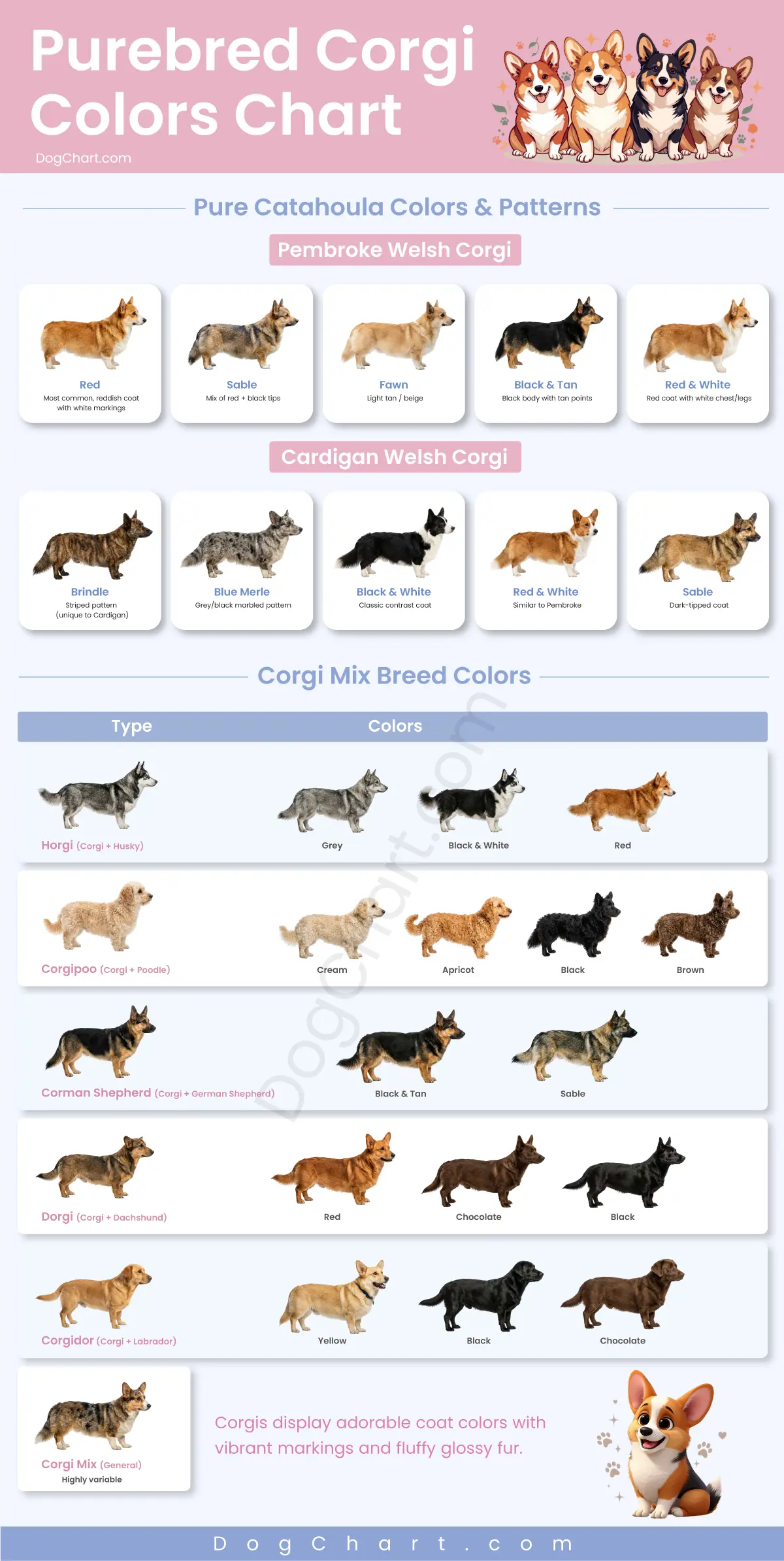
Table of Contents
Corgi Color Chart
| Trait | Details |
| Pembroke Colors Recognized | 4 |
| Cardigan Colors Recognized | 6 |
| Most Common Pembroke | Red and white |
| Most Common Cardigan | Brindle and white |
| Rarest Pembroke | Black-headed tricolor |
| Rarest Cardigan | Blue merle brindle |
| Standard Nose Color | Solid black |
Pembroke Welsh Corgi Colors
Purebred Pembroke Welsh Corgis come in four AKC standard colors. Each one carries white markings on the chest, legs, neck, and often the face. The most common Pembroke color is red. That’s the fox-like look most people picture when they hear the word corgi. Red Pembrokes range from light red to deep mahogany.
Sable Pembrokes have black-tipped hairs across the back and shoulders, which gives them a darker, shaded look. Fawn is the palest standard color, closer to tan than red. Black and tan counts as a tricolor and splits into two sub-types.
The first sub-type is the red-headed tricolor. Red points sit on the face and legs, and the foxy face shows lighter points. Red-headed tris are the more common of the two. The black-headed tricolor wears a darker mask and more solid color around the face. Black-headed tris are the rarer type, and many show a white blaze between the eyes.
White markings vary from dog to dog. The AKC accepts a full white blaze, tan with or without white legs, and partial white on the head. Some older Pembrokes fade to off-white with age. Some carry a faint saddle pattern across the back that shifts the body color. Every recognized Pembroke color has a solid black nose.
Cardigan Welsh Corgi Colors
The Cardigan Welsh Corgi has a wider color palette, because the standard allows brindle, merle, and merle-or-brindle mixes. Brindle and white is the most common Cardigan color. Red, sable, and black and tan follow behind it.
Blue merle is the standout Cardigan color. It creates a marbled grey and black coat, and blue merle Cardigans often have one or both eyes in pale blue. Cardigans can also appear in solid black with white markings, or black with white only on the chest and toes.
Cardigan black and tan shows tan points on the face, legs, and chest, with or without white trim. Paired with a darker body, this pattern is sometimes called the classic Cardigan saddle. Sable Cardigans carry the same black-tipped hair as Pembrokes, often on a heavier frame. The two breeds share red and white, but the Cardigan palette runs well past what the Pembroke line allows.
Purebred Corgi Color Chart
The chart below lists every recognized color for the Pembroke and Cardigan corgi. It draws on the AKC and Pembroke Welsh Corgi Club of America breed standard. These are the only colors accepted in AKC conformation shows.
| Breed Type | Color Name | Description |
| Pembroke Welsh Corgi | Red | Most common, reddish coat with white markings |
| Sable | Red with black tips | |
| Fawn | Light tan / beige | |
| Black & Tan | Black body with tan points | |
| Red & White | Red coat with white chest and legs | |
| Cardigan Welsh Corgi | Brindle | Striped pattern, unique to Cardigan |
| Blue Merle | Grey and black marbled pattern | |
| Black & White | Classic contrast coat | |
| Red & White | Similar to Pembroke | |
| Sable | Dark-tipped coat |
Corgi Mix Breed Colors
A mixed breed corgi inherits color from both parents, so the range runs wider than either purebred line. A crossbreed corgi falls outside the AKC purebred category and can’t enter conformation events. Plenty of them still make great family dogs with one-of-a-kind coats. For how mixes compare across breeds, see the dog breeds chart.
| Mix Breed | Color Variations | Description |
| Horgi (Corgi + Husky) | Grey, black and white, red | Husky-like patterns, sometimes blue eyes |
| Corgipoo (Corgi + Poodle) | Cream, apricot, black, brown | Curly coat, softer colors |
| Corman Shepherd (Corgi + GSD) | Black and tan, sable | Shepherd-like patterns |
| Dorgi (Corgi + Dachshund) | Red, chocolate, black | Long body, Dachshund shades |
| Corgidor (Corgi + Labrador) | Yellow, black, chocolate | Solid Labrador colors |
| Corgi Mix (general) | Highly variable | Any mix of parent colors |
A Horgi or Corgipoo can surprise new owners with colors that show up in neither purebred line. Husky genes add blue eyes. Poodle genes add cream and apricot. Labrador genes bring solid yellow and chocolate into the mix.
Blue Merle, Bluies, and Dilute Colors
Blue merle is a Cardigan-only color. It produces a marbled grey and black coat with random patches of blue. Merles carry one copy of the M locus merle gene, which lightens pigment at random across the coat.
Double merle Cardigans come from pairing two merle parents. The corgi community calls them bluies. Bluies carry two copies of the merle gene and often face deafness, vision problems, or microphthalmia. Responsible breeders never breed merle to merle, because the health risk to the puppies is too high.
Dilute colors come from the D locus, where the dilution gene lightens black to a steel blue or brown. Dilute corgis are rare in both lines and sit outside the standard colors. A dilute Pembroke or Cardigan can still make a healthy pet, but it can’t compete in the show ring.
Rare and Non-Standard Corgi Colors
A few colors turn up in corgi puppies but fall outside the AKC standard. They aren’t faults in a pet dog. They just can’t compete in AKC conformation shows or earn championship titles.
Fluffy corgis carry a recessive gene for a long, flowing coat instead of the standard double coat. They make popular family pets. The AKC disqualifies them from the conformation ring for failing the standard on coat length.
Solid black Pembrokes and mostly white Pembrokes are rare. Both sometimes link to health issues like deafness. Pembrokes don’t come in solid black, merle, or brindle. Those patterns belong to the Cardigan line. A so-called blue Pembroke is usually a dilute that falls outside the standard.
AKC Breed Standard and Color Recognition
The American Kennel Club and the Pembroke Welsh Corgi Club of America publish the official standard for Pembroke colors and markings. The Cardigan Welsh Corgi Club of America covers Cardigan colors under a separate standard. Color sits next to build and movement in the full corgi breed standard.
The AKC lists four recognized colors for Pembrokes: red, sable, fawn, and black and tan. The Cardigan standard lists six, including brindle and blue merle. Any color outside these lists can’t earn conformation titles, even on an AKC-registered, purebred dog.
Color and markings feed into both show judging and breeder pricing. Breeders who produce show-line puppies in rare but standard colors, like the black-headed tricolor, often charge $500 to $1,000 more than pet-line breeders.
How Corgi Coat Color Is Inherited
Corgi coat color comes down to a few gene pairs working together. The E locus sets red versus black base color. The K locus controls brindle. The M locus controls merle. A single copy of the merle gene gives Cardigans the standard blue merle pattern.
Red is recessive at the E locus, so two red parents usually produce red puppies. The tan-point pattern in black and tan is dominant. The dilution gene at the D locus is recessive and has to come from both parents to show.
Responsible breeders always avoid pairing two merle corgis. Double-merle puppies, the bluies, run a high risk of deafness, blindness, and eye defects. That risk is why the corgi community warns so strongly against the cross.
Does Color Affect Corgi Price?
Standard red and white Pembrokes land in the middle of the range at $1,000 to $2,200. Blue merle Cardigans and rare tricolor Pembrokes from show lines can reach $4,000 to $5,000. Purebred Pembrokes with champion lineage and rare standard colors sit at the top.
Color should never be the main reason you pick a puppy. Health clearances, temperament, and breeder reputation all matter more for a dog you’ll live with for 12 to 15 years. A healthy corgi of any color tends to outlast the rarest coat from poor breeding. For more on the breed’s personality, see our corgi temperament guide.
Frequently Asked Questions
What is the most common corgi color?
Red and white is the most common Pembroke color, at about 60 percent of the breed. Brindle and white is the most common Cardigan color.
Can Pembroke corgis be blue merle?
No. Blue merle isn’t an AKC-recognized Pembroke color. Any blue merle corgi is a Cardigan or a mix, because the merle gene doesn’t exist in the purebred Pembroke line.
What is a fluffy corgi?
A fluffy corgi carries a recessive gene for a longer double coat. Fluffies make wonderful pets, but the AKC disqualifies them from conformation shows for failing the standard on coat length.
Do corgi colors change as they grow?
Yes. Corgi puppies often shift color over the first 6 months. Sable puppies can look almost black at birth and lighten to red-sable as adults. Fawn puppies sometimes darken into their first year.
What color corgi is rarest?
Blue merle brindle Cardigans are the rarest standard color. Among Pembrokes, the black-headed tricolor is the least common of the four recognized colors.
Are corgis with two different colored eyes purebred?
Cardigans with one blue eye are often blue merles, and they can still be purebred. A Pembroke with two differently colored eyes is unusual and sometimes points to a mix rather than a purebred. For more on the breed, see our corgi temperament guide, and for full breed comparisons visit the dog breeds chart.