
Corgi Lifespan: How Long Do Corgis Actually Live?
My aunt’s Pembroke, Winston, made it to 16 years and 4 months, which is remarkable for any corgi. He was lean his whole life, never overfed, and walked twice a day until arthritis slowed him down at 14. That combination of diet, exercise, and good genetics is what the research keeps pointing to.
The average corgi lifespan is 12 to 13 years for Pembroke Welsh Corgis and 12 to 15 years for Cardigan Welsh Corgis. A 2024 Royal Veterinary College study of over 30,000 UK dogs found Pembrokes had a median lifespan of 13.2 years, slightly above the all-breed average.
This guide covers average lifespans, the top health issues that shorten corgi lives, and practical steps you can take to help your corgi reach 14 or 15 years in good shape.
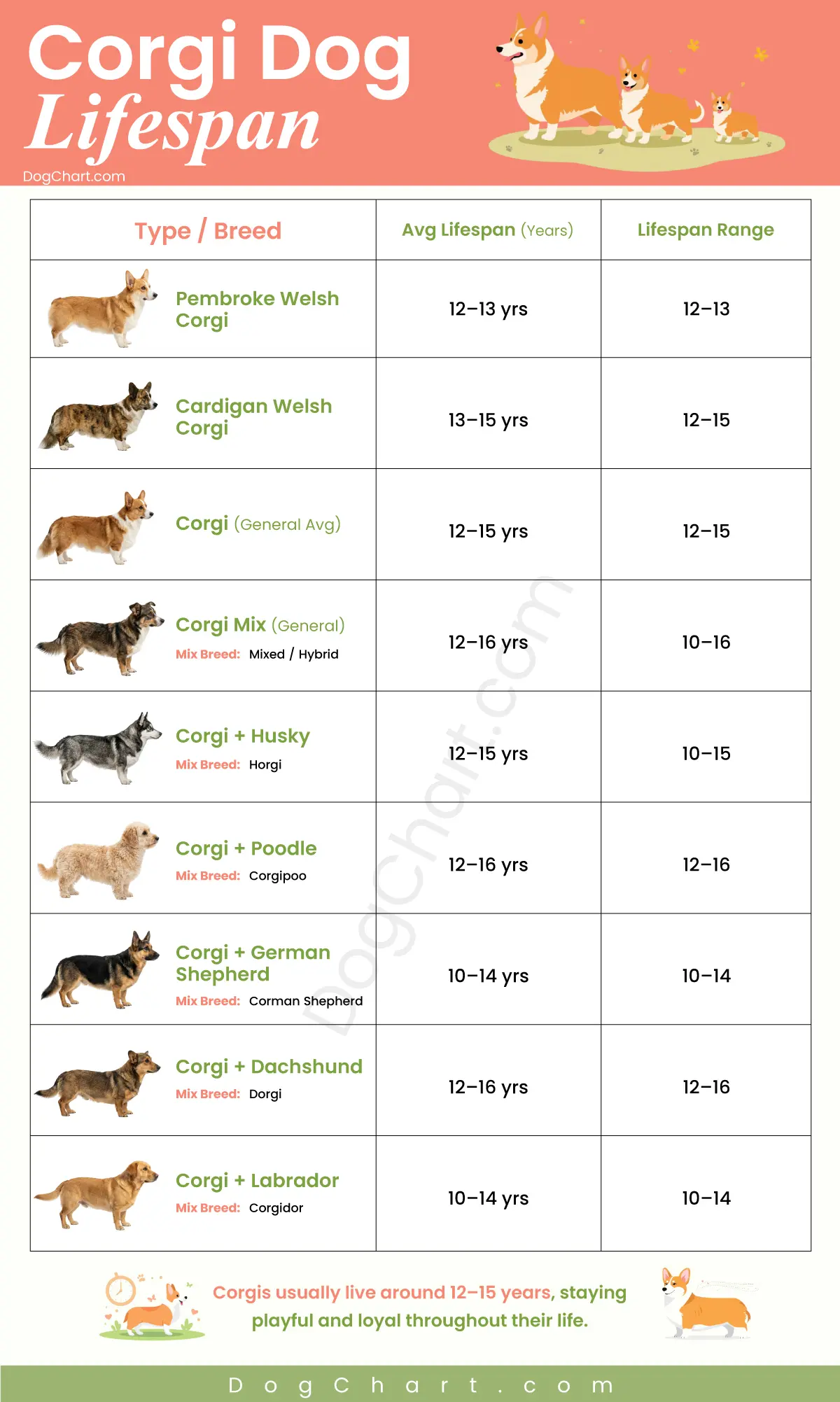
Table of Contents
Corgi Lifespan Chart
| Trait | Details |
| Pembroke Average | 12 to 13 years |
| Cardigan Average | 13 to 15 years |
| Longest Recorded | 18 years (Cardigan) |
| Senior Stage Begins | 7 to 8 years |
| Top Cause of Death | Old age and cancer |
| Ideal Corgi Weight | 22 to 28 lb (Pembroke) |
| Adult Height | 10 to 12 inches tall |
Corgi Lifespan Chart by Type and Mix Breed
How long a corgi lives comes down to type, and to whether the dog is purebred or a mix. The chart below covers both Pembroke and Cardigan lines plus the most common corgi crosses.
| Type / Breed | Mix Breed Name | Avg Lifespan | Range | Notes |
| Pembroke Welsh Corgi | N/A | 12–13 yrs | 12–13 | Slightly shorter than Cardigan |
| Cardigan Welsh Corgi | N/A | 13–15 yrs | 12–15 | Often lives a bit longer |
| Corgi (General Avg) | N/A | 12–15 yrs | 12–15 | Above-average lifespan for dogs |
| Corgi Mix (General) | Mixed / Hybrid | 12–16 yrs | 10–16 | Hybrid vigor may increase lifespan |
| Corgi + Husky | Horgi | 12–15 yrs | 10–15 | Depends on size and genetics |
| Corgi + Poodle | Corgipoo | 12–16 yrs | 12–16 | Often longer due to Poodle genes |
| Corgi + German Shepherd | Corman Shepherd | 10–14 yrs | 10–14 | Larger size may reduce lifespan |
| Corgi + Dachshund | Dorgi | 12–16 yrs | 12–16 | Similar body type, stable lifespan |
| Corgi + Labrador | Corgidor | 10–14 yrs | 10–14 | Lab genes may slightly shorten life |
These figures pull from AKC breed data, the Royal Veterinary College’s VetCompass study, and US vet clinic records. A corgi kept lean and seen regularly by a vet often beats these ranges by a year or two.
Pembroke vs Cardigan Welsh Corgi Lifespan
Pembrokes and Cardigans are separate breeds, and their lifespans differ a little. A Pembroke usually lives 12 to 13 years; a Cardigan averages 13 to 15 and occasionally reaches 18.
The gap is mostly genetic. Pembrokes have a smaller gene pool and a higher rate of degenerative myelopathy, both of which can pull the average down. Cardigans have a broader genetic base and a lower reported rate of DM.
Either way, both share the same long body and short legs, so the back and joint risks are the same. Diet, exercise, and early screening end up mattering as much as which type you pick.
Common Health Issues in Corgis
Corgis are sturdy little herding dogs, but a few breed-specific problems tend to set the ceiling on their lifespan. The good news is that most of them are far easier to manage, and cheaper to treat, when they’re caught early.
Degenerative myelopathy is the biggest worry for Pembrokes. This progressive spinal-cord disease usually appears after age 9 and leads to hind-leg weakness and, eventually, loss of mobility. DNA testing before breeding has brought the numbers down, but about 1 in 10 Pembrokes still carries the risk gene.
Intervertebral disc disease (IVDD) is the price of that long spine and those short legs. Around 15 to 20 percent of corgis develop some form of back trouble, often set off by jumping off a couch or down the stairs. Caught before it needs surgery, it’s far cheaper and faster to recover from.
Hip dysplasia turns up in roughly 18 percent of Pembrokes, per OFA data. A puppy from parents with OFA Good or Excellent hip scores is much less likely to develop it, which is one more reason breeder lineage is worth paying for.
| Health Condition | Prevalence | Impact on Lifespan |
| Degenerative Myelopathy | ~10% of Pembrokes | Shortens by 2–4 years |
| Intervertebral Disc Disease | 15–20% of corgis | Variable; surgical cases can recover |
| Hip Dysplasia | ~18% of Pembrokes | Reduces quality of life, not always lifespan |
| Obesity | ~40% of adult corgis | Cuts 1.5–2 years off lifespan |
| Progressive Retinal Atrophy | ~3% of Pembrokes | Vision only, no lifespan effect |
What Can Affect a Corgi’s Life Expectancy
Genetics set the ceiling, but day-to-day care decides whether a corgi lands at the top or bottom of its range. Weight, activity, dental care, and vet visits do most of the work.
Weight is the single biggest lever. In Purina’s lifetime diet study, an overweight dog lost close to two years compared with a lean littermate; for a corgi, that’s the difference between a 32-pound dog and a 24-pound one. Extra weight also drives up the risk of diabetes, joint wear, and heart disease.
Diet, missed vaccinations, and untreated dental disease all chip away at the rest. A corgi with advanced gum disease loses one to two years on average, because the infection eventually reaches the heart, kidneys, and liver.
How to Help Your Corgi Live Longer
Weight control is the most useful thing any owner can do. Feed measured portions twice a day based on the dog’s body weight, and watch the treats, which slip in more calories than people expect.
Daily walks of 30 to 45 minutes keep the back muscles strong and the joints loose. Long walks are great; what corgis don’t need is repeated high-impact jumping, so use ramps to keep them off the couch and bed. A glucosamine and chondroitin supplement is worth adding from about age 5 to support the joints.
Regular vet care catches trouble before it gets expensive. Plan on yearly exams through age 7 and twice-yearly after that, with a weight check, dental look, and senior bloodwork each time. A vet who knows the breed will screen for DM, hip dysplasia, and heart murmurs at the right ages.
Food rounds it out. A diet with 25 to 30 percent protein plus omega-3s supports muscle and coat at every stage. None of this is dramatic, but the daily habits are what actually add the years.
Corgi Life Stages
Corgis grow fast in their first year, settle into a long adult stretch, then cross into senior life around age 7. Knowing the stage your dog is in tells you what the care plan should be, from puppy shots to senior bloodwork.
| Life Stage | Age Range | Human Equivalent |
| Puppy | 0–12 months | 0–15 years |
| Young Adult | 1–3 years | 15–28 years |
| Adult | 3–7 years | 28–45 years |
| Senior | 7–11 years | 45–65 years |
| Geriatric | 11+ years | 65+ years |
Signs of Aging in Corgis
The first signs usually show up around age 7 or 8: slower walks, a little cloudiness in the eyes, gray creeping into the muzzle, and more hesitation about jumping onto furniture.
Cognitive changes, like confusion or nighttime restlessness, tend to appear after 11. Plenty of owners notice their dog wanting help with stairs or the car by age 10. That’s normal aging, but it’s worth a vet check to rule out pain or a thyroid issue.
Older corgis also gain weight easily once they slow down. Trimming portions by 15 to 20 percent as activity drops keeps a senior lean, which protects everything else.
Frequently Asked Questions
How long do corgis live on average?
Most corgis live 12 to 15 years, with Pembrokes nearer 12 to 13 and Cardigans nearer 13 to 15. Good genetics and a lean weight can stretch that to 15 or 16.
What is the longest a corgi has lived?
The oldest verified corgi on record was Bluey Lu, a Cardigan who reached 18. A handful of Pembrokes have hit 17 in recent years, which shows what’s possible with good care.
What do corgis usually die of?
The leading causes are old age, cancer (mainly lymphoma and hemangiosarcoma), and neurological decline from degenerative myelopathy. Obesity-linked diabetes and heart disease shorten plenty of lives too.
How can I tell if my corgi is getting old?
Watch for slower walks, a gray muzzle, cloudy eyes, more trouble jumping, and longer naps. Most corgis show clear senior signs around age 8 and ease into a lower-energy routine by 10.
Does spaying or neutering affect a corgi’s lifespan?
Spayed and neutered corgis tend to live a bit longer, mostly from lower cancer risk. Timing matters, though; many vets now suggest waiting until about 12 months so the joints finish developing.
Can you extend a dog’s lifespan with diet?
Yes, it’s one of the strongest levers you have. A lean weight, good food, and steady calorie control add one to two years in most breeds, the corgi included.
How do I keep my corgi healthy for a long life?
Keep it lean, walked daily, current on vaccines, and screened by a vet every year. For feeding guidance, see our corgi dog food guide, and for size and weight targets, see the corgi size chart.