
Corgi Size Chart by Age (Male vs Female)
I weighed my friend Mara’s Corgi puppy on a kitchen scale every Sunday. At eight weeks he hit five pounds. By his first birthday he was thirty. The jump caught her off guard.
A Corgi size chart tracks that growth month by month. It shows weight and height for males and females. Most Corgis reach full size near twelve months. Adults stand 10 to 12 inches tall and weigh 22 to 31 pounds.
Below you will find weight and height charts by age. You will also learn when Corgis stop growing and what a healthy weight looks like.
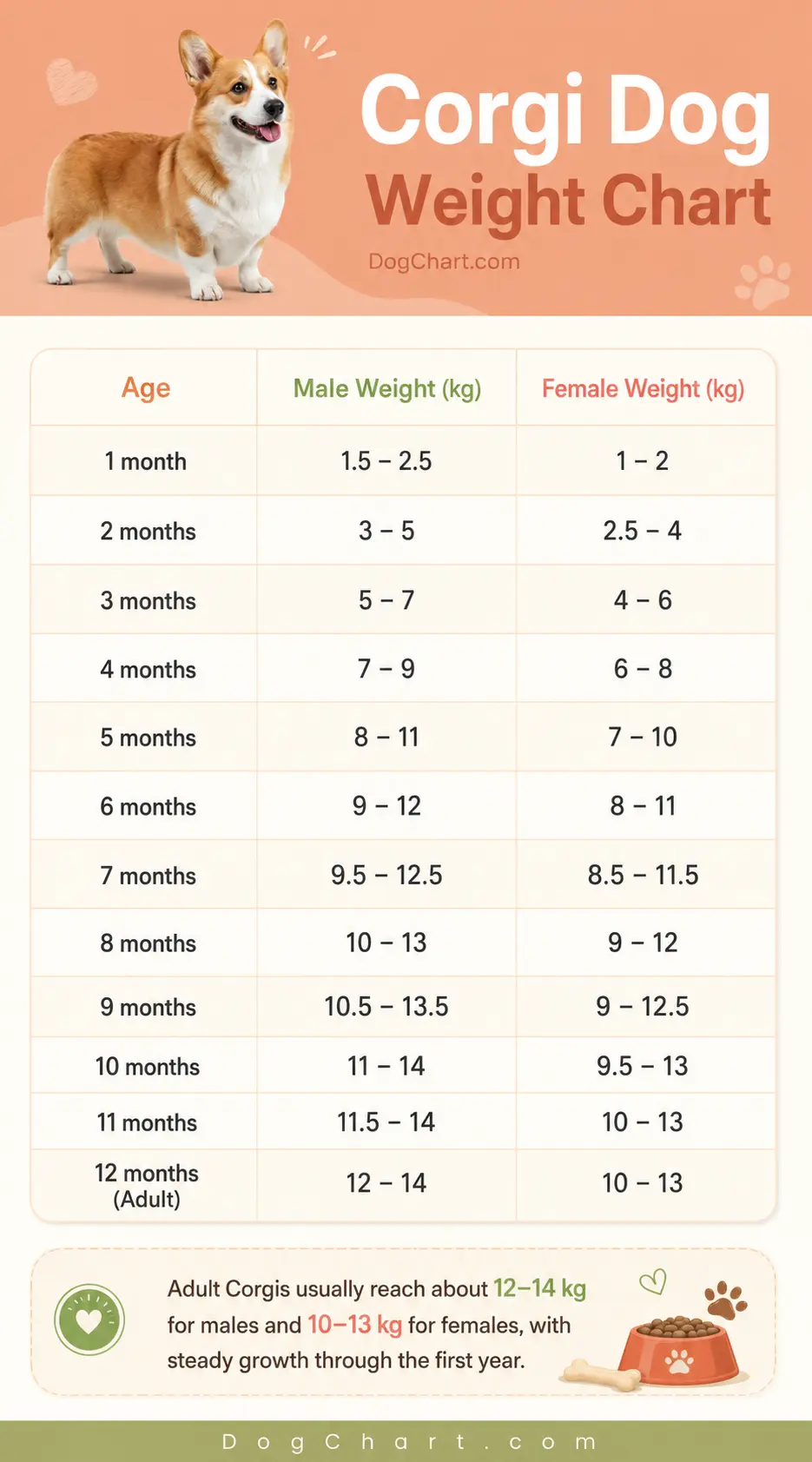
Table of Contents
Corgi Size at a Glance
| Feature | Details |
| Breed group | Herding |
| Adult height | 10 to 12 in (25 to 30 cm) |
| Adult weight (male) | 26 to 31 lb (12 to 14 kg) |
| Adult weight (female) | 22 to 29 lb (10 to 13 kg) |
| Full size reached | 12 months |
| Build | Long back, short legs |
| Lifespan | 12 to 15 years |
Corgi Weight by Age
This chart lists weight from one month to adult. Each cell shows kilograms with pounds. Males run a touch heavier than females.
| Age | Male Weight | Female Weight |
| 1 month | 1.5-2.5 kg (3-6 lb) | 1-2 kg (2-4 lb) |
| 2 months | 3-5 kg (7-11 lb) | 2.5-4 kg (6-9 lb) |
| 3 months | 5-7 kg (11-15 lb) | 4-6 kg (9-13 lb) |
| 4 months | 7-9 kg (15-20 lb) | 6-8 kg (13-18 lb) |
| 5 months | 8-11 kg (18-24 lb) | 7-10 kg (15-22 lb) |
| 6 months | 9-12 kg (20-26 lb) | 8-11 kg (18-24 lb) |
| 8 months | 10-13 kg (22-29 lb) | 9-12 kg (20-26 lb) |
| 10 months | 11-14 kg (24-31 lb) | 9-12 kg (20-26 lb) |
| 12 months (Adult) | 12-14 kg (26-31 lb) | 10-13 kg (22-29 lb) |
Growth is fastest in the first six months. After that, the pace slows. These ranges follow the broader dog size chart for small herding breeds.
Corgi Height by Age
Height is measured at the shoulder, not the head. Males and females track close together. The legs stay short by design.
| Age | Male Height | Female Height |
| 1 month | 3-4 in (8-10 cm) | 3-4 in (8-10 cm) |
| 2 months | 4-6 in (10-15 cm) | 4-6 in (10-15 cm) |
| 3 months | 6-8 in (15-20 cm) | 6-8 in (15-20 cm) |
| 4 months | 7-9 in (18-23 cm) | 7-9 in (18-23 cm) |
| 5 months | 8-10 in (20-25 cm) | 8-10 in (20-25 cm) |
| 6 months | 9-11 in (23-28 cm) | 9-11 in (23-28 cm) |
| 8 months | 10-11 in (25-28 cm) | 9-11 in (23-28 cm) |
| 10 months | 10-12 in (25-30 cm) | 10-11 in (25-28 cm) |
| 12 months (Adult) | 10-12 in (25-30 cm) | 10-11 in (25-28 cm) |
Height settles before weight does. A Corgi reaches near-full height by ten months. The body then fills out with muscle and bone.
How to Measure Your Corgi
Height is taken at the withers, the ridge between the shoulder blades. Stand your Corgi square on a flat floor. Measure straight down to the ground.
Weight is easier at home. Hold your Corgi and step on a scale. Then weigh yourself alone and subtract the difference. Track the number every two weeks for a puppy. For an adult, once a month is enough.
When Do Corgis Stop Growing?
Corgis grow fastest in the first six months. After that, growth slows. Most reach adult weight by twelve months. A few fill out until eighteen months. The chest deepens last of all. Height stops changing before weight does.
Large breeds grow for two years or more. Corgis finish far sooner. Their small frame sets faster than big dogs.
Corgi Growth Stages Explained
A Corgi moves through clear stages. Each one brings a change in body and need.
The puppy stage runs from birth to six months. Weight climbs fast in this window. Bones and joints are still soft. The juvenile stage spans six to twelve months. Growth slows and energy peaks. Adult height arrives near the end.
The adult stage starts around twelve months. The frame is set. Weight then depends on food and exercise.
Pembroke vs Cardigan Size
The two Corgi types differ in size. Pembrokes weigh 22 to 30 pounds. Cardigans run heavier at 25 to 38 pounds.
Cardigans also carry a longer body and bigger bone. Both share the same low, long shape and short legs.
Corgi Size Compared to Other Small Dogs
Corgis sit at the larger end of small breeds. They outweigh a Beagle by a few pounds. They stand lower than a Cocker Spaniel.
Their build sets them apart. A long spine on short legs gives more body than the height hints. Two Corgis weigh about the same as one Border Collie.
Healthy Weight vs Overweight
Corgis gain weight with ease. Their herding appetite runs strong. Extra pounds strain the long back.
You should feel the ribs under a light layer. A waist should show from above. If the belly sags, trim the meals.
Vets use a body condition score from one to nine. Aim for a four or five. Your vet will show you the right feel.
Check your dog against breed norms on the dog weight chart.
What Affects Corgi Size?
Genes set most of a Corgi’s adult size. Parents give the best clue. Ask the breeder for their weights.
Food and exercise shape the rest. Too much food adds fat, not frame. Spay and neuter timing also plays a part. A poor diet in puppyhood stunts the frame. Steady, measured meals build a sound adult body.
Compare your Corgi to other small dogs on the small dog breeds chart.
Frequently Asked Questions
How big does a Corgi get?
Adult Corgis stand 10 to 12 inches tall. Males weigh 26 to 31 pounds. Females weigh 22 to 29 pounds.
At what age is a Corgi full grown?
Most Corgis reach full size by twelve months. A few fill out until eighteen months as the chest deepens.
How much should a 6-month-old Corgi weigh?
A six-month-old male weighs 9 to 12 kg (20 to 26 lb). A female weighs 8 to 11 kg (18 to 24 lb).
Are male Corgis bigger than females?
Yes, by a small margin. Males run a couple of pounds heavier and sit at the top of the height range.
Do Corgis look bigger than they weigh?
Yes. Their long body and thick coat add bulk. A 28-pound Corgi looks heavier than the number suggests.
Is my Corgi too small?
A grown Corgi under 20 pounds runs small for the breed. Ask your vet to rule out a health cause.
Do Corgis come in a smaller size?
No. There is no toy or mini Corgi breed standard. Dogs sold as mini Corgis are runts or mixes, not a separate type.
Why is my Corgi overweight?
Corgis gain weight fast and love food. Measure meals and skip table scraps. To compare healthy ranges, see the dog breeds chart and the dog life expectancy chart.