
Can a Corgi Be a Service Dog?
My friend Elena has panic disorder and works from home with her Pembroke, Miso. Miso alerts her to rising anxiety about 10 minutes before Elena feels it. Miso isn’t a certified service dog. Her psychiatric service training still took 14 months. She now joins Elena on flights and at medical appointments without trouble.
Yes, a corgi service dog is legal and works well for the right roles. The ADA doesn’t restrict service dogs by breed. Corgis do well as psychiatric service dogs, hearing alert dogs, and emotional support animals. They aren’t built for mobility or guide work, because they’re small.
This guide covers which service roles corgis handle well, how training works, what the ADA allows, and what to expect from a corgi service dog.
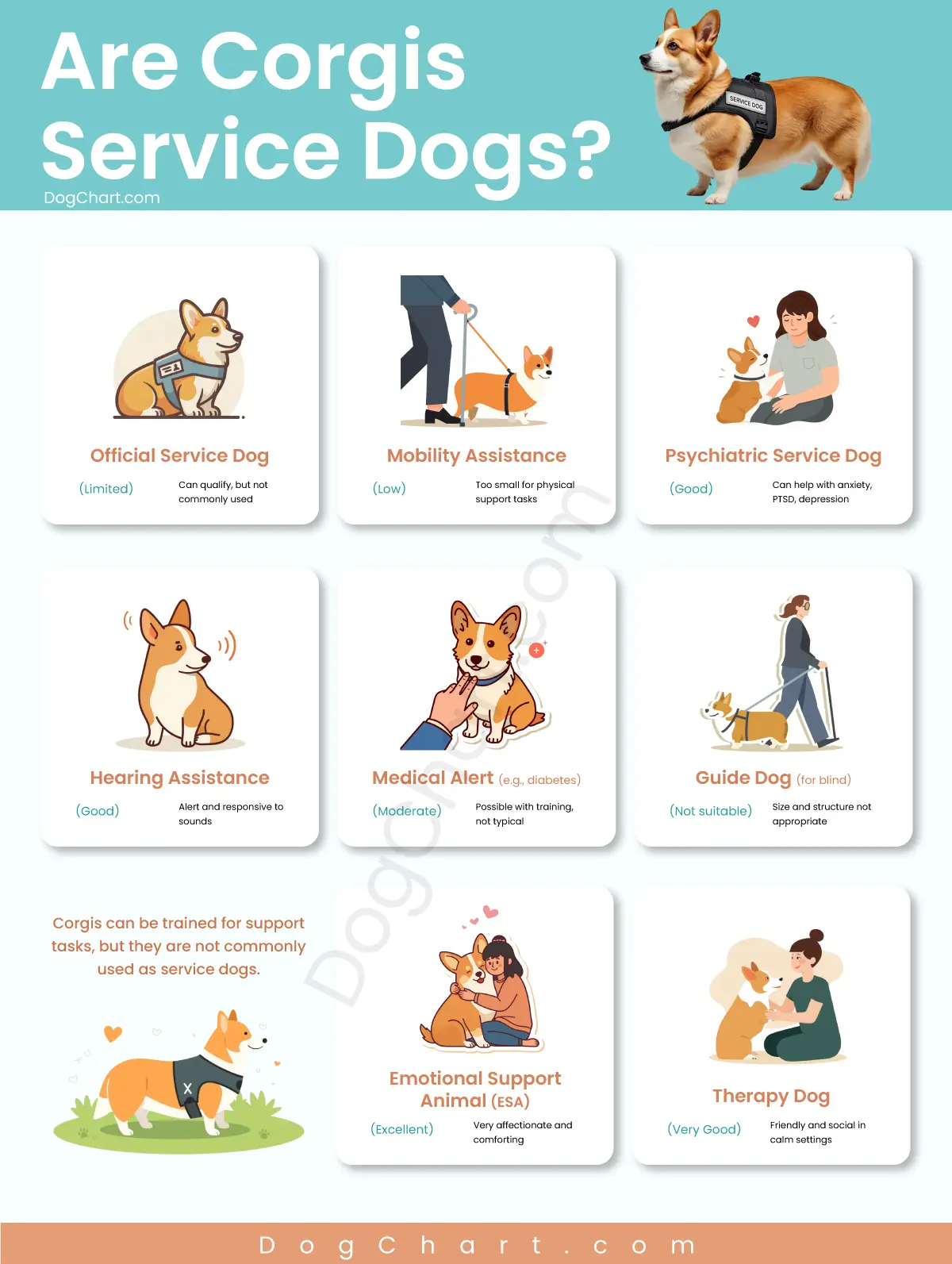
Table of Contents
Corgi Service Dog Chart
| Trait | Details |
| ADA Legal Status | Yes, any breed allowed |
| Best Service Roles | Psychiatric, hearing, ESA |
| Service Dog Training Time | 6–18 months |
| Training Cost | $0–$25,000 |
| Height | 10–12 in (25–30 cm) |
| Weight | 22–30 lb (10–14 kg) |
| Public Access Rights | Yes for service dogs, no for ESAs |
Are Corgis Service Dogs? Suitability Chart
The chart below rates the Welsh corgi across the main service dog categories. The scores draw on size, temperament, and case studies from service dog handlers. Use it as a starting point when you weigh a corgi as a service dog for your home.
| Category | Corgi Suitability | Explanation |
| Official Service Dog | ★★★☆☆ Limited | Can qualify, but not commonly used |
| Mobility Assistance | ★★☆☆☆ Low | Too small for physical support tasks |
| Psychiatric Service Dog | ★★★★☆ Good | Can help with anxiety, PTSD, and depression |
| Hearing Assistance | ★★★★☆ Good | Alert and responsive to sounds |
| Medical Alert (e.g., diabetes) | ★★★☆☆ Moderate | Possible with training, but not typical |
| Guide Dog (for blind) | ★☆☆☆☆ Not Suitable | Size and structure are not appropriate |
| Emotional Support Animal | ★★★★★ Excellent | Affectionate and comforting |
| Therapy Dog | ★★★★☆ Very Good | Friendly and social in calm settings |
Corgis score well in psychiatric, hearing, and therapy dog roles. They score low in guide and mobility work. They stand only 10 to 12 inches (25 to 30 cm) tall. They weigh 22 to 30 pounds (10 to 14 kg), too small for most physical tasks. You can see the full build in our corgi size chart.
Service Roles Corgis Can Fill
Corgis are one of the smartest herding breeds. That brain gives them real talent in service work that leans on attention and task training, not muscle. They also bond hard with their handler, which matters for psychiatric and support roles. A corgi raised by its handler from puppyhood can learn set tasks for mental health conditions, hearing loss, and medical alerts.
The main limit is size. At 22 to 30 pounds (10 to 14 kg), a corgi can’t brace a falling handler, pull a wheelchair, or guide a blind person through traffic. A Labrador, Golden, or German Shepherd fits those roles better.
Psychiatric Service Dog Work
Corgis do well at psychiatric tasks. Think deep pressure therapy, anxiety alerts, medication reminders, and interrupting a panic attack. Their small size makes travel easy. Their herding instinct also maps onto tasks like crowd buffering or pulling a handler out of intrusive thoughts.
Common psychiatric tasks include waking a handler from a nightmare, bringing meds on cue, and signaling rising anxiety. Many corgi service dogs work with adults managing PTSD, depression, OCD, or panic disorder.
Psychiatric training runs about 12 to 18 months. It blends basic obedience, public access skills, and 2 to 3 tasks aimed at the handler’s daily problem. A psychiatric service dog is trained for the needs of one specific person with a disability.
Hearing Alert Work
Corgis are alert and vocal, which suits hearing alert work. A trained hearing dog signals for the doorbell, the oven timer, a smoke alarm, or the handler’s name. The corgi’s sharp ears and fast response fit the job.
Hearing alert training takes about 8 to 12 months of focused work. The dog learns to bark or paw at the handler when a set sound goes off, then lead them to it. Corgis pick this up fast, because it mirrors the alert-and-report style they used on farms.
Medical Alert Dogs for Corgis
Medical alert work is possible for corgis but less common. A trained corgi can learn to catch changes in a handler’s scent. That’s how diabetic alert dogs warn of low blood sugar, and how some dogs flag a seizure or an allergen.
Medical alert is the most specialized service training there is. The corgi has to detect faint chemical cues on the handler’s breath or skin, then act. That might mean pawing, nudging, or fetching a glucometer. Training often runs 18 to 24 months, and not every corgi has the nose for it.
For a family managing a severe allergy, a corgi can fetch an EpiPen, trigger a medical alarm, or go get another adult. These tasks change lives for some handlers. Owners should still expect a longer training curve than average.
Guide and Mobility Work
Guide and mobility dogs need to be large, steady, and able to bear weight. A corgi is too short and too light to brace a fall, pull a wheelchair, or steer a blind handler through a busy intersection.
Some handlers keep a corgi alongside a larger guide dog. The corgi works as a home support dog while the bigger dog handles the physical tasks. The handler gets the corgi’s affection without asking it to do work it isn’t built for.
Emotional Support Animal vs Service Dog
Corgis make excellent emotional support animals. The legal split from a service dog is simple. ESAs have no public access rights under the Americans with Disabilities Act. They’re covered by the Fair Housing Act instead, so landlords must allow them even in no-pet buildings.
An ESA needs one piece of paper: a letter from a licensed mental health professional. There’s no registry, no license, and no training requirement. Therapy dogs are a third category, working in hospitals, schools, and nursing homes. Corgis do well there too, since their friendly temperament holds up in calm group settings.
Service Dog Training for Corgis
Owner-training is legal in the US. It works well for corgis, thanks to their brains and drive. Plan on 120 to 200 hours of structured training across 12 to 18 months. That covers obedience, public access skills, and task training for the handler’s disability.
A fully trained program service dog costs $15,000 to $25,000 and usually comes from a Labrador or Golden kennel. Corgi-specific programs are rare. Most corgi service dogs are owner-trained or shaped by a private trainer who knows small breeds. Many handlers split the difference, hiring a pro for the first 6 months and finishing on their own.
Start with a breeder who health-tests the parents and socializes puppies from 3 weeks on. The best service prospects show up calm, curious, and people-focused. Steer clear of pups that play stubborn or territorial in early sessions.
Legal Rights and Public Access
Under the ADA, a business can ask only two questions. Is the dog a service animal needed for a disability? What task is it trained to perform? Staff can’t ask about the handler’s condition, demand a license, or require a vest. Trained service dogs get public access by federal law, whatever the breed.
Handlers don’t have to put a vest on the dog, though many do because it smooths things in public. ESAs and therapy dogs get no ADA public access. A corgi ESA can’t legally enter a restaurant, store, or other no-pet space, even with a letter.
A person with a disability who uses a corgi for disability-related support is protected anywhere the public can go. A disabled veteran with PTSD and a psychiatric corgi has the same rights as someone with a guide dog, even when the tasks look different.
Who Should Consider a Corgi Service Dog
A corgi service dog suits a person who needs a medium-energy, quick-learning dog for psychiatric, hearing, or medical alert work. Match the dog to the task, not the task to the dog. Don’t force a corgi into work it isn’t built for. Read up on the breed’s drive in our corgi temperament guide before you commit.
Pick a puppy from a reputable breeder with steady temperament and no fear aggression in the line. Choose at 8 weeks, then bring in a trainer who knows service work. Done right, the puppy can be a fully trained partner by age 2.
Frequently Asked Questions
Can any dog be a service dog?
Under the ADA, any breed can be a service dog if it’s trained to perform specific tasks for a disability. There are no breed restrictions at the federal level. A dog of any size qualifies as long as it’s individually trained for the handler’s needs.
How long does it take to train a corgi service dog?
Most corgi service dogs need 12 to 18 months of training, including 120 to 200 hours of structured work. Medical alert specialties can take 24 months, because detecting chemical changes is harder to teach.
Are corgis too small to be service dogs?
Corgis are too small for mobility and guide work. They’re the right size for psychiatric, hearing alert, and medical alert tasks. Small dogs make good service dogs when the task matches their size.
Do I need to register my corgi as a service dog?
No. There’s no official service dog registry in the US. Any site selling certification is optional at best, and the ADA requires no license or paperwork. Proof of task training is the only standard, and staff can ask only what the dog is trained to do.
Are corgis stubborn during training?
Corgis can be stubborn, but they’re also smart and food-motivated. Steady positive reinforcement and short sessions beat long drills. A good trainer can shape that stubborn streak into focus within a few months.
How much does a corgi service dog cost?
Owner-trained corgi service dogs run $1,000 to $5,000, including the puppy, classes, and gear. Program-trained setups cost $15,000 to $25,000. For more on whether the breed fits you, see our corgi temperament guide, and for full breed comparisons visit the dog breeds chart.