
Dog Life Stages Chart: From Newborn Puppy to Senior Dog in 7 Stages
I fostered a 9-week-old Beagle puppy named Pepper last year. The first month was a blur of crate training, vaccine appointments, and carpet cleaner.
By the time she hit 6 months, she was a different dog. That is what life stages do. They reshape a dog’s body, brain, and care needs on a set schedule from newborn to senior.
A dog life stages chart splits a dog’s life into seven phases. The phases are neonatal, transitional, socialization, juvenile, adolescent, adult, and senior. Each one has its own milestones and care needs. The AAHA Canine Life Stage Guidelines use this framework to guide vet care.
The ages shift with breed and size. Small breeds stay in adulthood longer. Large dogs reach the senior stage sooner.
This guide covers all 7 dog life stages. It shows what happens at each phase from puppyhood to the senior years, how size changes the timeline, and the feeding and training priorities for every stage.
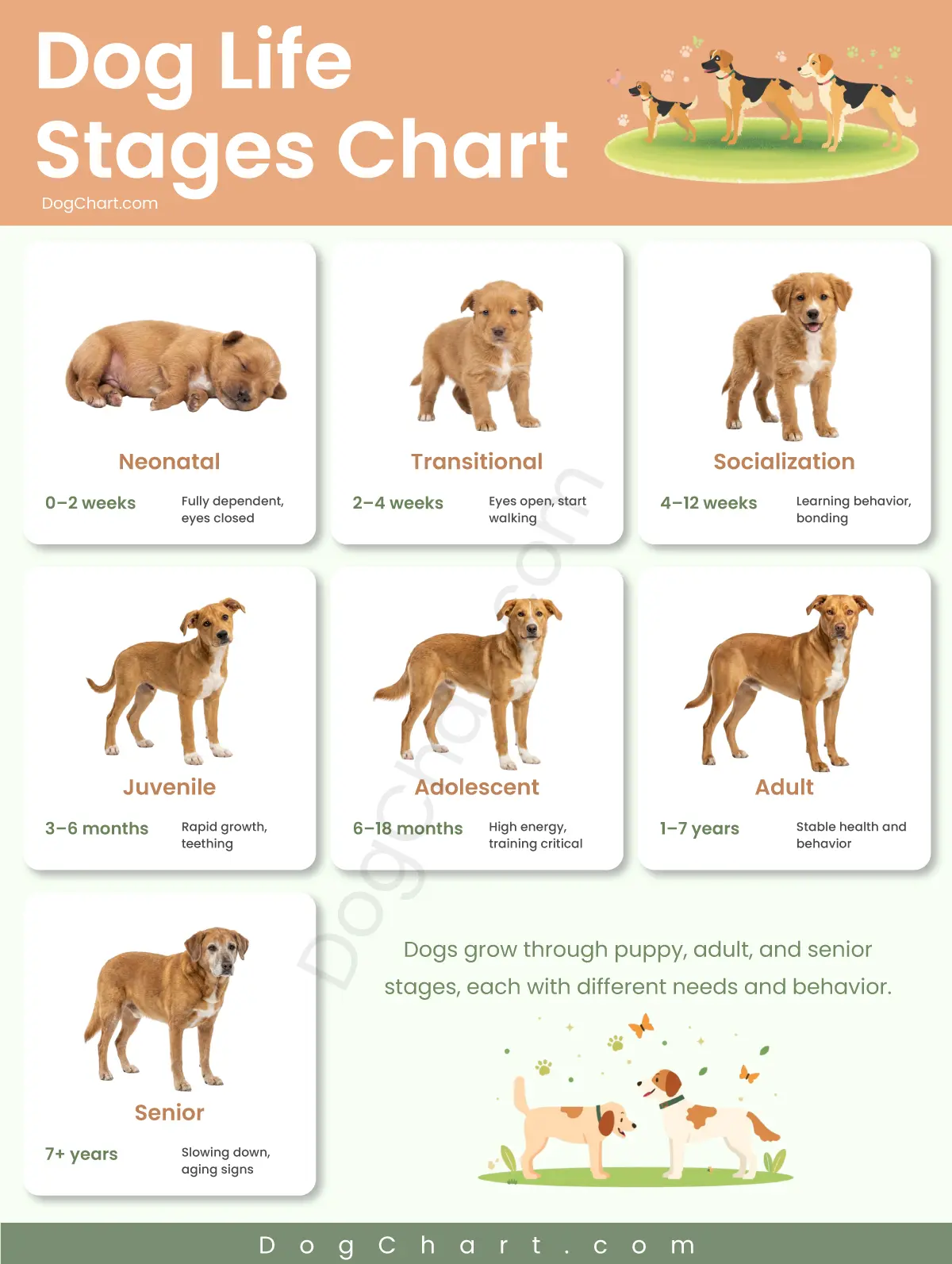
Table of Contents
Dog Life Stages Chart
| Attribute | Details |
| Total life stages | 7 (neonatal to senior) |
| Neonatal stage | Birth to 2 weeks |
| Socialization window | 4 to 12 weeks, critical for social skills |
| Adolescent stage | 6 to 18 months |
| Adult stage | 1 to 7 years depending on breed |
| Senior stage starts | 7+ years for most dogs |
| Large breeds reach senior | Earlier than small breeds |
| Source framework | AAHA Canine Life Stage Guidelines |
Dog Life Stages Chart
This chart shows the 7 stages every dog passes through, from newborn to senior. Use it as a reference whether you are a new owner, raising a puppy, or caring for a senior dog. The age ranges fit most breeds, with small shifts for breed and size.
| Life Stage | Age Range (All Dogs) | Description |
| Neonatal | 0–2 weeks | Fully dependent, eyes closed |
| Transitional | 2–4 weeks | Eyes open, start walking |
| Socialization | 4–12 weeks | Learning behavior, bonding |
| Juvenile | 3–6 months | Rapid growth, teething |
| Adolescent | 6–18 months | High energy, training critical |
| Adult | 1–7 years | Stable health and behavior |
| Senior | 7+ years | Slowing down, aging signs |
A Labrador puppy and a Chihuahua puppy both start in the same neonatal stage. By adolescence, the timelines split. Small dogs wrap up puppy growth by 9 months. Large breeds may still be growing at 18 months or later.
1. Neonatal Stage (0–2 Weeks)
The neonatal phase covers the first 2 weeks of life. A newborn puppy depends fully on its mother, with eyes and ears closed. It nurses, sleeps, and naps between feedings. Puppies this age cannot control their body temperature, so they stay close to mom and their littermates.
Neonatal puppies grow fast. Many double their birth weight in the first week. Little happens in terms of behavior, but the body is laying the groundwork for what comes next. Breeders handle newborn pups gently and briefly, mostly to check health. The best care now is a warm, quiet space and no interference.
2. Transitional Stage (2–4 Weeks)
At 2 weeks, the eyes open and the puppies start to wean off milk. The transitional stage is short but packed with change. Puppies begin to walk, wobbly at first. They respond to sounds and wag their tails. By week 3, they know their littermates and start to play.
This is when puppies first learn about the world. A good breeder begins gentle handling to build confidence. Solid food usually comes in around week 3 or 4, mixed with formula at first. The stage ends near week 4, when socialization opens up.
3. Socialization Stage (4–12 Weeks)
The socialization stage is the most important window in a dog’s life. Weeks 8 to 12 matter most. A puppy’s brain is wide open during this time. It learns what is safe, normal, and fun.
Puppies should meet new people, other dogs, surfaces, sounds, and situations now. Good experiences make it easier to raise a steady adult dog with strong social skills. Too little socialization leads to fear, reactivity, and anxiety later. The AVMA and AAHA both recommend starting socialization classes by eight weeks, before the vaccine series is even finished. Keep it going through 16 weeks.
Most puppies leave the breeder or shelter between weeks 8 and 10. This is a busy time for a new owner. Expose your pup to as much as you can in a calm, safe way. The small stuff counts too: car rides, stairs, umbrellas, and different floor textures.
4. Juvenile Stage (3–6 Months)
The juvenile stage runs from 3 to 6 months. Growth and teething take over. Baby teeth fall out and adult teeth come in, which is why puppies chew everything in reach. Stock up on safe chew toys or your furniture pays the price.
This is when real obedience training starts. Sit, down, stay, and come should be solid by the end of the stage. Puppies test boundaries and act more independent. That is curiosity, not rebellion. The juvenile phase ends when the first signs of sexual maturity show, which depends on breed.
5. Adolescent Stage (6–18 Months)
Adolescence is the hardest stage for most owners. Dogs test limits and sometimes blank on commands they nailed as puppies. Hormones drive most of it. It feels like raising a teenager.
Training has to ramp up, not slow down. Most dogs surrendered to shelters fall in this age range. Steady structure, daily exercise, and mental work all help. Small breeds reach full maturity around 12 months. Large breeds take longer, often 18 months or more. Giant breeds like the Great Dane may not finish developing until 24 months.
6. Adult Stage (1–7 Years)
The adult stage is the longest phase of a dog’s life. Weight, personality, and behavior settle. An adult dog falls into a steady routine of regular vet visits, a consistent diet, and predictable exercise. This is when dogs become their true selves, with energy and temperament locked in.
Annual vet visits and core vaccines on schedule carry most adult dogs through without trouble. Dental disease starts to show by age 4 or 5, especially in small breeds. Weight tends to creep up around year 4 as metabolism slows. Use this phase to set a baseline of blood work, so your vet has something to compare against later.
Not every dog ages at the same pace here. A 5-year-old Great Dane is near senior territory. A 5-year-old Pomeranian is in the middle of her adult years. For breed-specific longevity, see our dog life expectancy chart.
7. Senior Stage (7+ Years)
The senior stage starts around age 7 for most dogs. Senior dogs slow down, gray at the muzzle, and may show stiffness, cloudy eyes, or hearing loss. The exact timeline varies. A dog may show these signs earlier or later depending on size and genetics.
Care shifts to comfort, mobility, and early detection. Twice-yearly vet exams become standard. Common senior conditions include arthritis, hypothyroidism, dental disease, heart murmurs, and early kidney changes. Most can be managed with diet, supplements, and medication when caught early.
Ask your vet about a senior-formula diet around year 7. Older dogs do well on lower-calorie food with added joint support. Cognitive decline affects about 25 percent of dogs over 11 and most dogs over 15. Caught early, it slows with mental work and medication.
How Breed Size Changes the Timeline
The same age means different things for a Chihuahua and a Great Dane. Small breeds live longer and age slowly. Large dogs pack their stages into a shorter life. Canine aging runs unevenly across sizes, which is why a breed-adjusted chart helps with care.
| Dog Size | Adult Stage Begins | Senior Stage Begins |
| Small (under 20 lb) | 1 year | 10 to 11 years |
| Medium (25-50 lb) | 1 to 2 years | 8 to 9 years |
| Large (50-90 lb) | 2 years | 6 to 7 years |
| Giant (90+ lb) | 2 to 3 years | 5 to 6 years |
A 7-year-old Labrador is a senior. A 7-year-old Chihuahua is still in the adult phase. Vets use size and genetics to time senior blood panels, joint screening, and heart checks. For breed-specific age conversions, see our dog age chart and the dog years to human years chart.
Feeding and Training Priorities by Stage
Each of the 7 dog life stages has its own nutrition and training focus. Getting it right at each phase supports health, behavior, and a longer life.
Puppies need high-calorie, nutrient-dense food until 12 months. Adolescent large breeds need controlled-growth food to protect their joints. Adults hold steady on a standard adult formula. Seniors do well on lower-calorie, joint-support diets.
Training has its own timeline. Socialization classes start at 8 weeks. Basic obedience kicks off at 3 to 4 months. Adolescence needs the most structure, since that is when dogs push back on the rules. Adult dogs stay sharp with ongoing mental work. Senior dogs still learn, just more slowly, so keep sessions short and rewarding.
For feeding amounts by life stage, see our dog food chart, and check the dog weight chart for healthy weight ranges through the adult years.
Frequently Asked Questions
What are the 7 stages of a dog’s life?
The 7 stages are neonatal (0-2 weeks), transitional (2-4 weeks), socialization (4-12 weeks), juvenile (3-6 months), adolescent (6-18 months), adult (1-7 years), and senior (7+ years). Many care guides fold these into 5 broader phases. The 7-stage version shows early puppyhood in more detail.
At what age does a dog become an adult?
A dog reaches adulthood between 12 and 24 months, depending on breed. Small dogs hit it at 1 year. Medium dogs reach the adult stage at 1 to 2 years. Large breeds take 18 months to 2 years, and giant breeds can need up to 3 years to fully mature.
When does a dog enter the senior stage?
Most dogs enter the senior stage around age 7. Small breeds may not reach it until 10 or 11. Large breeds hit senior at 6 or 7, and giant breeds as early as 5 or 6. The shift comes from internal health changes and aging signs, not just behavior.
What is the most important stage in a puppy’s life?
The socialization stage, from 4 to 12 weeks, is the most important. A puppy’s brain is most open during these weeks. Good experiences with people, other dogs, sounds, and places now shape behavior for years. Miss the window and fear, anxiety, or reactivity often follow.
How do I know what stage my dog is in?
Start with age. Under 6 months is puppyhood, 6 to 18 months is adolescent, 1 to 7 years is adult, and 7+ years is senior. Size and genetics adjust the edges, and a small breed becomes an adult sooner. Ask your vet if you are unsure of your dog’s age or stage. See our dog age chart and dog size chart.