
Dog Food Chart by Weight and Age
One thing I’ve struggled with the most as a dog owner is feeding my dog. Not because I’m broke, but because it’s just too much work. How much do I give? Am I choosing the right type of food? And the universal question, is my dog even eating enough?
Honestly, every meal felt like a workout. I got tired of the guessing game and of just hoping I was feeding my dog right, so I finally did the research, talked to people who know pets, and put together a balanced feeding chart.
Then I thought, why keep it to myself? If I was this tired of figuring out every meal alone, other dog owners probably are too. So this is for you. Everything is broken down by breed, weight, and age. You’re welcome.
Dog Food Calculator by Breed Weight and Age
I made this calculator with the help of a vet. Just put in your dog’s breed, weight and age, and it gives you everything you need.
If you like to read, keep going. I promise it’ll be worth your time. But if reading isn’t really your thing, that’s totally fine. The calculator gives you the full answer, so you can skip everything below and go feed your dog.
Dog Food Calculator
Calculate your dog’s estimated daily calorie and food needs by weight, breed, age, and activity level.
Your Dog Food Estimate
Estimated daily feeding needs
Table of Contents
Dog Feeding Chart by Weight and Age
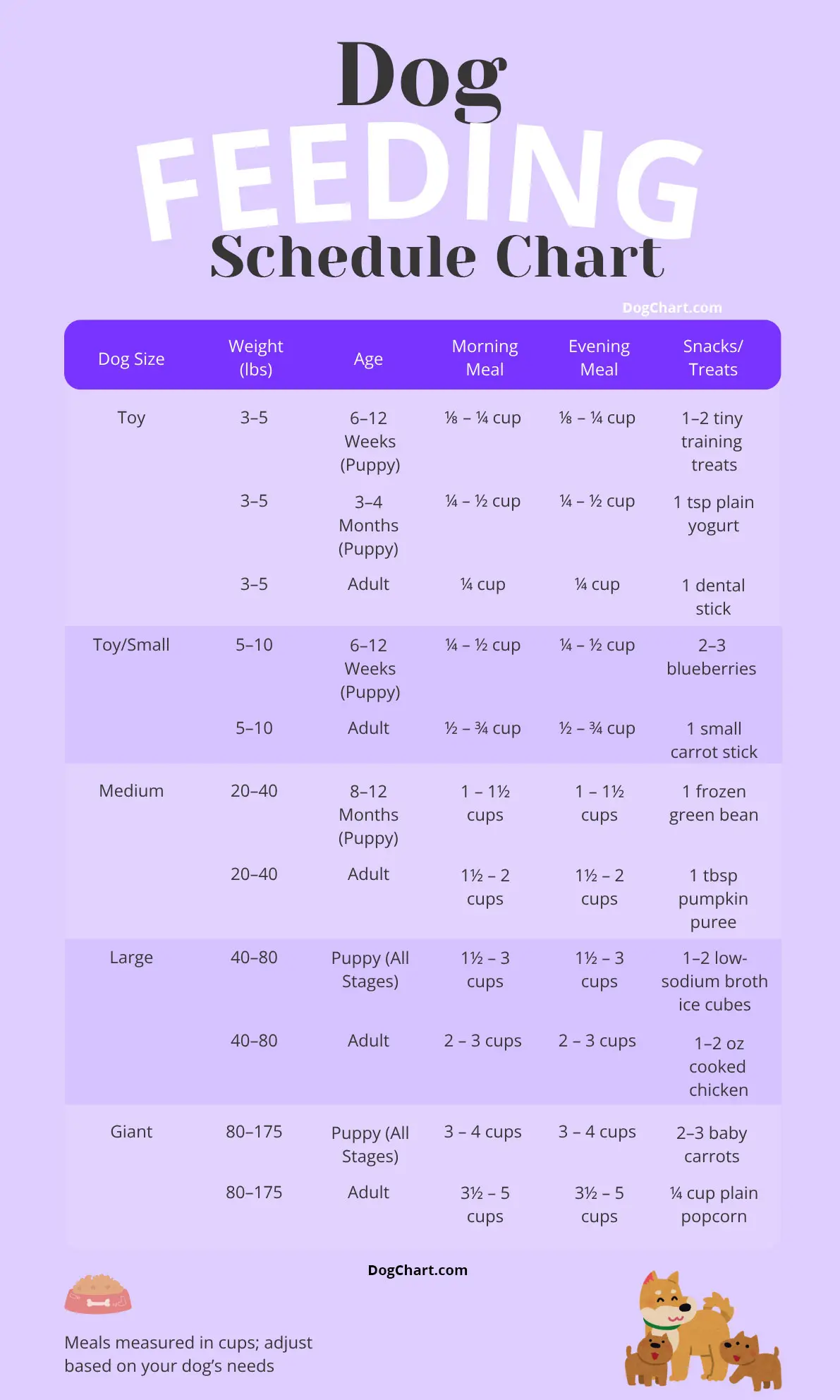
We often overcomplicate feeding. We consider every little detail before we even understand the basic feeding schedule. So to keep it simple, you only need to look at two things, weight and age. If you’re as lost as I was, this is a good place to start.
Age and weight give you a very clear picture without making things complicated. A puppy and a senior dog at the same weight don’t eat the same amount, and a 5 kg dog and a 30 kg dog obviously don’t either. Take a look at the chart below. It breaks the comparison down in detail, so you know exactly how to go about it.
| Dog Size | Weight | Age | Morning Meal | Evening Meal | Snacks/Treats |
| Toy | 3 – 5 lbs | 6 – 12 Weeks (Puppy) | ⅛ – ¼ cup | ⅛ – ¼ cup | 1 – 2 tiny training treats |
| 3 – 4 Months (Puppy) | ¼ – ½ cup | ¼ – ½ cup | 1 tsp plain yogurt | ||
| Adult | ¼ cup | ¼ cup | 1 dental stick | ||
| Small | 10 – 20 lbs | 5 – 7 Months (Puppy) | ¾ – 1 cup | ¾ – 1 cup | ½ apple slice (no seeds) |
| Adult | ½ – ¾ cup | ½ – ¾ cup | 1 – 2 crunchy biscuits | ||
| Medium | 20 – 40 lbs | 8 – 12 Months (Puppy) | 1 – 1½ cups | 1 – 1½ cups | 1 frozen green bean |
| Adult | 1½ – 2 cups | 1½ – 2 cups | 1 tbsp pumpkin puree | ||
| Large | 40 – 80 lbs | Puppy (All Stages) | 1½ – 3 cups | 1½ – 3 cups | 1 – 2 low-sodium broth ice cubes |
| Adult | 2 – 3 cups | 2 – 3 cups | 1 – 2 oz cooked chicken | ||
| Giant | 80 – 175 lbs | Puppy (All Stages) | 3 – 4 cups | 3 – 4 cups | 2 – 3 baby carrots |
| Adult | 3½ – 5 cups | 3½ – 5 cups | ¼ cup plain popcorn |
Disclaimer: This chart is a general guideline. Always consult your vet to determine your dog’s specific dietary needs.
Factors That Impact Dog Feeding
Now the above chart isn't one size fit all because each dog has their own unique needs and requirements so here are some more important factors you need to consider
1. Activity Level
As obvious as it sounds, activity level is one of the biggest factors in how much your dog should eat. I have a very active dog, and don’t even ask. Handling him is a full-time job. Some days I wish I had a laid-back, chill dog, but on most days I wouldn’t trade him for one.
Back to the point, feed according to your dog’s body needs. An active dog burns a lot more energy, so he needs a more calorie-dense diet. A less active dog needs fewer calories to stay at a healthy weight. Keep in mind that activity changes too.
A dog who runs around all summer and then barely moves in winter shouldn’t be eating the same portions all year. Check their body condition every few weeks. You should be able to feel their ribs without pressing hard, and they should have a visible waist when you look from above.
2. Size
Again, as simple as it sounds, I’m surprised how many people don’t consider this. Toy breeds need smaller but more frequent meals because of their fast metabolism. Their tini tiny bodies burn through energy quickly, and going too long without food can make them weak or shaky.
Larger breeds need bigger portions overall, but I wouldn’t give them one giant meal. Splitting it into two meals a day is easier on their stomach and lowers the risk of bloat, which is a serious problem in big, deep-chested dogs. So the bigger the dog, the bigger the total amount, but spread it out.
3. Reproductive Activity
Now, this is a factor many people don’t consider, but it’s so important. A pregnant dog needs more food, especially in the last few weeks. A nursing mom needs even more, sometimes double her normal amount, because she’s producing milk for the whole litter.
On the other side, spayed and neutered dogs usually have a slower metabolism and need fewer calories than before, so if you keep feeding the same portions after the surgery, the weight adds up fast.
How Often Should You Feed Your Dog?
No, don't feed them the moment they give you those puppy eyes. I know, I know, they’re hard to resist. But it’s for their own good.
For most adult dogs, two meals a day is the sweet spot, one in the morning and one in the evening, roughly 8 to 12 hours apart. It keeps their energy steady and helps with digestion. And btw dogs love routine more than we give them credit for.
Puppies are different. They’re growing fast and their tiny stomachs can’t hold much, so they need more frequent meals. Under 6 months, aim for three to four small meals a day. Between 6 and 12 months you can slowly bring it down to two or three.
Senior dogs usually do best with two smaller meals as well. Their metabolism slows down and their digestion isn’t what it used to be, so smaller portions are easier on them.
A few things I’ve learned along the way:
Stick to a schedule. Feed around the same time every day. It makes digestion more predictable, and it makes potty breaks a lot easier to plan too.
Don’t free feed. Leaving a full bowl out all day sounds convenient, but it makes it impossible to track how much your dog is actually eating, and they will get fatty before you even know it.
Count the treats. They add up quicker than you’d think. A simple rule I made up (steal it). Treats should stay under about 10% of your dog’s daily calories, so if you’re handing out a lot, take a little off their meals.
Watch for changes. If your dog suddenly eats a lot less, or more, than usual, don’t just brush it off. Appetite changes can be the first sign something is off, so check in with your vet.
Best Times to Feed Your Dog
People ask me this all the time, and honestly, I think it’s kind of a useless question. Your dog doesn’t care if breakfast is at 7:00 or 8:30. What they care about is that it actually shows up, and that it shows up around the same time every day.
That’s really the whole answer. Pick times that fit your own schedule and stick to them.
For most adult dogs that means one meal in the morning and one in the evening, with about 8 to 12 hours between them. If you’re a 6 AM person, feed at 6. If you don’t function until 9, feed at 9. Dogs adjust to whatever routine you give them, as long as you keep it steady.
There’s only one timing rule I’d actually say is worth following, don’t feed right before or right after hard exercise. Give your dog about an hour to calm down first. Running around on a full stomach can cause digestive problems, and in bigger, deep-chested dogs it can even lead to bloat, which is serious.
Other than that, stop overthinking the clock. Consistency matters way more than the exact time
Wet vs Dry Dog Food: Which is better
Okay, I’ll just say it, dry food as the base, wet food as the upgrade. That’s my opinion, and here’s why.
Dry food is the easy winner for everyday feeding. It’s cheaper, it’s easy to measure (which matters a lot if you’re following a feeding chart), it doesn’t smell up your kitchen, and you can leave it out for a few hours without it going bad. For most dogs, a good quality kibble covers everything they need, and I don’t care what the fancy packaging says.
Wet food is great, but it’s not my go-to for every meal. It’s mostly water, which is why it’s so much more expensive per serving, and it spoils fast. Once a can is open, it has to go in the fridge and be finished in a couple of days. Feeding a big dog only wet food will drain your wallet.
So my pick is to mix them. Use dry as the main meal and add a spoonful of wet on top. Your dog gets the taste and the extra moisture, and you don’t go broke. Just remember to cut back the dry portion a little so you’re not overfeeding.
And let me bust a myth while we’re at it, dry food doesn’t really clean your dog’s teeth. Kibble doesn’t replace brushing, so don’t pick dry food for that reason alone.
Snacks and Treats: What to Include
Treats are basically how we tell our dogs we love them. But before you empty the pantry, here’s what’s actually worth giving.
The Good Stuff
- Carrots: Crunchy, cheap, and low calorie. A lot of dogs go nuts for them.
- Apple slices: Sweet and juicy. Just take out the core and seeds first.
- Blueberries: Tiny, healthy, and they double as a fun game when you toss them across the floor.
- Watermelon: The perfect summer treat.
- Plain cooked chicken: The VIP treat. Your dog will act like you just won them the lottery.
- Plain peanut butter: The classic. Smear it on a toy or a lick mat and you’ve bought yourself ten quiet minutes. Check the label thou and make sure it has no xylitol.
- Sweet potato: Cooked and plain. Dogs love it and it’s actually good for them.
The Never List
- Chocolate: Toxic to dogs. The darker it is, the worse.
- Grapes and raisins: They can cause kidney failure, even in small amounts.
- Onions and garlic: Bad for their blood cells, raw or cooked.
- Xylitol: This sweetener hides in sugar-free gum, candy, and some peanut butters. Super dangerous for dogs, so always check labels.
- Cooked bones: They splinter and can hurt your dog’s mouth, throat, or gut.
- Alcohol and caffeine: Yeah, this should be obvious, but it still needs to be said.
If your dog eats something on the “never” list, call your vet right away. Don’t wait for symptoms to show up
Puppy Feeding Chart by Weight and Age
Puppies grow up at lightning speed, so they need more food for their size and smaller meals more often. This chart breaks down exactly how much based on their weight and age.
| Age Range | Meal Frequency | Key Notes |
| 6 – 12 Weeks | 3 – 4 Meals/Day | High-calorie, nutrient-rich diet |
| 3 – 6 Months | 3 Meals/Day | Gradually increase portion sizes |
| 6+ Months | 2 Meals/Day | Move to adult feeding schedule |
FAQs
How much should I feed my dog a day?
It depends on their weight, age, and activity level. Start with the chart above, then adjust based on how your dog looks and feels. If you can feel their ribs without pressing hard, you’re doing it right.
Can I switch my dog’s food whenever I want?
You can, but don’t do it overnight. Switching too fast can upset their stomach. Mix the new food with the old one over 7 to 10 days, adding a little more of the new food each day.
What if my dog doesn’t finish their meal?
Don’t panic. One skipped meal usually isn’t a big deal. Pick the bowl up after 15 to 20 minutes and try again at the next mealtime. If it keeps happening for more than a day or two, call your vet.
Is it okay to feed my dog human food?
Some of it, yes. Plain chicken, carrots, and pumpkin are fine in small amounts. But always stay away from chocolate, grapes, onions, and anything with xylitol, and keep it to a treat, not a meal.
When should I switch from puppy food to adult food?
Most dogs switch around 12 months, but big breeds can take longer, sometimes up to 18 to 24 months. Ask your vet when your dog is ready, and do the switch slowly just like you would with any new food.