
Labrador Dog Age Chart: From Puppy to Senior in Human Years
My neighbor got a chocolate Lab puppy named Cooper last spring. By his first birthday Cooper hit 70 pounds (32 kg) and looked grown. The vet still kept calling him a teenager. That mix-up trips up a lot of new Lab owners. The dog looks adult. The brain and body run on different clocks. The old rule that one dog year equals seven human years breaks down fast.
This Labrador dog age chart walks through every life stage in both dog years and human years. Labradors live 10 to 12 years. Some reach 13 or 14, and the AKC now lists the standard at 11 to 13. Labs age fast for the first two years. After that, each dog year adds about 4 to 5 human years, because they sit in the medium-to-large bracket.
Below you’ll find an age conversion table, weight by month, the four life stages, the signs your Lab has gone senior, and a short FAQ. For a wider view, the dog life expectancy chart covers all sizes side by side.
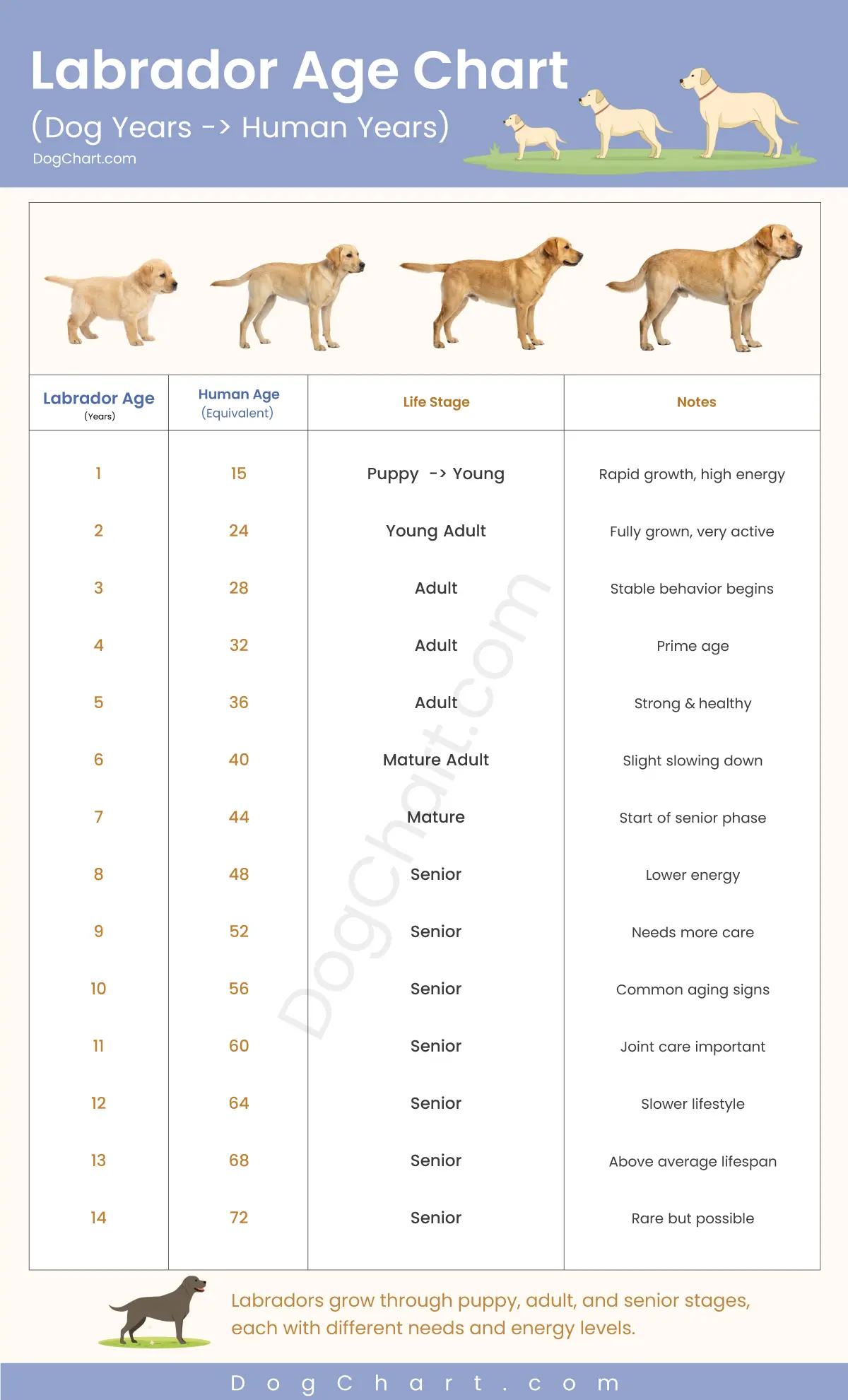
Table of Contents
Quick Facts About Labrador Age and Lifespan
| Fact | Detail |
| Average lifespan | 10 to 12 years (AKC range 11 to 13) |
| Senior age | 7 years and older |
| Adult weight (male) | 65 to 80 lb (29 to 36 kg) |
| Adult weight (female) | 55 to 70 lb (25 to 32 kg) |
| Adult height | 21.5 to 24.5 in (55 to 62 cm) |
| Reaches full height | Around 12 months |
| Reaches full weight | 18 to 24 months |
| Mental maturity | 2 to 3 years |
| Oldest recorded | Adjutant, a black Lab who reached 27 years |
Labrador Age Chart (Dog Years to Human Years)
The Labrador retriever sits in the medium-to-large bracket, so the conversion skips the old multiply-by-7 rule. Each year past the second adds about 4 human years, not 7. The chart below shows your Lab’s age in human years from puppy to senior, with the life stage at each point.
| Labrador Age (Years) | Human Age | Life Stage | Notes |
| 1 | 15 | Puppy to Young | Rapid growth, high energy |
| 2 | 24 | Young Adult | Fully grown, active |
| 3 | 28 | Adult | Stable behavior begins |
| 4 | 32 | Adult | Prime age |
| 5 | 36 | Adult | Strong and healthy |
| 6 | 40 | Mature Adult | Slight slowing down |
| 7 | 44 | Mature | Start of senior phase |
| 8 | 48 | Senior | Lower energy |
| 9 | 52 | Senior | Needs more care |
| 10 | 56 | Senior | Common aging signs |
| 11 | 60 | Senior | Joint care important |
| 12 | 64 | Senior | Slower lifestyle |
| 13 | 68 | Senior | Above average lifespan |
| 14 | 72 | Senior | Rare but possible |
How to Convert Dog Years to Human Years
The rule that one dog year equals seven human years has been around since at least the 1950s. It’s wrong. The American Veterinary Medical Association (AVMA) swapped the multiply-by-7 formula for size-based math. It splits dogs into small, medium, large, and giant brackets. Labradors land in the medium-to-large group.
Here’s the AVMA math that holds up better:
- Year 1 of a dog’s life equals about 15 human years.
- Year 2 adds another 9 human years, so age 2 is about 24.
- Each year after that adds 4 to 5 human years for a Lab.
To skip the mental math, the American Kennel Club hosts a dog age calculator that uses the same brackets. These tools give estimates, not exact numbers, since growth rate, weight, and breed all shift the result.
Why Labradors and Humans Age Differently
Researchers at the University of California San Diego published a 2020 paper that gave the dog-to-human math a real biological basis. The team, led by Trey Ideker, studied DNA from 104 Labrador Retrievers. They tracked DNA methylation, the same chemical markers used to measure aging in people. The formula they built rests on how DNA changes over time, not on guesswork.
The headline: dogs age fast in the first year, then slow down. A one-year-old Lab matches a 31-year-old human in methylation terms. An eight-year-old Lab matches a human in their late 60s. The curve is logarithmic, not linear, which is why multiply-by-7 never worked.
Breeds age differently for two main reasons. Smaller dogs tend to live longer, thanks to a slower metabolism and less runaway cell growth. Large and giant breeds run out of biological runway sooner, because their cells divide faster in puppyhood. A Great Dane is geriatric at 6. A Chihuahua isn’t until 12.
The Four Life Stages of an Adult Dog
Vets sort dog ages into four broad life stages. The stage tells you what to feed, how much exercise is safe, and which screenings to ask for at the next checkup. Labs move through the first two stages fast, then settle into a long, steady adulthood.
| Stage | Age Range | Human Equivalent | Care Focus |
| Puppy | 0 to 12 months | Newborn to teen | Socialization, puppy food, vaccines |
| Adolescent | 12 to 24 months | 15 to 24 years | Training reset, joint protection, neuter talk |
| Adult | 2 to 7 years | 24 to 45 years | Weight control, dental care, yearly bloodwork |
| Senior | 7 years and up | 45 years and up | Senior diet, twice-yearly vet visits, joint support |
Labrador Puppy Growth Rate and Weight by Age
Labrador puppies stop growing taller around their first birthday, and most reach full height by 12 months. Weight keeps climbing until 18 months. A few late bloomers fill out until 24 months. Growth is fastest from week 8 to month 6, when a puppy can gain a pound (about 0.5 kg) a week.
| Age | Male Weight | Female Weight |
| 2 months | 10 to 20 lb (4.5 to 9 kg) | 8 to 17 lb (3.6 to 7.7 kg) |
| 3 months | 22 to 30 lb (10 to 13.6 kg) | 20 to 26 lb (9 to 11.8 kg) |
| 4 months | 30 to 40 lb (13.6 to 18 kg) | 25 to 35 lb (11.3 to 15.8 kg) |
| 6 months | 45 to 55 lb (20 to 25 kg) | 40 to 50 lb (18 to 22.6 kg) |
| 9 months | 57 to 68 lb (26 to 31 kg) | 50 to 60 lb (22.6 to 27 kg) |
| 12 months | 65 to 80 lb (29 to 36 kg) | 55 to 70 lb (25 to 32 kg) |
| 18 months | 70 to 80 lb (32 to 36 kg) | 55 to 70 lb (25 to 32 kg) |
| 24 months | Adult: 65 to 80 lb (29 to 36 kg) | Adult: 55 to 70 lb (25 to 32 kg) |
For a deeper breakdown by month and gender, see the Labrador puppy growth chart and the Labrador height and weight chart.
Signs of Aging in Dogs: When Your Lab Becomes a Senior Dog
Most Labs reach the senior bracket between age 7 and 8. The signs come on slow. You might catch the first one when your dog hesitates at the bottom of the stairs or quits chasing the tennis ball. The chart below covers the early signs to watch as your Lab gets older.
| Senior Sign | What to Do |
| Greying muzzle and eyebrows | Cosmetic only, no action needed |
| Stiff after rest | Add joint supplements with glucosamine and omega 3 |
| Cloudy eyes (lenticular sclerosis) | Normal aging, but ask the vet to rule out cataracts |
| Slower on walks | Shorter, more frequent walks instead of one long one |
| Weight gain | Switch to senior formula, cut treats by 25 percent |
| Yellow or worn teeth | Schedule a dental cleaning under sedation |
| Lumps under the skin | Get every new lump aspirated, don’t wait |
| Confusion or restless nights | Could be canine cognitive dysfunction, ask the vet |
How to Help Your Dog Live a Longer, Healthier Life
Responsible ownership is the single biggest lever on your Lab’s lifespan. A 14-year Purina study followed Labrador Retrievers and found the leaner half lived nearly two years longer than dogs kept at average weight. Two years is huge, and weight is the one factor any owner can control without a prescription.
A few habits that move the needle:
- Keep your Lab at a body condition score of 4 or 5 out of 9. You should feel the ribs without pressing.
- Feed measured meals matched to your Lab’s weight. The Labrador food chart lists portions by life stage.
- Walk twice a day. Mental work counts too, since boredom often turns into overeating.
- Brush the teeth at least three times a week. Dental disease shortens lifespan by hitting the heart and kidneys.
- Book yearly vet care from age 1 and twice-yearly care from age 9. Ask about senior bloodwork from age 6.
- Skip retrieves on hot days. Labs chase the ball past the point of safety, so you have to call it.
These habits won’t stop your dog from getting older. They push the senior signs back a year or two and add real time on the back end.
How Labrador Aging Compares to Other Dog Breeds
Size matters more than breed for aging. Small dogs like a Chihuahua tend to outlive large dogs and turn geriatric around 12. Large and giant breeds like a Great Dane often hit geriatric age by 6. The pattern points to body weight, not color, coat, or temperament.
| Breed Size | Senior at Age | Average Lifespan |
| Toy / small dogs (under 20 lb / 9 kg) | 9 to 10 years | 13 to 16 years |
| Medium (20 to 50 lb / 9 to 23 kg) | 8 to 9 years | 12 to 14 years |
| Labrador (55 to 80 lb / 25 to 36 kg) | 7 to 8 years | 10 to 12 years |
| Large dogs (80 to 100 lb / 36 to 45 kg) | 6 to 7 years | 10 to 12 years |
| Giant (100 lb / 45 kg plus) | 5 to 6 years | 7 to 10 years |
Small dogs outlive large dogs by 4 to 5 years on average, one of the clearest patterns in canine biology. The Labrador sits in the middle, which is why a healthy Lab can reach 14 with good care. For how breeds line up, the large dog age chart digs into Mastiffs, Danes, and Newfies, and the dog life expectancy chart shows every size in one view.
Frequently Asked Questions
How old is a 1 year old Labrador in human years?
A 1-year-old Lab is about 15 in human years. The body looks adult, but the brain still acts like a teenager. That’s why most of the chewing and counter-surfing lands between 12 and 18 months.
How do I calculate my dog’s age in human years?
Use the size-based formula, not the old multiply-by-7 rule. For a Lab, count year one as 15 human years, year two as 9 more (total 24), then add 4 to 5 for each year after. The AKC dog age calculator uses the same method.
Do English or American Labradors live longer?
Field-bred American Labs and show-bred English Labs share the same 10 to 12 year range. English Labs tend to be heavier, which can cost a few months if they get overweight. Bloodline matters less than diet and vet care.
At what age is a Labrador considered old?
Most vets call a Lab a senior at 5 or 6 and a geriatric patient at 11 or 12. Plan on twice-yearly visits and senior bloodwork once your Lab hits 6.
What is the longest a Labrador has lived?
The Guinness record for an English Labrador is 27 years and 3 months, set by Adjutant from Lincolnshire. Most Labs today reach 12 to 14 years with good care, lean weight, and regular checkups.
How can I tell my dog’s age if I adopted him?
Check the teeth (yellowing and tartar after age 3), the eyes (cloudiness from age 7), and muscle tone along the spine and shoulders. A vet can give a 1 to 2 year estimate from these. For more on how breeds age, see the Labrador puppy growth chart and the dog life expectancy chart.