
Large Dog Age Chart: From Puppy to Senior for Breeds 50-90 Pounds
My neighbor’s Golden Retriever, Max, turned 7 last spring. At the vet that morning, Dr. Patel said something that stuck with me: “He’s a senior now.” Max still sprints after tennis balls and eats like a puppy, so it felt early.
That’s the thing about large dogs, though. They hit middle age around year 5 and enter their senior years closer to 6 or 7, not 10 like smaller breeds.
A large dog age chart helps owners of breeds weighing 50 to 90 pounds plan vet visits, food changes, and exercise as the dog grows. Large breeds include Labradors, Golden Retrievers, German Shepherds, Boxers, and similar dogs. They age faster than small breeds because bigger bodies wear down sooner, and most large breeds live 10 to 12 years on average.
This guide covers how large dogs convert to human years, the five life stages for big breeds, lifespan ranges for popular large breeds, signs of aging to watch for, and answers to common questions about large dog care by age.
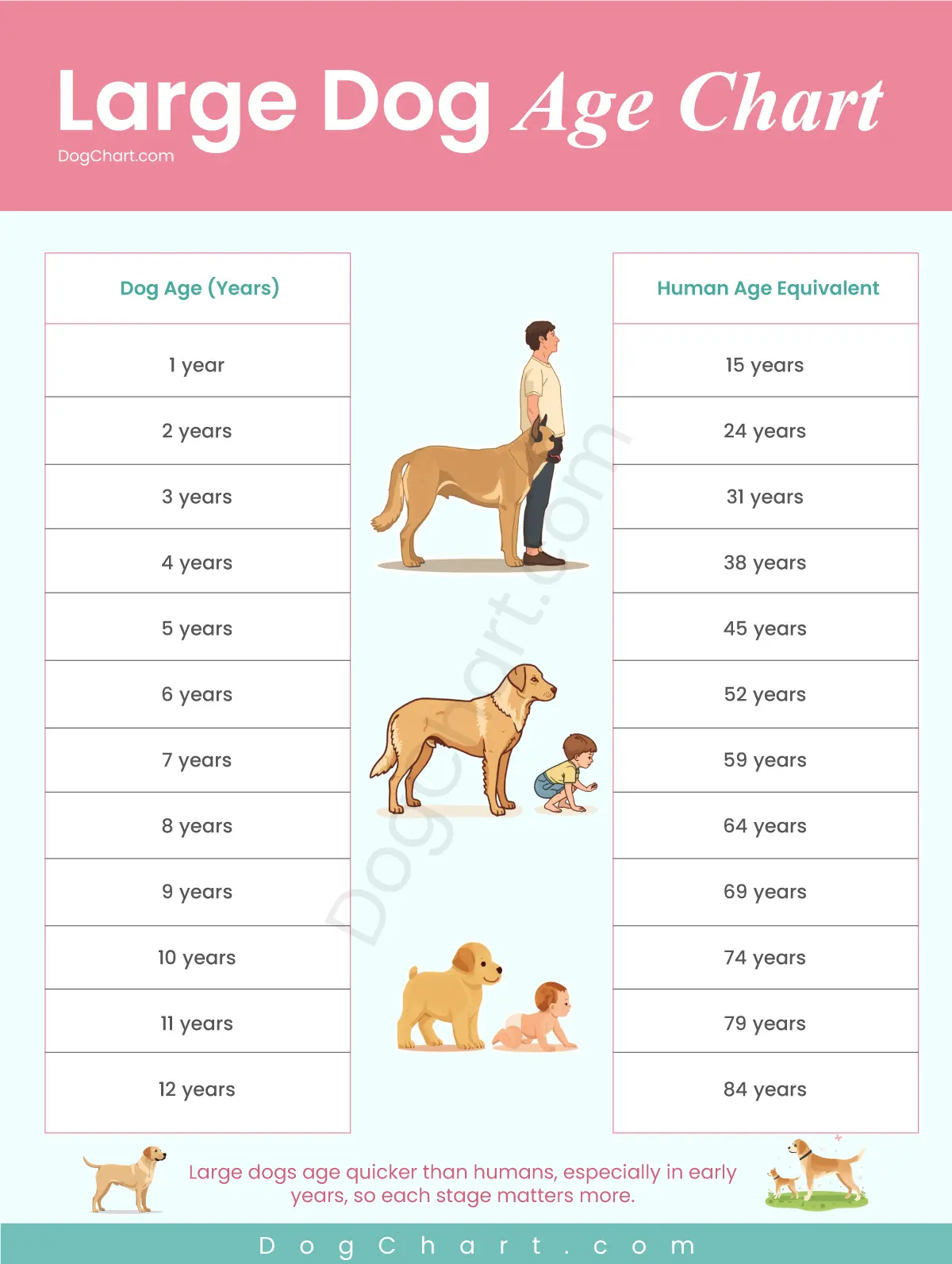
Table of Contents
Large Dog Aging Chart
| Attribute | Details |
| Adult weight range | 50 to 90 pounds (23 to 41 kg) |
| Average life expectancy | 10 to 12 years |
| Senior age | 6 to 7 years |
| Puppy stage ends | 18 to 24 months |
| First dog year equals | 15 human years |
| Each year after | Roughly 5 to 7 human years |
| Aging process speed | Faster than smaller breeds |
| Common breeds | Labrador, Golden Retriever, German Shepherd, Boxer |
Large Dog Age Chart: Dog Years to Human Years
This dog age chart converts large dog age (breeds 50 to 90 pounds) into human age. Use it as a quick age calculator to find where your large dog sits in human years.
| Dog Age (Years) | Human Age Equivalent |
| 1 year | 15 years |
| 2 years | 24 years |
| 3 years | 31 years |
| 4 years | 38 years |
| 5 years | 45 years |
| 6 years | 52 years |
| 7 years | 59 years |
| 8 years | 64 years |
| 9 years | 69 years |
| 10 years | 74 years |
| 11 years | 79 years |
| 12 years | 84 years |
A Labrador at age 7 is around 59 in human years, well into senior territory. By age 10, most large dogs reach 74, which is why dogs this age develop joint issues and visibly slow down.
How to Calculate Dog Age in Human Years
The old 7-human-years-per-dog-year rule is wrong. It flattens out a process that runs fast early and slows later. A 1-year-old large dog is already 15 in human terms because puberty and full growth hit quickly. A dog’s true human-age depends on size more than anything else.
To convert a large dog’s age, use this: year 1 equals 15 human years, year 2 adds 9 more, then each year after adds 5 to 7 depending on size. A 5-year-old Labrador hits 45. Other sizes use different multipliers, since small dogs age slower and giant breeds age faster.
A 2019 study by scientists at UC San Diego used methylation, which tracks chemical changes in DNA, to measure biological age. They landed on a formula of roughly (16 × ln(dog age)) + 31. That matches the chart above far better than the 7-year myth, especially for older dogs.
Online dog DNA tests from companies like Embark also include age-calculator features. They compare your dog’s biological markers against the breed average, which tells you whether your dog is aging faster or slower than expected.
Why Large Dogs Age Faster Than Smaller Breeds
Large breeds reach adult size around 18 to 24 months, but their cells keep dividing fast long after. That speeds up wear on joints, organs, and tissue. A 2013 study found that every 4.4 pounds of body mass knocks roughly one month off a dog’s life. Smaller breeds live longer because they finish growing by 12 months and skip this extended cell turnover.
Large dogs also carry more weight per joint, which loads the hips, elbows, and knees. Hip dysplasia is far more common in Labradors and German Shepherds than in small dogs. Cancer rates climb with size too. Osteosarcoma hits Great Danes and Rottweilers at rates small breeds rarely see.
A Chihuahua can live 16 years while a Great Dane might only reach 7 or 8. Toy Poodles and other small dogs last longer because their bodies hold up better over time. It is why a medium breed like a Beagle often outlives a Labrador by 2 to 3 years on similar care.
Life Stages for Large Breed Dogs
Large dogs pass through five stages. Each has its own feeding, exercise, and veterinary priorities. The ages overlap because individual dogs age differently even within the same breed.
| Stage | Age Range | Weight Status | Key Focus |
| Puppy | 0 to 6 months | Rapid growth | Socialization, vaccines |
| Adolescent | 6 to 18 months | Near full size | Training, joint care |
| Young adult | 18 months to 5 years | Peak weight | Exercise, nutrition |
| Mature adult | 5 to 7 years | Steady weight | Weight control |
| Senior | 7+ years | May lose muscle | Vet visits, mobility |
I switched Max to a large-breed senior formula at age 6 on the vet’s advice. Senior kibble has fewer calories, more joint support like glucosamine, and easier-to-digest protein. The shift held him steady at 72 pounds instead of creeping toward 80.
Large dogs need a different kind of care around year 6 or 7. The AKC recommends twice-yearly vet visits then, with blood work and joint screening. Mind and body both need attention: puzzle toys and scent work help even when long walks get hard.
Popular Large Breeds and Their Life Expectancy
Life expectancy varies inside the large-breed range. Some breeds reach 14 on the lighter end, while giant-leaning ones top out at 8 or 9. Purebred dogs often live shorter lives than mixed breeds of similar size because they carry more breed-specific health issues.
| Breed | Typical Weight | Average Life Expectancy |
| Labrador Retriever | 55 to 80 lb | 10 to 12 years |
| Golden Retriever | 55 to 75 lb | 10 to 12 years |
| German Shepherd | 50 to 90 lb | 9 to 13 years |
| Boxer | 55 to 80 lb | 10 to 12 years |
| Standard Poodle | 45 to 70 lb | 12 to 15 years |
| Doberman Pinscher | 60 to 100 lb | 10 to 13 years |
| Rottweiler | 80 to 135 lb | 9 to 10 years |
| Bernese Mountain Dog | 70 to 115 lb | 7 to 10 years |
| Siberian Husky | 35 to 60 lb | 12 to 14 years |
| Weimaraner | 55 to 90 lb | 10 to 13 years |
A mixed-breed dog in this weight range often lives a bit longer than purebreds thanks to genetic diversity. A 65-pound mutt might reach 13 or 14, while purebreds at the same weight top out earlier. The oldest on reliable record was a Labrador named Adjutant at 27 years, though most large breeds land around 12.
Large Dogs vs Other Sizes: Aging Comparison
Dogs age at different speeds by size. A small dog outlives a large one by roughly 3 to 5 years on average. The senior years hit large dogs first, which changes when you shift to senior food, vet screening, and gentler exercise.
| Dog Size | Age at Senior Stage | Average Lifespan |
| Toy / smaller dog | 10 to 12 years | 14 to 18 years |
| Small dogs (under 20 lb) | 10 to 11 years | 12 to 16 years |
| Medium-sized dog (25-50 lb) | 8 to 9 years | 12 to 15 years |
| Large dog (50-90 lb) | 6 to 7 years | 10 to 12 years |
| Giant (90+ lb, Great Dane) | 5 to 6 years | 7 to 10 years |
Smaller breeds hit the senior stage later and stay active well into their teens. Toy Poodles regularly reach 16 or 17 and are still bouncing at 14. A Great Dane at 7 is the human equivalent of a Chihuahua at 13. For side-by-side comparisons across every size, see our dog years to human years chart.
Signs of Aging in Dogs
Large dogs show their age earlier than smaller breeds. Spotting the signs early lets you adjust care before small issues grow. By year 7, problems show up first in the joints, teeth, and eyes.
| Sign | What to Do |
| Slower on walks | Shorten distance, add rest breaks |
| Stiff after lying down | Add joint supplement, vet check for hip dysplasia |
| Tartar buildup and bad breath | Dental cleaning, brush daily for dental health |
| Gray hair around muzzle | Normal, no action needed |
| Cloudy eyes | Vet check for cataracts |
| Weight gain | Switch to senior dog food, reduce calories |
| Less interested in toys | Shorter play sessions, mental games |
| Accidents in the house | Vet check for UTI or cognitive decline |
Dental tartar is one of the most common issues. By age 5, most large dogs have tartar buildup, and daily brushing is the only way to slow it.
Poor dental health feeds into heart and kidney disease, which shortens lifespan. That is why vets push exams that include a dental check: untreated dental disease can take 1 to 2 years off a dog’s life.
Owners often miss early signs because the dog still seems happy. A slower trot or a hesitation before jumping into the car counts. Expecting the slowdown makes it easier to adjust the routine in time. See our dog life expectancy chart for breed-specific longevity data.
Senior Care for Large Dogs
Once your large dog reaches 6 or 7, senior care becomes the main focus. Veterinary care shifts from once a year to twice. Blood panels catch kidney and liver changes early, and x-rays can show joint changes before obvious pain sets in.
Nutrition matters most. Switching to a senior formula around year 6 helps manage weight and supports the joints. Brands like Hill’s Science Diet Senior and Royal Canin Large Breed Senior are built for large breeds over 5 years old. Many owners add joint supplements with glucosamine and chondroitin, which vets often recommend for any senior dog over 50 pounds.
Keep exercise going, but cut the intensity. A senior dog still needs daily movement; shorter and slower is better. Nose work or rally obedience gives mental stimulation without joint stress, and many older dogs prefer it to long runs. For feeding amounts by age, see our dog food chart.
Frequently Asked Questions
How old is my dog in human years if he is a large breed?
For a large dog, year 1 equals 15 human years, year 2 is 24, and each year after adds 5 to 7. A 7-year-old Labrador is around 59 in human years. A 10-year-old German Shepherd is about 74. Use the chart above or an online age calculator for precise numbers by breed.
At what age is a large dog considered senior?
Large dogs reach their senior years at 6 to 7, earlier than small dogs, which don’t hit senior until 10. Your veterinarian will usually recommend senior blood panels and twice-yearly exams for any dog over 50 pounds once it turns 7.
How long do large dogs live compared to small dogs?
Most large dogs live 10 to 12 years. Small dogs live longer, typically 14 to 18. Toy Poodles and Chihuahuas often reach 16 to 18. Great Danes and other giants often live only 7 to 10. Every 4.4 pounds of body mass takes about a month off a dog’s life on average.
Do mixed-breed dogs live longer than purebreds?
Yes, by about 1 to 2 years on average. A mixed-breed dog benefits from genetic diversity, which lowers the risk of breed-specific issues. Purebreds carry conditions like hip dysplasia or heart disease more predictably, which can shorten lifespan. A breeder who health-tests helps but doesn’t fully close the gap.
When should I switch my large dog to senior food?
Around age 6 to 7 for most large breeds. Senior kibble has fewer calories, added glucosamine, and more digestible protein. A weight shift or joint stiffness is the signal to switch. See our dog food chart for feeding amounts and the dog size chart for weight ranges by breed.