
Pitbull Bite Force PSI – How Strong Is a Pit Bull’s Bite?
The internet says Pitbulls have a bite force of 235 PSI. Or 300 PSI. Or 1,800 PSI. The numbers change depending on who’s writing and what point they’re trying to make.
Here’s the truth: measuring bite force in dogs is complicated. Most numbers circulating online are estimates, not lab measurements. And the pitbull bite isn’t even close to the strongest among dog breeds.
This guide covers what we actually know about the pitbull’s bite force, how it varies by type and mix, how it compares to other different dog breeds, and why the numbers matter less than people think.
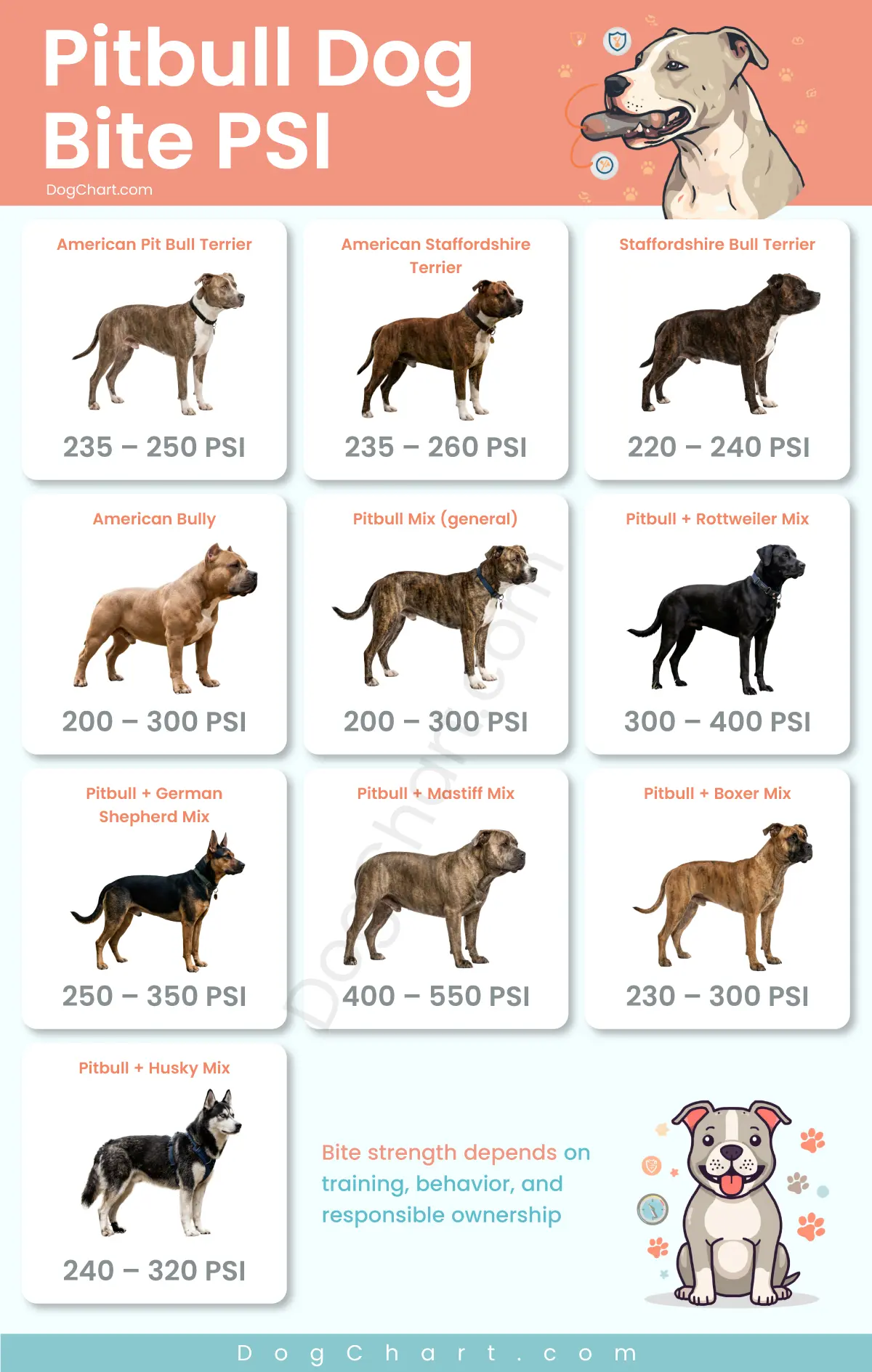
Table of Contents
Pitbull Bite Force Chart
| Factor | Details |
| What is PSI | Pounds per square inch |
| Average pitbull bite force | 235 PSI |
| Strongest bite among dogs | Kangal at 743 PSI |
| Pitbull rank globally | 6th–7th among common breeds |
| Locking jaw | Myth – no scientific basis |
| Highest mix bite force | Pitbull + Mastiff (400–550 PSI) |
| Human bite (comparison) | 120–160 PSI |
| Domestic cat bite | 75 PSI |
What Is PSI and How Is Bite Force Measured?
PSI stands for “pounds per square inch.” It measures the pressure exerted on one square inch of surface. The psi bite rating tells you how much force a dog can exert with their jaws.
Measuring a dog’s bite requires a sleeve with pressure sensors. The dog bites the sleeve, sensors record the force. The problem: dogs don’t always bite at full force during tests. Motivation, training, and individual temperament affect the results.
That’s why most psi bite force numbers online are estimates based on skull size and jaw muscle mass, not direct measurements. A dog’s bite strength varies even within the same breed.
Pitbull Bite Force PSI by Type and Mix
“Pitbull” covers several types and a growing list of mixes. Pit bull bites vary based on jaw structure, body size, and the genetics of the other parent breed. The standard bite force of 235 PSI for the APBT is just the starting point.
| Type / Mix | Bite Force (PSI) |
| American Pit Bull Terrier | 235–250 PSI |
| American Staffordshire Terrier | 235–260 PSI |
| Staffordshire Bull Terrier | 220–240 PSI |
| American Bully | 200–300 PSI |
| Pitbull Mix (general) | 200–300 PSI |
| Pitbull + Rottweiler Mix | 300–400 PSI |
| Pitbull + German Shepherd Mix | 250–350 PSI |
| Pitbull + Mastiff Mix | 400–550 PSI |
| Pitbull + Boxer Mix | 230–300 PSI |
| Pitbull + Husky Mix | 240–320 PSI |
Why Pitbull Mix Bite Force Varies
American Pit Bull Terriers and similar bull breeds share a baseline around 235 PSI. But mixed Pitbulls inherit jaw structure from both parents. The bite force depends on which side they take after.
Pitbull + Rottweiler (300–400 PSI): Rottweilers bite at 328 PSI. The mix often crosses 400 PSI because both parents have powerful jaws.
Pitbull + German Shepherd (250–350 PSI): German Shepherds bite at 238 PSI. The mix lands close to the higher end because of the German Shepherd’s longer skull leverage.
Pitbull + Mastiff (400–550 PSI): This is the strongest pitbull-type dogs mix on the chart. English Mastiffs bite at 552 PSI on average. Some lab tests have measured up to 500 PSI in this mix. The massive jaw structure carries through.
Pitbull + Boxer (230–300 PSI): Boxers bite around 230 PSI. The mix stays in a similar range with slightly more variability.
Pitbull + Husky (240–320 PSI): Huskies bite at about 320 PSI. The mix sits between the parent averages.
Larger dog breeds always score higher on the PSI scale. A muscular dog with broader jaw structure generates more force. Pit bulls may share similar size and strength with Boxers, but bite force depends on jaw shape too.
Pitbull Bite Force vs Other Breeds
Which dog has the strongest bite? Not the Pitbull. The Kangal does. The Pitbull doesn’t even crack the top 5 for bite force among common breeds.
| Breed | Bite Force (PSI) | Notes |
| Kangal | 743 PSI | Strongest bite force overall |
| Cane Corso | 700 PSI | Italian mastiff |
| Dogo Argentino | 500 PSI | Hunting breed |
| English Mastiff | 556 PSI | Massive jaw structure |
| Rottweiler | 328 PSI | Strong, protective |
| German Shepherd | 238 PSI | Police and military use |
| American Pit Bull Terrier | 235 PSI | Average for medium dog |
| Labrador Retriever | 230 PSI | Similar to Pitbull |
| Belgian Malinois | 195 PSI | Lighter build |
| Chihuahua | 100–150 PSI | Weak but willing |
Among dogs, the strongest bite force belongs to the Kangal. Cane Corsos come second. The Rottweiler at 328 PSI, the German Shepherd at 238 PSI, and the Pitbull at 235 PSI all sit in the mid-range.
Breeds like the Cane Corso, Dogo Argentino, and Mastiff all bite harder than any Pitbull. Yet they don’t have the same media attention. For a complete bite force breakdown across breeds, the dog bite force chart has every breed.
Misconceptions About Pit Bull Bites
Misconceptions about pit bull bites are everywhere. The biggest misconception: that they have a powerful bite stronger than other breeds. They don’t.
Their strong bite force is average. Plenty of breeds have a stronger bite force, and many have a higher PSI rating without any reputation problems.
So why the focus on pit bull’s bites? It’s not the PSI. It’s the bite and hold behavior. Pitbulls were historically used in dog fighting, which selected for dogs that gripped and held on. This grip-and-shake style causes more tissue damage than a quick snap, even from a dog with a more impressive bite.
That history doesn’t define modern Pitbulls. Once called America’s dog, they were popular family pets in the early 1900s. Aggression comes from training and environment, not from anatomy.
The Locking Jaw Myth
Pitbulls do not have a locking jaw. This is a persistent myth with zero scientific basis. Their jaw structure is identical to any other dog breed. No special bone. No locking mechanism.
Veterinary anatomists have studied Pitbull skulls extensively. The jaw strength comes from muscle mass and skull width, not from any special anatomy. The American Veterinary Medical Association has publicly stated no breed has a locking jaw.
What Pitbulls do have is determination. When a Pitbull bites and holds, it’s behavioral, not anatomical. Training prevents this behavior in well-raised dogs.
What Influences a Dog’s Bite Strength?
Several factors influence a dog’s bite strength. When it comes to dog bites, anatomy and behavior both matter.
Skull size and shape. Broader skulls and larger jaw muscles generate more force. The Kangal’s massive head is why it tops the PSI charts.
Body weight. Bigger dogs bite harder. A 100-pound dog bites with more force than a 50-pound dog of the same breed.
Jaw leverage. Longer jaws give more leverage but less raw crushing power. Shorter jaws crush harder. Pitbulls have a balanced jaw shape.
Motivation. A dog defending itself bites harder than one biting during play. A single bite in a stress response can be much stronger than test conditions show.
Age and health. Puppies have weaker bites. Senior dogs may also have reduced bite force due to dental issues or jaw muscle loss.
Dog Bite Statistics and Real-World Impact
Dog bite statistics matter more than PSI ratings. About 4.5 million Americans are bitten by dogs each year. About 800,000 need medical attention. Dog bite injuries range from minor scratches to severe injuries needing hospitalization.
Most dog bite incidents involve dogs the victim already knows. Children and the elderly are the most common dog bite victims, and they tend to suffer more severe injuries because of size differences.
A bite from any larger breed can cause more severe injuries than a small dog bite. A dog with a 230 PSI bite is enough to break bones, regardless of breed name. Anyone injured by a dog should seek medical attention immediately, even for what looks like a minor wound.
Fatal dog attacks are extremely rare – about 30–40 per year in the US. The CDC says breed alone is not a reliable predictor of dangerous dog behavior. Training, socialization, and ownership matter far more. Most dog owners never experience a dog attack with their pet.
Legal Aspects of Dog Bite Cases
If you’re bitten by a dog, document everything. Photos, medical reports, witness statements. Dog bite lawyers handle thousands of these cases each year. Most states have strict liability laws – dog owners are responsible regardless of the dog’s history.
A dog bite attorney can help you file a dog bite claim against the owner’s homeowner’s insurance. Compensation typically covers medical bills, medical expenses, lost wages, and damages for pain and suffering.
Owners of pit bulls face higher insurance costs because of breed restrictions. Some homeowner’s policies exclude Pitbulls entirely. Others require additional liability coverage. Check your policy before bringing one home.
Pain and suffering damages can be substantial in serious cases. The legal system treats every dog bite as a serious matter regardless of the breed involved.
How to Prevent Dog Bites
Responsible ownership prevents most bite incidents. Here’s what works:
Socialize early. Expose puppies to different people, dogs, and environments before 16 weeks. A well-socialized Pitbull is rarely aggressive toward humans.
Never encourage aggressive play. Tug is fine. Wrestling is fine. Rewarding growling, snapping, or guarding behavior creates problems.
Spay or neuter. Intact males are involved in most serious bite incidents across all breeds. Neutering reduces hormone-driven aggression.
Supervise children. No dog of any breed should be left unsupervised with small children. This is a dog rule, not a Pitbull rule.
Know warning signs. Stiff body, whale eye, raised hackles, growling. Respect them. A growl is communication, not aggression.
Train consistently. A Pitbull with solid obedience training is far less likely to bite. Basic commands and impulse control build the foundation.
For more on the breed’s reputation versus reality, the aggressive dog breeds page covers data and context.
FAQs
Do Pitbulls have the strongest bite?
No. The average bite force of a Pitbull is 235 PSI. Kangals (743), Cane Corsos (700), and Mastiffs (556) all bite harder. Some sources cite Kangal bites as high as 730 PSI or more. Pitbulls rank 6th–7th among common breeds.
Do Pitbulls have locking jaws?
No. The American Veterinary Medical Association has confirmed this is a myth. No dog breed has a locking jaw mechanism. The structure is the same as every other dog.
Which Pitbull mix has the strongest bite?
The Pitbull + Mastiff mix at 400–550 PSI. Mastiffs contribute most of the bite force. Pitbull + Rottweiler is second at 300–400 PSI.
Can a Pitbull bite break bones?
Yes. Any medium-to-large dog’s bite has enough force to fracture bones, especially in children or elderly victims. This is true of Labs and German Shepherds too – not just Pitbulls.
Are Pitbulls more likely to bite than other breeds?
Studies are mixed. Breed identification in bite reports is unreliable. The AVMA states breed alone is not a reliable predictor of bite risk. Training and socialization matter more.
What’s the bite force of an American Bully?
200–300 PSI depending on the line. Standard American Bullies fall around 250 PSI. XL Bullies bite harder due to size. For naming your dog, the Pitbull names guide has 200+ ideas. For lifespan info, the Pitbull lifespan page covers life expectancy. For diet, the Pitbull food guide covers nutrition.