
Small Dog Age Chart | Dog Years to Human Years for Breeds Under 20 Pounds
My aunt’s Yorkie, Biscuit, turned 15 last winter. She still jumps onto the couch on her own. She eats like she is starving and barks at every delivery person within a mile. Biscuit weighs 7 pounds. A long life like that is normal for small breeds, which often live into their mid-teens.
A small dog age chart covers breeds that weigh under 20 pounds. The group includes Chihuahuas, Yorkshire Terriers, Pomeranians, Shih Tzus, Maltese, Dachshunds, and most toy breeds. Small dogs live 12 to 16 years. A few reach 18 or 19, which is past 90 in human terms. They age slowest of all the size groups.
This guide shows how small dogs convert to human years. It covers their life stages, the lifespans of popular small breeds, the signs of aging to watch for, and the questions owners ask most about care by age.
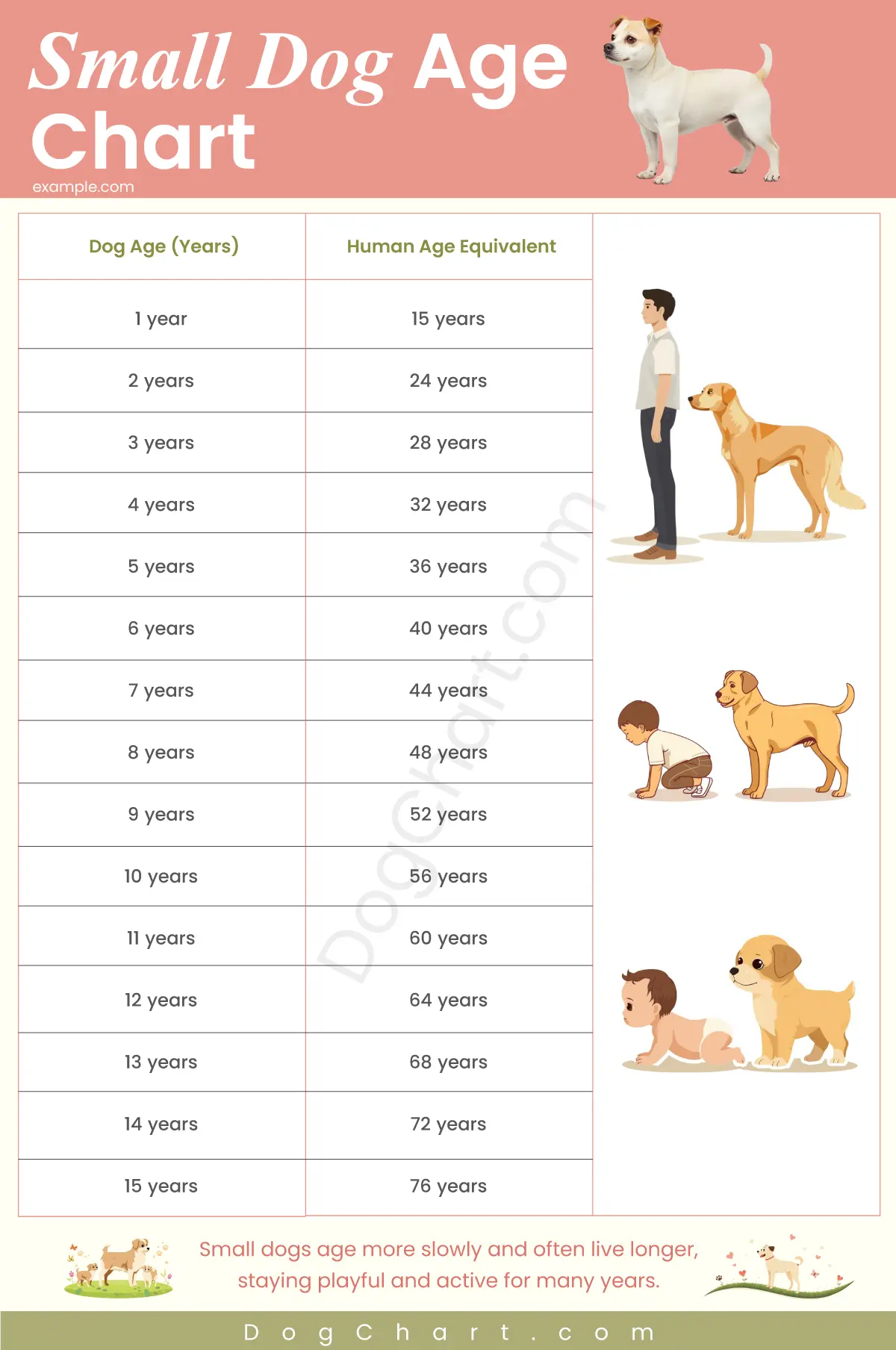
Table of Contents
Small Dog Aging Chart
| Attribute | Details |
| Adult weight range | Under 20 pounds (under 9 kg) |
| Average life expectancy | 12 to 16 years |
| Senior dog age | 10 to 11 years |
| Puppy stage ends | 9 to 12 months |
| First year equals | 15 human years |
| Each year after | 4 human years |
| Common small breeds | Chihuahua, Yorkie, Pomeranian, Shih Tzu |
| Longevity tied to | Genetics, dental care, weight |
Small Dog Age Chart: Dog Years to Human Years
This dog age chart turns a small dog’s age into a human age. After puppyhood, each year adds about 4 human years for small breeds. Use the chart to read your dog’s age at a glance.
| Dog Age (Years) | Human Age Equivalent |
| 1 year | 15 years |
| 2 years | 24 years |
| 3 years | 28 years |
| 4 years | 32 years |
| 5 years | 36 years |
| 6 years | 40 years |
| 7 years | 44 years |
| 8 years | 48 years |
| 9 years | 52 years |
| 10 years | 56 years |
| 11 years | 60 years |
| 12 years | 64 years |
| 13 years | 68 years |
| 14 years | 72 years |
| 15 years | 76 years |
At 5 years, a small dog hits 40 in human years. At 10, she reaches 56. By 15, she is 76. The math is steadier than it is for large dogs, because small dogs age at a consistent pace once they pass age 2. How long a small dog lives comes down to breed, but most clear 14 with room to spare.
How to Calculate Dog Age in Human Years
The old seven-year rule is out of date. A 2019 study at the University of California, San Diego used DNA methylation to measure dog age more accurately. The real formula uses a natural logarithm: multiply the natural log of the dog’s age by 16, then add 31. That tracks the chart above for small breeds.
For quick math on small dogs, use a simpler version. Year 1 equals 15 human years. Year 2 adds 9 more to reach 24. After that, multiply each year by 4. A 10-year-old Yorkie lands at 56. A 15-year-old Pomeranian lands at 76. The method works for calculating dog years across small breeds.
You can run it backward to convert human years to dog years. Take your age, subtract 31, and divide by 4. That gives a rough small-dog match, though it only holds past age 40. The AKC publishes an official chart with the same numbers.
| Human Years | Small Dog Years Equivalent |
| 15 years | 1 year |
| 24 years | 2 years |
| 32 years | 4 years |
| 40 years | 6 years |
| 48 years | 8 years |
| 56 years | 10 years |
| 64 years | 12 years |
| 72 years | 14 years |
| 76 years | 15 years |
See our dog age chart for the full table across every size.
Why Small Dogs Live Longer Than Larger Dogs
Small breeds finish growing by 9 to 12 months. They then sit in a stable adult phase for most of their lives. Their cells stop dividing fast earlier, which lowers the risk of the aggressive cancers that cut large-breed lives short. On average, small dogs live 3 to 5 years longer than large dogs.
Small bodies also put less strain on joints and organs. A 6-pound Yorkie has almost no weight pressing on her hips or knees. Heart disease still hits some breeds, like the Cavalier King Charles Spaniel. But overall organ stress stays low, and that adds years.
The tradeoff shows up elsewhere. Small breeds are prone to dental disease, luxating patellas, and tracheal collapse. They also get spoiled on table scraps, which leads to obesity by middle age. A 3-pound gain on a 10-pound dog is like 45 pounds on a person.
Small dogs age slowly, but only when weight, teeth, and parasite prevention stay under control. Breed genetics matter more than size alone.
Life Stages for Small Breed Dogs
Small dogs pass through five life stages, but the later ones stretch out. Many stay in the mature adult phase until age 10 or 11. Their aging process runs much slower than a medium or large dog’s after the puppy stage.
| Stage | Age Range | Key Focus |
| Puppy | 0 to 4 months | Vaccines, socialization |
| Adolescent | 4 to 9 months | Training, dental start |
| Adult | 9 mo to 6 years | Dental care, exercise |
| Mature adult | 6 to 10 years | Dental, weight control |
| Senior | 10+ years | Vet visits, heart check |
Biscuit moved to senior kibble at age 11, when she started sleeping more and lost interest in her evening walks. Most small breeds do well on a senior switch around age 10 to 11. That is later than medium or large breeds. A senior small-breed kibble adds vitamin and mineral support for the joints, kidneys, and teeth.
Popular Small Breeds and Their Life Expectancy
Small-breed lifespans vary less than medium or large ones. Most land in the 12 to 16 year range. A few, like the Chihuahua and Toy Poodle, reach 18 or 19. When a small breed falls short, the cause is usually a specific health condition, not size.
| Breed | Typical Weight | Average Life Expectancy |
| Chihuahua | 2 to 6 lb | 14 to 18 years |
| Yorkshire Terrier | 4 to 7 lb | 13 to 16 years |
| Pomeranian | 3 to 7 lb | 12 to 16 years |
| Shih Tzu | 9 to 16 lb | 10 to 16 years |
| Maltese | 4 to 7 lb | 12 to 15 years |
| Toy Poodle | 4 to 6 lb | 14 to 18 years |
| Miniature Dachshund | 8 to 11 lb | 12 to 16 years |
| Papillon | 5 to 10 lb | 14 to 16 years |
| Havanese | 7 to 13 lb | 14 to 16 years |
| Cavalier King Charles | 13 to 18 lb | 9 to 14 years |
The Cavalier King Charles Spaniel sits at the low end because of mitral valve disease, a common heart problem. A pup from health-tested parents has a better shot at the top of its breed’s range. With good dental care, weight control, and regular vaccines, a Chihuahua or Pomeranian often passes 15.
Signs of Aging in Small Dogs
Small breeds show their age later than large dogs. They still need attention in their senior years. Dental and heart problems top the list of age-related concerns. The early changes are easy to miss, which is why regular checkups matter.
| Sign | What to Do |
| Bad breath, dental buildup | Professional cleaning, daily brushing |
| Coughing when excited | Vet check for heart murmur or tracheal collapse |
| Gray on the muzzle | Normal, no action needed |
| Cloudy eyes | Vet check for cataracts |
| Sleeping more | Normal, but watch for lethargy |
| Reluctance to jump | Joint supplement, ramps for couch and bed |
| Weight gain | Senior kibble, fewer treats |
| Skin or allergy flare-ups | Vet check, possible flea or tick issue |
Small dogs need yearly vet exams until about age 10, then twice a year after that. Heart exams with a stethoscope are standard for small-breed seniors, since murmurs are so common.
Your vet also checks for fat buildup, dental disease, and other age-related signs that owners miss day to day. Steady veterinary care is a big reason some small dogs reach 18 or more.
Mental and physical play matters too. A 13-year-old who still acts like a puppy usually has an owner who keeps her busy with short walks, food puzzles, and play. For breed-by-breed numbers, see our dog life expectancy chart and the dog years to human years chart.
Frequently Asked Questions
How do I calculate dog age in human years for a small dog?
For a small dog, year 1 equals 15 human years and year 2 equals 24. Each year after adds 4. A 10-year-old Yorkie is 56 in human age. The seven-year rule misses because dogs mature fast in their first 2 years. Use the chart above instead of multiplying by 7.
At what age is a small dog considered senior?
Small breeds reach their senior years at age 10 to 11. That is later than medium or large breeds. Many are still active at 10, so the senior label is more about medical screening than slowing down.
How long do small dogs live?
Most small breeds live 12 to 16 years. Chihuahuas and Toy Poodles often reach 16 to 18. Lifespan depends on breed, dental care, weight, and genetics. A small dog with good care beats the average. The longest verified canine life was 22 years, held by a small mixed breed.
Why do smaller dogs live longer than larger dogs?
Smaller dogs live longer because their cells divide more slowly after the first few years, which lowers cancer rates. They also carry less weight per joint and put less strain on organs. Large breeds like the Labrador Retriever age faster than people expect, often hitting senior status by age 7.
When should I switch my small dog to senior food?
Around age 10 to 11 for most small breeds. Switch sooner if your dog gains weight or has dental, heart, or kidney trouble. Senior kibble has fewer calories, added vitamins and minerals, and protein that is easier to digest. See our dog food chart for feeding amounts and the small dog breeds chart for breed info.