
Vizsla Dog Colors – Every Accepted Coat Shade Explained
The first time I saw two Vizslas side by side, I thought one was much darker than the other. Same breed. Same rust color. Just slightly different shades. That’s the whole range for this breed – variations of a single golden rust color that define the Vizsla look.
The Vizsla color palette is simple: golden rust and nothing else. The Vizsla coat color is described in the breed standard as rust in varying shades.
The golden rust color is the defining feature of the Vizsla breed. Hungarian Vizslas are a self-colored breed – the Vizsla is self-colored, meaning the coat, nose, and eyes all blend into harmonious shades of the same warm palette.
The AKC describes the Vizsla as a “hunting dog of distinguished appearance,” and the solid rust coat is a major part of that distinction. This guide covers every accepted shade, the strict breed standard rules for white markings, and colors that simply don’t exist in the breed.
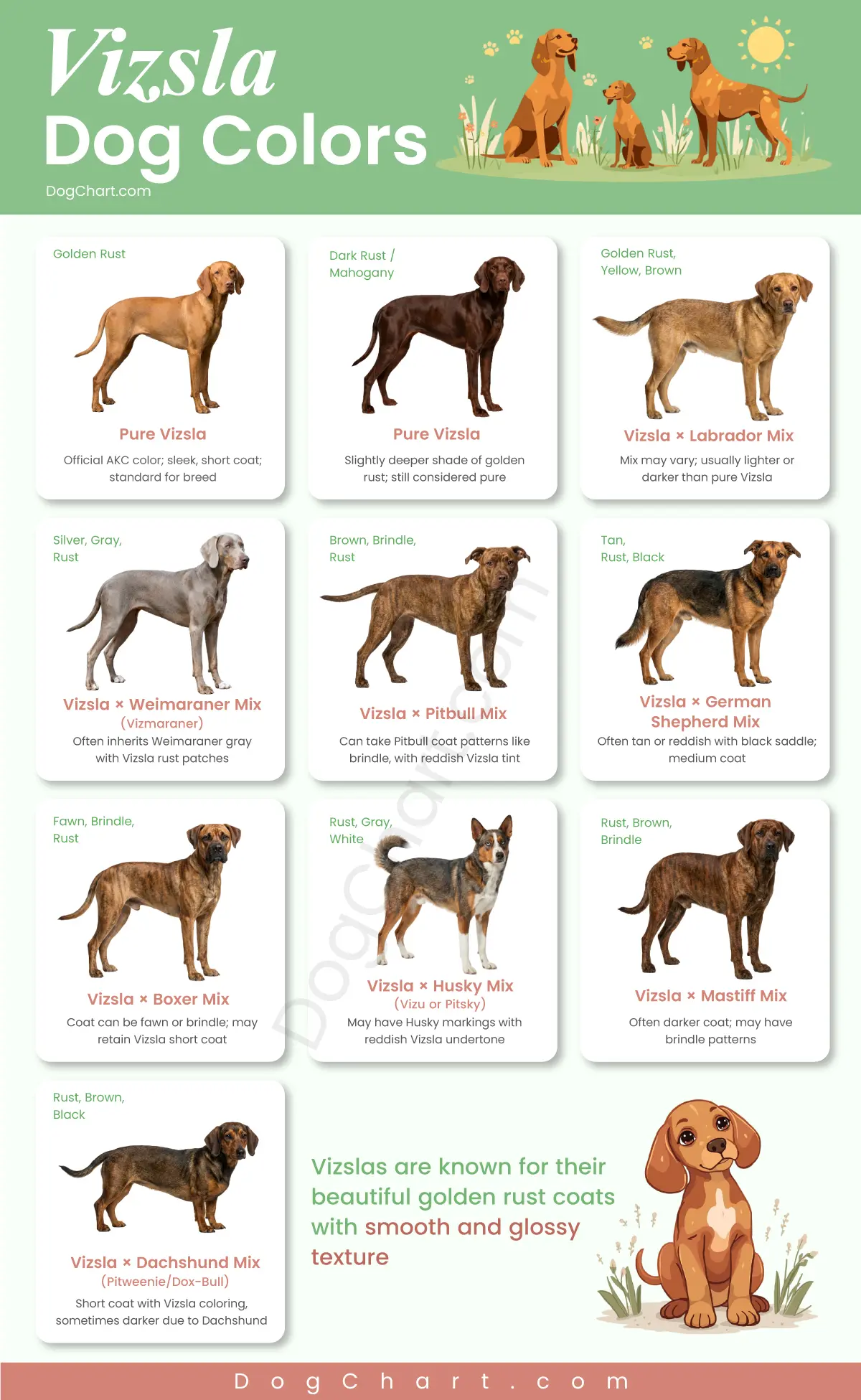
Table of Contents
Accepted Vizsla Colors
The color of the coat falls within a narrow range. All accepted shades are variations of the same golden rust base. The different shades range from light gold to deep red:
| Color Shade | Description |
| Golden Rust | Standard AKC color, most common |
| Russet Gold | Warm golden shade, slightly reddish |
| Dark Sandy Gold | Deeper gold with sandy undertone |
| Dark Rust | Rich deep red-brown, reddish tone |
| Light Rust | Lighter, almost honey-colored |
| Sandy Yellow | Lighter pale yellow gold |
| Copper Brown | Rare shade with copper tint |
Russet gold is the most prized shade in the show ring. Sandy yellow and pale yellow are on the lighter end. Reddish or mahogany tones lean darker.
The natural shading varies within each dog too – the back and ears are often slightly darker than the belly and chest.
AKC Breed Standard for Vizsla Color
The AKC standard and standards for the Vizsla set by the American Kennel Club and Vizsla Club of America are very specific about the color of the coat:
The breed standard calls for “solid golden rust in different shadings.” The rust color should be uniform across the body. Darker shading on the ears and back is normal and accepted. The sides of the neck and neck and shoulders should blend smoothly with the body color.
The coat type must be short-coated and smooth. A long coat is a disqualification in the AKC ring. A woolly undercoat is also not accepted – the Vizsla should have a single, close-lying coat without dense underlayers.
White Markings: What’s Allowed and What’s Not
The white markings rules are strict in the Vizsla breed standard. Small white markings are permissible in limited areas. The amount of white determines whether a dog can be shown:
Allowed: A small white patch on the chest (not exceeding 2 inches) is acceptable. White on the toes is accepted. These minor markings don’t affect the dog’s status as a purebred.
Disqualification: Solid white extending beyond the forechest is a disqualification. White extending above the toes is a disqualification.
White extending on the shoulders or anywhere else on the dog is a disqualification. White on toes or white anywhere else else on the dog except the dog except the forechest and toes is not allowed.
Too much white – any white markings beyond the chest and toes – means the dog cannot compete in conformation.
The color is faulty if white extends beyond accepted areas. A disqualification in the show ring doesn’t mean the dog isn’t a purebred – just that it doesn’t meet show breed standard.
Nose, Eye, and Skin Color
The Vizsla’s nose should match the coat – a brownish rust color. A partially or completely black nose is a disqualification under AKC rules. The nose blends with the coat, creating the self-colored look that defines the breed.
Eyes should be shades of brown or amber, harmonizing with the coat color. Blue or green eyes are not accepted.
Skin is tight and close-fitting with no wrinkles. The skin color beneath the coat is a warm flesh tone.
Colors That Don’t Exist in Vizslas
Black: Does not exist. A “black Vizsla” is a mixed breed or a different dog breed entirely.
White: Does not exist as a full coat color. Only small markings are possible.
Merle: Does not exist. Vizslas don’t carry the merle gene.
Blue: Does not exist. Blue is a diluted black not present in the gene pool.
Brindle: Does not exist. Brindle is a tiger-stripe pattern not found in this breed.
If someone sells a “rare blue Vizsla” for $5,000, it’s a scam. Either the dog is mixed or the seller is using Photoshop.
Color in Breeding Programs
A responsible breeding program doesn’t select for specific shades. The Vizsla’s color is determined by genetics, and reputable breeders prioritize health and temperament over shade.
Some breeders in Hungary and the US describe their puppies using specific shade names, but these are informal descriptions. A “mahogany” Vizsla and a “light gold” Vizsla are the same breed with the same genetics. Neither is rarer or more valuable.
Avoid any breeding program that charges extra for “rare” colors. There are no rare Vizsla colors. Only variations of the same golden rust.
Vizsla Puppy Color Development
Vizsla puppy coats start slightly darker than adult color. The coat lightens as they grow. By 6–8 months, the adult rust shade is usually visible.
Some puppies have patchy or uneven coloring that evens out by maturity. Small white on the chest may shrink as the dog grows but typically remains visible.
If a puppy has large white patches, extensive dark markings, or any color outside the rust range, it’s likely a mix rather than a purebred.
Vizsla Color vs Weimaraner Color
People confuse Vizslas with Weimaraners because both are lean, athletic hunting dogs. But the colors are completely different.
Vizslas are golden rust. Weimaraners are silver-gray. No overlap. A “silver Vizsla” is a Weimaraner or a mix. Both share a similar temperament but look nothing alike in color.
Does Color Affect Temperament or Health?
No. All Vizsla shades have identical temperament, health, and lifespan. The color variation is cosmetic only.
Don’t pay a premium for a specific shade. If a breeder charges extra for a specific vizsla color, walk away. For more on the breed’s personality, the Vizsla temperament page covers everything. For price info, the Vizsla price page covers costs.
FAQs
Do Vizslas come in black?
No. Black is not a Vizsla color. The gene pool doesn’t carry it.
What color are Vizslas supposed to be?
Golden rust. The AKC accepts different shadings ranging from sandy yellow to dark sandy gold to deep red mahogany.
Are white markings on a Vizsla normal?
Small white on the chest and toes is accepted. Anything more is a show disqualification but doesn’t affect the dog’s health or status as a purebred.
Why do Vizslas only come in one color?
Genetic isolation. The breed developed in Hungary from a small founding population. The rust color became fixed over centuries. For the full breed overview, the Vizsla dog breed page covers history. For size details, the Vizsla size page has measurements.