
Vizsla Temperament – What Living with a Velcro Dog Is Really Like
A Vizsla owner once told me she couldn’t go to the bathroom alone for 9 years. That’s not an exaggeration. Her Vizsla sat outside the door every time, and if she closed it, he’d whine until she opened it. “I didn’t know what a velcro dog meant until I got him,” she said.
The Vizsla dog breed – also called the Hungarian Vizsla, Magyar Vizsla, or Vizsla or Hungarian Pointer – has a temperament defined by one word: attachment. The Vizsla personality centers on a deep, unshakable bond with their owner. They’re the original velcro dog.
This guide provides full Vizsla dog breed information on temperament, behavior with family, kids, strangers, and other pets. If you’re getting a Vizsla, this is what you’re signing up for.
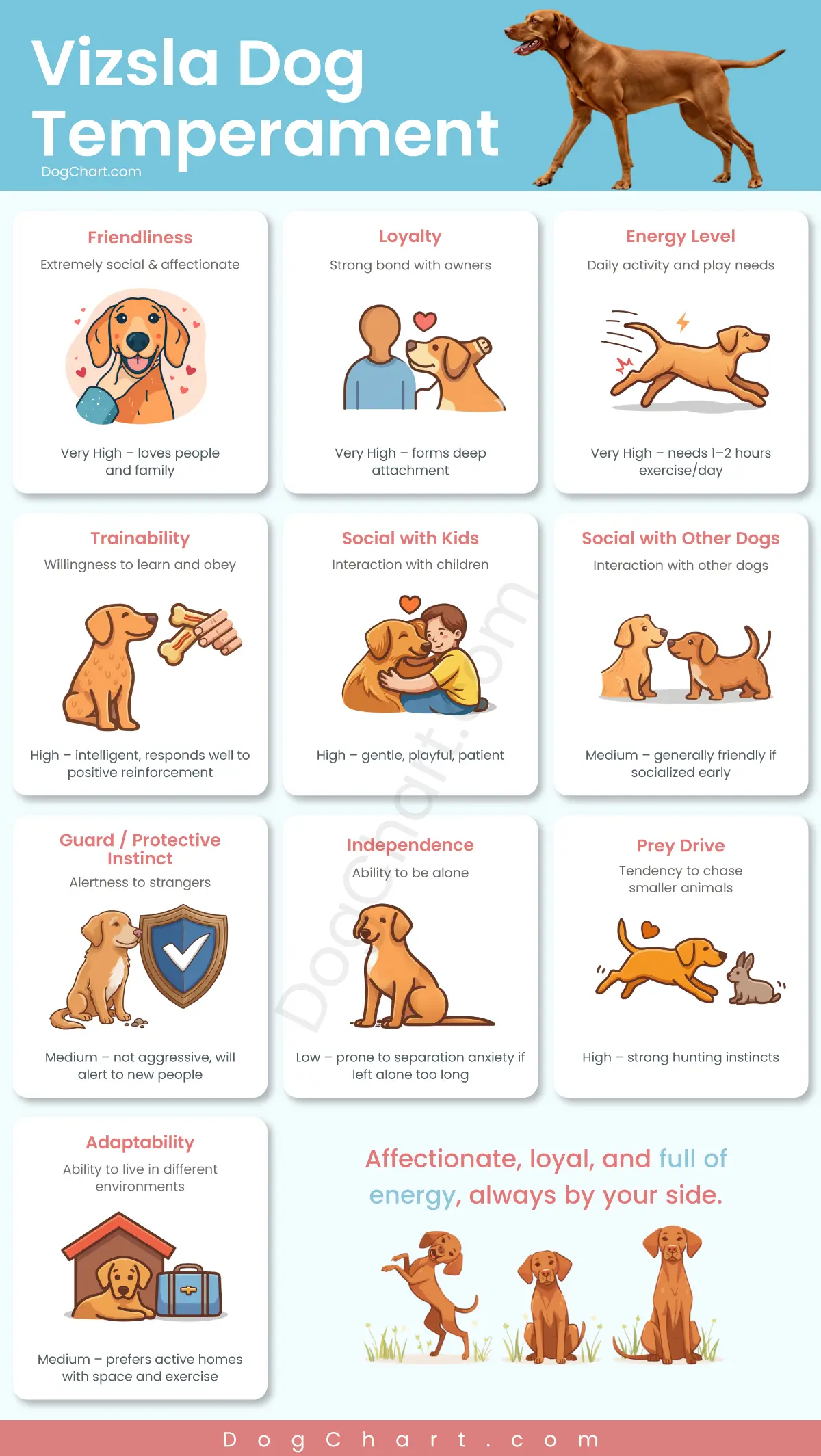
Table of Contents
Vizsla Temperament Chart
| Trait | Rating |
| Affection level | Very High (velcro dog) |
| Energy level | High energy |
| Attachment to owner | Extreme (velcro) |
| Kid-friendly | High with supervision |
| Stranger-friendly | Moderate |
| Trainability | High |
| Exercise needs | 60–90 minutes daily |
| Separation anxiety risk | Very High (never left alone long) |
| Barking | Moderate |
| Size category | Medium-sized dog |
Breed History and Origins
The Vizsla’s temperament traces back centuries. These dogs were bred by Hungarian sportsmen as early as the 10th century to work long days in the field pointing and flushing game. They needed to stay close to the handler, read body language, and retrieve on command.
The breed nearly went extinct but survived the Turkish occupation, both World Wars, and Soviet-era Hungary.
Breed enthusiasts smuggled dogs to Austria and eventually the United States in the 1950s. The modern-day Vizsla carries that same intense bond with humans because it was bred in, not trained in.
As a Hungarian pointer and hunting dog, the Vizsla was always a one-person dog that slept beside the hunter and worked alongside them from dawn to dusk. That’s why they still follow you from room to room today. For hunting breed comparisons, the hunting dog breeds page covers the full category.
The Velcro Dog Reputation
Velcro is the most accurate word for this breed. They stick to you constantly. This isn’t just following you around. It’s physical closeness. They want to touch you at all times.
If you sit down, the Vizsla sits next to you. If you lie down, they lie next to you. If you stand up, they stand up too. They’ll follow you from room to room for their entire life.
This attachment has a major downside: separation anxiety. A Vizsla should never be left alone for more than 4–5 hours. Dogs left alone for long periods become destructive, anxious, and depressed. This is the reality of owning a Vizsla that surprises the most people.
With Family, Kids, and Other Pets
As a family dog, the Vizsla excels. They’re gentle, patient, and incredibly loving inside the home. Vizsla owners often say their dog reads their mood better than any human in the household.
They’re excellent with older children. Patient and tolerant. Their high energy matches well with active kids. The only concern is their size and enthusiasm – a 60-pound Vizsla at full speed can knock over a toddler.
With other dogs and cats, results vary. Most Vizslas are friendly with other dogs, especially when socialized early. Cats are hit or miss. The hunting instinct can trigger prey drive with small running animals. Introduce slowly.
Exercise Needs: This Is Non-Negotiable
This is an active breed that demands an active lifestyle. The Vizsla breed needs 60–90 minutes of vigorous daily exercise, minimum. Two hours is better.
A quick walk around the block isn’t enough. They need running, swimming, fetch, or agility. They need both mental and physical outlets. Without mental and physical stimulation, they fall apart. A lot of mental stimulation through puzzle toys, nose work, and training sessions keeps the brain engaged.
At the dog park, they’ll run circles around most breeds. Fair warning: if a squirrel shows up, your Vizsla will chase it. Every time. A squirrel at the park triggers the same hunting drive that made them great field dogs for centuries.
They excel at dog sports – agility, dock diving, field trials, and flyball. Similar breeds like German Shorthaired Pointers and the Weimaraner share the same exercise demands. For comparisons, the Vizsla size page has breed-to-breed size details.
Training and Socialization
Dog training is straightforward with this breed. They’re smart, eager to please, and food-motivated. Most learn basic commands within a few weeks.
Start early and use positive reinforcement. Harsh methods backfire badly with this sensitive breed. Focus on good recall training early. Vizslas have a strong prey drive and need reliable recall for off-leash safety. A responsible dog owner invests in this from day one.
Vizsla puppies are wild, bitey, and full of energy. If you’re getting a puppy, start socialization before 16 weeks. Expose them to different people, dogs, surfaces, and environments.
When looking for Vizsla puppies, find a reputable breeder registered with the Kennel Club or Vizsla Club of America.
A good reputable breeder breeds to the breed standard and socializes puppies from birth. The Wirehaired Vizsla is a separate breed with slightly different temperament – less intense attachment but still energetic.
Health Issues That Affect Behavior
Some health conditions in Vizslas show up as behavioral changes.
Epilepsy affects a small percentage of the breed. Seizures can cause temporary disorientation, fear, and clinginess. Manageable with medication, and most affected dogs live normal lifespans.
Vizsla inflammatory polymyopathy is a rare breed-specific muscle condition. It causes muscle wasting, pain, and reduced activity. Early vet intervention matters.
Hypothyroidism causes lethargy and weight gain that owners sometimes mistake for laziness. Bloodwork confirms it.
Feed them at least twice daily to keep energy levels stable. The best dog food for Vizsla page covers nutrition.
The Vizsla coat is short hair in a russet gold color. Easy to groom – weekly brushing is enough. The Vizsla colors page covers all accepted shades.
Are Vizslas Good Watchdogs?
Sort of. They’re good watchdogs in that they’ll alert bark when someone arrives. But they’re not guard dogs. After the initial bark, most Vizslas want to greet the visitor and make a new friend.
Their protective instinct is mild. They won’t confront an intruder the way a German Shepherd or Rottweiler would. They’re better as an alarm system than a security system.
Is the Vizsla the Right Breed for You?
For dog lovers who want the best dog for an active lifestyle, the Vizsla is hard to beat. But they’re not for everyone. Honest dog ownership means matching the right breed to your life, not the other way around.
Yes if: You’re home most of the day, exercise daily, want constant companionship, and don’t mind a dog that follows you everywhere.
No if: You work long hours, travel often, live a sedentary life, or want an independent dog.
For price info, the Vizsla price page covers costs. For lifespan, the Vizsla lifespan page covers longevity.
FAQs
Are Vizslas good family dogs?
Yes, for active families. They’re affectionate, gentle with kids, and bond deeply.
Can Vizslas be left alone?
Not for long. 4–5 hours maximum. Severe separation anxiety and destructive behavior are common when isolated.
Are Vizslas aggressive?
No. They’re one of the least aggressive breeds. Aggression usually signals fear, pain, or poor socialization.
Do Vizslas bark a lot?
Moderately. They alert bark but aren’t yappy. Bored or anxious Vizslas bark more. Exercise reduces barking.
Are Vizslas easy to train?
Yes. Intelligent and eager to please. Positive reinforcement works best. The Vizsla weight page tracks healthy growth. The Vizsla dog breed page covers the full breed overview.