
Akita Bite Force – How Strong Is an Akita’s Bite?
A vet tech once told me about an Akita that bit through a leather muzzle during a nail trim. Not chewed through. Bit through.
Clean puncture. The vet switched to a wire basket muzzle and said, “I don’t underestimate Akitas anymore.” That’s 350–400 PSI in action.
The Akita’s bite force ranks among the strongest in the dog world. Their massive skull, powerful jaw muscles, and broad muzzle generate serious pressure. But the numbers only tell part of the story. This guide covers what we know about Akita bite force, how it compares, and why temperament matters more than PSI.
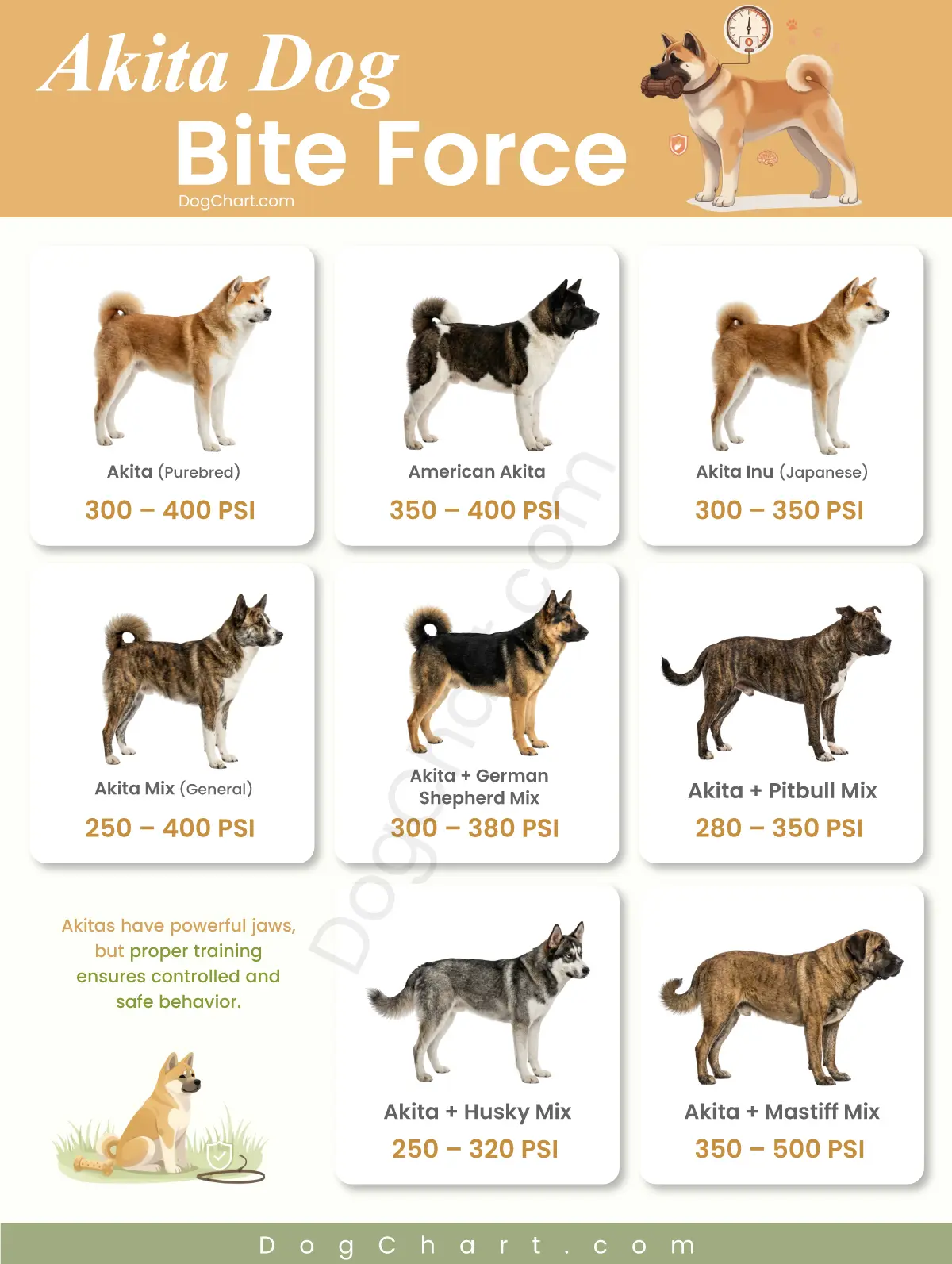
Table of Contents
Akita Bite Force Chart
| Factor | Details |
| Estimated bite force | 350–400 PSI (pounds per square inch) |
| Rank among breeds | Top 10 high-PSI breeds |
| Skull type | Broad, bear-like (American Akita) |
| Jaw muscle mass | Very high |
| Locking jaw | Myth (no breed has this) |
| Historical use | Hunting bear, boar, and deer |
| Temperament | Protective, territorial, prone to aggression if poorly socialized |
Akita Bite Force by Type and Mix
Bite force varies between Akita types and mixes. The American Akita generates the highest PSI bite of the purebreds because of its broader skull.
Mixes with other powerful breeds like the mastiff push numbers even higher. Below is the bite strength range for each common type.
| Dog Type | Bite Force (PSI) |
| Akita (Purebred) | 300 – 400 PSI |
| American Akita | 350 – 400 PSI |
| Akita Inu (Japanese) | 300 – 350 PSI |
| Akita Mix (General) | 250 – 400 PSI |
| Akita + German Shepherd Mix | 300 – 380 PSI |
| Akita + Pitbull Mix | 280 – 350 PSI |
| Akita + Husky Mix | 250 – 320 PSI |
| Akita + Mastiff Mix | 350 – 500 PSI |
The Akita + Mastiff mix tops the chart with a bite force of 500 PSI in the upper range. That puts it close to the Dogo Argentino and approaching English Mastiff territory. The Akita + Husky mix sits at the lower end because Huskies have a lighter jaw structure.
How Strong Is an Akita’s Bite?
The Akita’s bite force is estimated at 350–400 PSI (pounds per square inch). That’s a strong bite force, putting this dog breed firmly among the high-PSI breeds.
It’s stronger than a Rottweiler (328 PSI), German Shepherd (238 PSI), and Pitbull (235 PSI). Only a handful of breeds have a more powerful bite force.
The American Akita’s broad, bear-like skull generates more force than the narrower Japanese Akita Inu. Both are powerful breeds, but the American version has the edge due to skull width and jaw muscle mass. The Tosa Inu, another Japanese fighting breed, has a similar bite force range and similar build.
These dogs were originally bred to hunt bears, wild boar, and deer in northern Japan. Their impressive bite force was essential for holding large, dangerous game. The same trait that made them effective hunters now makes them a good guard dog when properly trained.
Akita Bite Force vs Other Breeds
| Breed | Bite Force (PSI) | Notes |
| Kangal | 743 PSI | Strongest bite force of any breed |
| Cane Corso | 700 PSI | Italian mastiff, powerful breed |
| Dogue de Bordeaux | 556 PSI | French mastiff, force of 556 PSI |
| English Mastiff | 556 PSI | Massive jaw, war dog history |
| Dogo Argentino | 500 PSI | Bite force of 500 PSI, hunting breed |
| Tosa Inu | 450 PSI | Japanese fighting breed |
| American Bulldog | 305 PSI | Bite force of 305 PSI |
| Akita | 350–400 PSI | Bear-hunting heritage |
| Rottweiler | 328 PSI | Guarding breed |
| German Shepherd | 238 PSI | Police/military working dog |
| American Pit Bull Terrier | 235 PSI | Average for medium dog |
| Labrador Retriever | 230 PSI | Similar to Pitbull |
The Kangal at 743 PSI holds the title for the dog that has the strongest bite among recognized breeds. Cane Corsos and the Dogue de Bordeaux (French mastiff) follow close behind.
The Akita ranks in the top 10. For the full breakdown across every breed, the dog bite force chart covers each one with notes on temperament and history. Wolfdogs, while not standardized, often test in similar ranges.
Why Akita Bites Are Serious
PSI is only part of the equation. The Akita’s bite is serious because of three factors working together.
Force. 350–400 PSI is enough to fracture bones and cause deep tissue damage. Bites at this strength cause more severe injuries than those from medium breeds. Dog bite injuries from large dogs are statistically more likely to require surgery.
Size. A 100–130 pound dog behind that bite means the full body weight amplifies the impact. When someone is injured by a dog this size, the damage often extends beyond the bite wound itself.
Temperament. Akitas are protective and territorial. They don’t bite casually, but when they do, it’s with commitment. They were bred to hold large game, which means they grip rather than snap. This is why they cause serious injuries in the rare cases when bites occur.
This is why proper socialization and training matter so much. A well-raised Akita pup almost never bites, and most adult dogs go their entire lives without a first bite incident. A poorly socialized one is a genuine dangerous dog. The Akita personality guide covers training approaches.
Akita Attacks and Bite Statistics
Akita attacks are rare compared to more common breeds, but when they happen, the damage tends to be significant.
Dog bite incidents involving Akitas frequently result in dog bite victims needing emergency care because of the bite force and grip strength. The Akita is sometimes listed under the UK’s Dangerous Dogs Act considerations, though it is not a banned breed.
Most attacks on humans involving this breed trace back to poor socialization, chaining, or unaltered males. The dog in question is rarely a well-raised family pet. If your dog has never bitten anyone, that’s the result of training and management, not luck.
If you or someone you know has been the result of a dog attack involving an Akita, dog bite attorneys and dog bite lawyers familiar with dog bite law can help with a personal injury case. Each state handles personal injury claims differently, and specialized counsel matters.
The Locking Jaw Myth
Akitas do not have locking jaws. No dog breed does. Their jaw structure is anatomically identical to every other breed. The American Veterinary Medical Association has confirmed this.
What Akitas do have is determination. When they grip, they hold on. This is behavioral, not anatomical. It traces back to their hunting heritage. Training manages this behavior in well-raised dogs.
How to Prevent Bite Incidents
Socialize early. Before 16 weeks. Expose puppies to different people, another dog, and varied environments.
Respect their space. Akitas don’t tolerate being crowded by strangers. Warn visitors not to reach over their head.
Never chain or isolate. Chained dogs of any breed become more aggressive. Akitas especially.
Spay or neuter. Intact males are involved in most serious bite incidents across all breeds.
Know the signs. Stiff body, hard stare, raised hackles, low growl. These are warnings. Respect them.
For context on breed aggression, the aggressive dog breeds page covers the data. For lifespan info, the Akita lifespan page covers longevity.
What Affects an Akita’s Bite Force?
Several factors determine how hard an individual Akita bites. Skull width is the biggest one. The American Akita’s broad skull generates more force than the narrower Japanese Akita Inu. Wider skulls mean larger jaw muscle attachment points and more crushing power.
Body weight matters too. A 130-pound Akita bites harder than an 80-pound one of the same breed. More body mass behind the jaw amplifies force. Motivation also plays a role.
A dog biting defensively generates far more force than one biting during play. Test conditions don’t replicate real-world scenarios, which is why PSI numbers are always estimates.
Prime adults (2–7 years) bite hardest. Puppies have weaker bites. Senior dogs lose jaw muscle mass and may have dental issues reducing force. The Akita’s jaw is moderately short and very wide, optimized for grip and crush rather than reach.
FAQs
How strong is an Akita’s bite?
350–400 PSI. Stronger than German Shepherds, Pitbulls, and Rottweilers. In the top 10 among all breeds for bite strength.
Do Akitas have locking jaws?
No. This is a myth. No breed has a locking jaw mechanism, including Cane Corsos, mastiffs, or any other powerful breed.
Are Akitas more dangerous than Pitbulls?
Their bite is stronger (350–400 vs 235 PSI) and they’re larger. But danger depends on training and socialization, not breed alone. A well-raised Akita is safer than a poorly raised dog of any breed.
Can an Akita’s bite break bones?
Yes. 350+ PSI is more than enough to fracture human bones. This is true of most large dogs. Responsible ownership prevents incidents.
What were Akitas bred to bite?
Bears, wild boar, and deer in the mountains of Japan. Their bite force was essential for holding dangerous game. For the full breed overview, the Akita dog breed page covers history. For nutrition, the Akita food guide covers feeding.