
Borzoi Dog Colors – Every Coat Color and Pattern
I went to a Borzoi specialty show last year and saw more coat colors than I expected. Pure white. Cream with apricot points. A striking black and tan. A mahogany sable with white markings. Even a blue brindle.
The breed standard allows every color, which makes Borzois one of the most diverse sighthounds. For breed comparisons, see the dog breeds chart.
The Borzoi dog colors accepted by the AKC cover every combination you’d expect and several you wouldn’t. The breed standard places no restrictions on color, patch size, or pattern.
This traces back to the breed’s origins in imperial Russia. Wolf-hunting ability mattered more than looks. Breeders built the AKC standard around structure, not coat color.
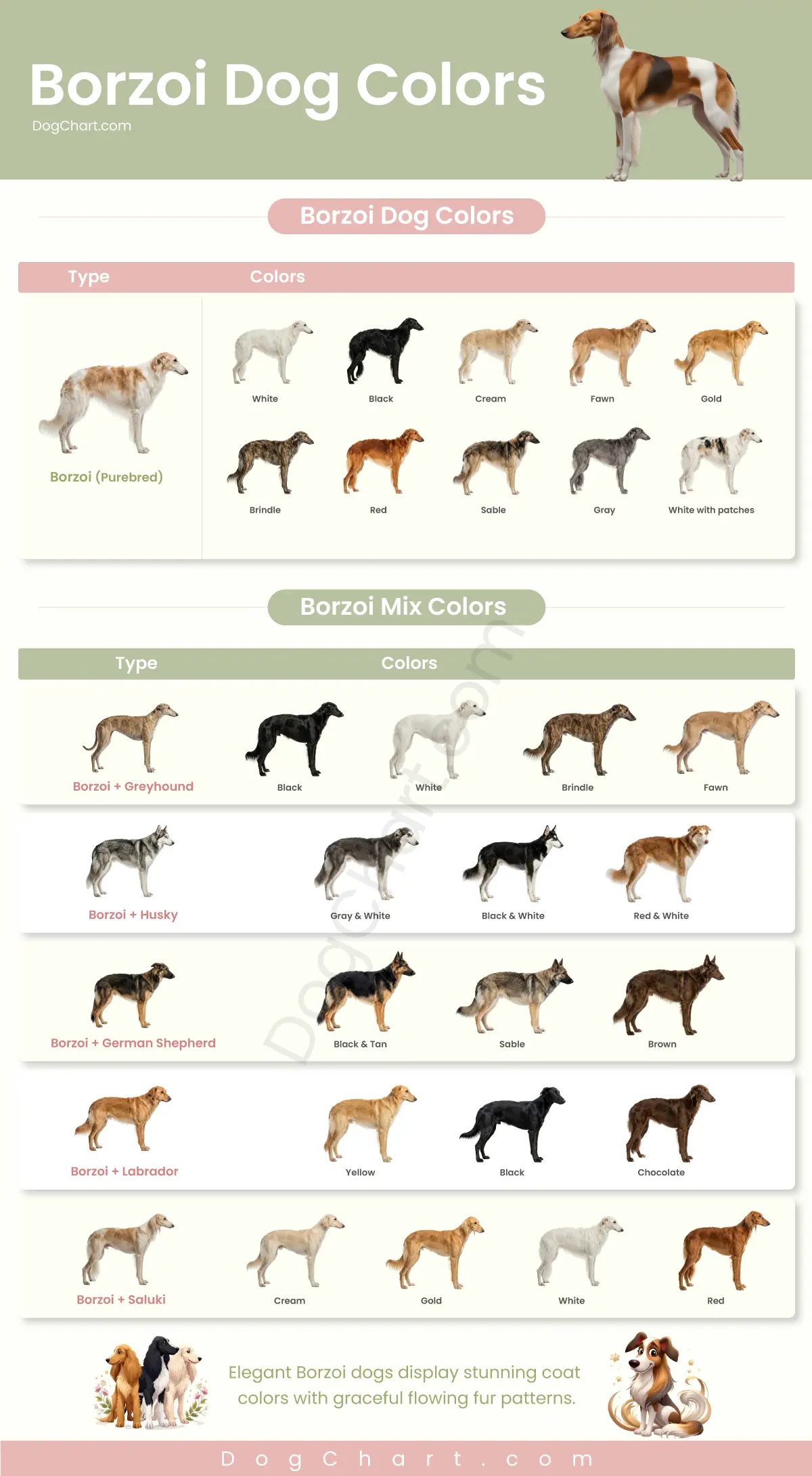
Table of Contents
Borzoi Dog Colors (Purebred)
Every color accepted under the AKC breed standard is listed below. These apply to purebred Borzois and represent the range seen at national specialty shows worldwide.
| Type | Colors |
| Borzoi (Purebred) | White, Black, Cream, Fawn, Gold |
| Brindle, Red, Sable, Gray | |
| White with patches (any color combination) |
White is the most common Borzoi color. Pure white dogs or white with patches make up about 40% of the breed. Sable and gold follow. Solid-color adults are less common than parti-color dogs because the breed’s genetics favor white spotting. Solid black is rare in Borzoi bloodlines. Gray (blue dilute) is even rarer.
Common Borzoi Color Patterns
Beyond base color, Borzois display several pattern types. These patterns exist independently of color, so a sable parti-color and a brindle parti-color show up in the same litter.
| Pattern | Description |
| Solid | One single color (rare) |
| Bi-color | White + another color |
| Tri-color | White + black + tan |
| Brindle | Tiger-like stripes |
| Parti-color | Mostly white with patches |
Parti-color is the most frequent pattern. Solid dogs are rare because the white spotting gene is so widespread in this breed.
A fully solid adult Borzoi turns heads at shows. Tri-color (black, tan, white) produces striking dogs with tan points around the eyes, on the muzzle, and on the legs.
Coat Color Genetics
Dog coat color comes from two pigments: eumelanin (black) and phaeomelanin (red/yellow). Every Borzoi color is a result of how much of each pigment the body produces, where it’s placed, and whether it’s diluted.
The K locus controls whether a dog is brindle, solid, or allows other patterns to show. A dominant black KB allele produces solid black hairs across the body. A kbr allele produces brindle. The recessive ky lets patterns from other loci show through, including sable and tan point.
The A locus controls sable versus tan point. The ay allele creates sable, the dominant yellow pattern seen in most gold and red Borzois.
The atat combination produces tan point (tri-color), where the dog is black with tan markings around the eyes, on the muzzle, and on the legs. Clear sable and shaded yellow are variations on the ay allele. Shaded sable shows more black-tipped guard hairs over a red base.
The D locus controls dilution. A dd combination turns black pigment into gray (blue) and red pigment into cream. True blue Borzois are rare and carry a risk of color dilution alopecia. Both parents must carry the dilute gene to produce dilute puppies.
Merle does not exist in Borzoi genetics. If a seller advertises a merle Borzoi, the dog is either mislabeled or not purebred. A genetics lab test confirms the real color pattern.
Individual Color Breakdown
White
The classic and most recognizable Borzoi color. White Borzois have dark nose leather and dark eyes, which separates them from true albinos. A few white dogs carry patches of another color behind the ears or at the tail base.
Sable
Sable describes red or tan dogs with black-tipped guard hairs over the base color. Clear sable has minimal black tipping and looks close to pure red. Shaded sable has heavier tipping and appears darker, reaching mahogany in deep shades. The ay allele controls this range.
Brindle
A brindle dog has vertical black stripes over a lighter base. Borzoi brindle appears over red, gold, fawn, or diluted bases. Silver brindle is the rarest form, with black stripes on a gray base. The kbr allele on the K locus controls brindle.
Black and Tan (Tan Point)
Tan point dogs are black with defined tan markings around the eyes, on the muzzle, on the chest and legs, and under the tail. The atat combination on the A locus controls this pattern. Tan point Borzois are less common than sable but not rare.
Red and Gold
Red dogs show rich reddish-tan coloring from phaeomelanin without black tipping. Gold describes a paler yellow-tan shade with minor shading. Both appear with or without white markings.
Black
Solid black Borzois exist but are uncommon. A fully black dog requires the dominant black KB allele without white spotting. Most “black” Borzois are actually black and white parti-color. True solid black is rare.
Blue / Gray
The blue dilute turns black pigment into slate gray. Blue Borzois are rare because the dilute gene is recessive. Both parents must carry it. Breeders charge $500–$1,000 more for a blue dilute. The Borzoi price guide covers how color affects pricing.
Cream
Cream is a diluted version of red or gold. It looks pale ivory with darker points. Cream and white look similar from a distance, but cream has a yellow tone in natural light.
Borzoi Mix Colors
Borzoi mixes inherit color traits from both parent breeds. The table below shows common color outcomes for popular crosses.
| Mix Type | Common Colors |
| Borzoi + Greyhound | Black, White, Brindle, Fawn |
| Borzoi + Husky | Gray & White, Black & White, Red & White |
| Borzoi + German Shepherd | Black & Tan, Sable, Brown |
| Borzoi + Labrador | Yellow, Black, Chocolate |
| Borzoi + Saluki | Cream, Gold, White, Red |
Borzoi mixes show unpredictable combinations because each parent contributes different color genes. A Borzoi + Husky cross produces puppies with blue eyes or bi-color markings not seen in purebreds. A Borzoi + Saluki mix stays within sighthound color ranges and is the most consistent cross visually.
How Puppies Change Color
Borzoi puppies look different as adults. A puppy that appears solid cream develops sable tipping as the adult coat grows in. A pale red puppy deepens into mahogany by 18 months. Black puppies lighten into blue or silver if they carry the dilute gene.
The adult coat settles by 18–24 months. Before then, color shifts are normal. Sable puppies are the hardest to predict because the black tipping develops gradually. Tan point puppies start lighter and darken. White markings stay stable from birth.
If you’re buying a puppy for a specific color, ask the breeder for photos of both parents at adult age and previous litters at 2 years old. Breeders who track their lines predict adult color with high accuracy.
Does Color Affect Price?
Not much. Unlike breeds where rare colors carry $1,000+ premiums, Borzoi breeders don’t price by color alone. A $2,500 pet-quality puppy costs the same whether it’s white, sable, or black and tan. Structure, health clearances, and pedigree drive price more than color. The Borzoi price guide covers typical pricing.
The exception is blue dilute and blue brindle. Breeders price these $500–$1,000 higher because of rarity. But blue coloring is linked to color dilution alopecia, a coat condition that causes hair thinning. Reputable breeders screen for this and avoid breeding dilute lines.
Does Coat Color Affect Health or Temperament?
Temperament: no. Color has zero effect on personality. A white Borzoi behaves the same as a black and tan one.
The breed’s calm, gentle temperament holds across every color. See the Borzoi personality guide for what to expect.
Health: one exception. Blue and other dilute colors carry a risk of color dilution alopecia. It’s not life-threatening, but it affects coat quality.
Reputable breeders test for it and avoid pairings that produce affected puppies. For longevity data, the dog life expectancy chart has breed-specific numbers.
Grooming the Borzoi Coat
All Borzoi colors have the same silky coat. The texture is fine and tangles behind the ears, under the legs, around the tail feathering, and in the hindquarters. Brush 2–3 times per week with a pin brush and slicker to prevent mats. The coat is straight or wavy depending on the line.
White Borzois show dirt faster and need bathing every 4–6 weeks. Dark-colored Borzois hide dirt but still shed.
All Borzois blow coat twice a year in spring and fall. During those weeks, daily brushing keeps loose undercoat under control. The Borzoi size guide covers growth, and the dog size chart compares large breeds.
Frequently Asked Questions
What is the most common Borzoi color?
White, either pure white or white with sable, cream, or red patches. About 40% of Borzois fall into this category. White is the default Borzoi look that most people picture when they think of the breed.
What is the rarest Borzoi color?
Solid black, blue dilute, and blue brindle are the rarest. These colors appear in fewer than 5% of litters because they require specific gene combinations.
Do Borzoi puppies change color as they grow?
Yes. Coat color shifts until 18–24 months. Sable intensifies or softens, clear sable puppies become shaded adults, and light colors deepen. White markings stay stable from birth.
Does Borzoi color affect price?
Not for most colors. Breeders price by quality and bloodline, not coat. Blue variants cost $500–$1,000 more due to rarity. The Borzoi size guide covers size differences that affect pricing more than color.
Are white Borzois albinos?
No. White Borzois have normal pigmentation, dark noses, and dark eyes. True albinism does not occur in this breed. A white Borzoi is a spotted dog with extreme white spotting, not an albino.
Do Borzois come in merle?
No. Merle does not exist in Borzoi genetics. A seller advertising a “merle Borzoi” is either mislabeling the dog or selling a mix. A genetics lab test confirms the real color pattern.