
Borzoi Dog Personality – Temperament and Traits
I asked a Borzoi breeder what the biggest misconception about the breed was. She said, “People think they’re aloof. They’re not. They’re picky about who they love.” Then her 90-pound male walked over, leaned against her hip, and closed his eyes. Not aloof. Choosy.
The Borzoi dog personality is quiet, dignified, and misunderstood. These dogs were bred to hunt wolves in imperial Russia.
That job required independence and the nerve to think without waiting for commands. That independence shows up in daily behavior. They’re not obedient like a Labrador. They’re thoughtful and stubborn in equal measure.
This guide covers what living with a Borzoi is like: temperament, prey drive, kids and other pets, training, and the quirks that set this breed apart from every other large dog.
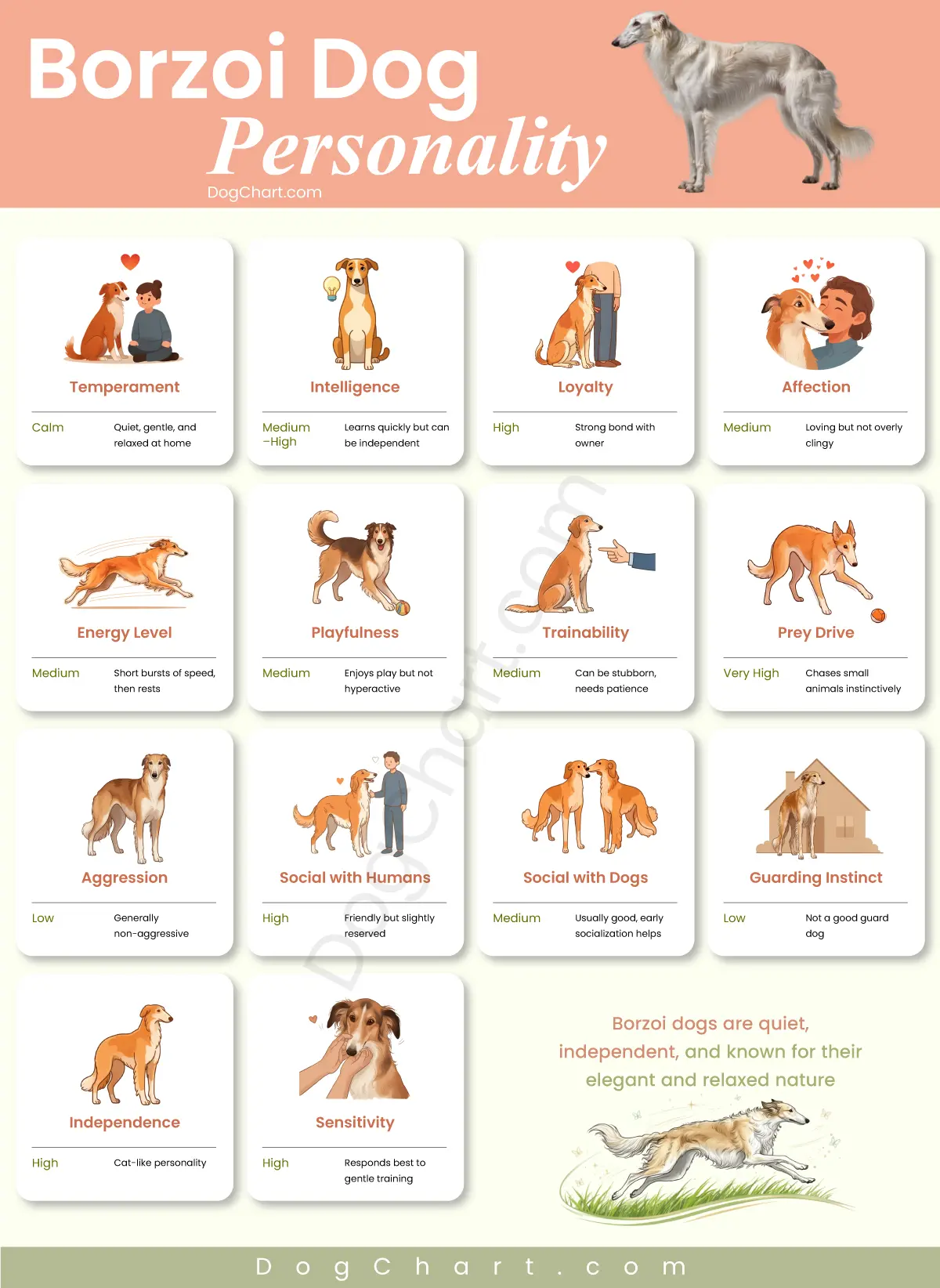
Table of Contents
Borzoi Personality Traits
Every Borzoi has its own quirks, but the breed shares a consistent temperament profile. The table below rates 14 personality factors from breeder surveys and kennel club data. For breed comparisons, see the dog breeds chart.
| Trait | Level | Description |
| Temperament | Calm | Quiet and relaxed at home |
| Intelligence | Medium–High | Learns fast but independent |
| Loyalty | High | Strong bond with owner |
| Affection | Medium | Loving but not clingy |
| Energy Level | Medium | Short speed bursts, then rests |
| Playfulness | Medium | Enjoys play, not hyperactive |
| Trainability | Medium | Stubborn, needs patience |
| Prey Drive | Very High | Chases small animals on instinct |
| Aggression | Low | Non-aggressive |
| Social with Humans | High | Friendly but reserved |
| Social with Dogs | Medium | Good with early socialization |
| Guarding Instinct | Low | Not a guard dog |
| Independence | High | Cat-like personality |
| Sensitivity | High | Responds to gentle training |
That high sensitivity rating matters for training. Borzois shut down under harsh corrections. Positive reinforcement works far better than punishment.
Temperament and Core Traits
Borzois are the quietest large dogs I’ve spent time with. They rarely bark. They don’t demand attention. They’re content to lie on a soft couch for hours, watching the room. Then they sprint like rockets for 5 minutes in the yard and collapse again. Classic sighthound behavior.
Dignified and regal are the words breeders use most. Borzois carry themselves with aristocratic calm that traces back to their origins with Russian nobility.
They don’t jump on visitors or wrestle. They observe. When a Borzoi bonds with a person, the bond runs deep but stays quiet. A Borzoi leaning against your leg is the breed’s version of a golden retriever tackling you.
They’re sensitive to tone. Harsh voices shut them down. Positive reinforcement and patience work better than corrections. Their independent streak means they think before obeying. This frustrates owners who expect instant compliance.
History of the Borzoi Breed
The personality makes more sense with context. Borzois originated in Russia as wolf-chasing sighthounds for the aristocracy. They were called Russian Wolfhound in the West until 1936, when the AKC adopted “Borzoi” as the breed name. The word means “swift” in Russian.
Russian wolf hunting shaped everything about this breed. Working in pairs, Borzois chased wolves across open country, pinned them, and held until hunters arrived. The job demanded independence under pressure. It took courage to face a wolf without commands. Those traits still define the breed today.
The breed was devastated during the Russian Revolution when aristocratic kennels were destroyed. Modern Borzois descend from dogs exported to England and America before 1917. The Borzoi Club of America was founded in 1903. For pricing and pedigree info, the Borzoi breed details has the full breakdown.
Prey Drive and Chase Instinct
This is the biggest behavioral factor with the breed. Borzois have extreme prey drive bred into them for centuries. They will chase squirrels, rabbits, cats, and any fast-moving object. At 40+ mph sprint speed, a Borzoi covers 100 yards in under 10 seconds.
Never let a Borzoi off-leash in unfenced areas. A single deer across the field will send the dog half a mile away before you say its name. Even well-trained Borzois ignore recall when prey triggers kick in. Use 6-foot fenced yards, long lines for training, and off-leash time only in enclosed areas.
Lure coursing is the best outlet. Many cities have sighthound clubs that run lures in enclosed fields. Borzois love it. If no club is nearby, a large fenced yard with a flirt pole works as a substitute.
Borzois Around Children
Borzois do well with calm, older kids (8+). They’re gentle and patient with children. In practice, the issue is rough play. Borzois walk away from kids who grab ears or pull their snout. A child who respects boundaries will earn a deep bond with this breed.
Teach young children to approach calmly and sit next to the dog instead of chasing or grabbing. Never leave a Borzoi alone with a toddler. Not because of aggression, but because their size means accidental bumps during play hurt a small child.
Borzois with Other Pets
With other dogs, Borzois are easy. They don’t start fights and tend to ignore other dogs at the park. Same-sex adult pairs show tension during introductions, but most live peacefully with housemates of any size. Socialize before 4 months old for the best results.
Cats are different. The prey drive is the problem. A Borzoi raised with a cat from puppyhood will coexist fine in many cases. Others will not. Never leave a Borzoi alone with an unfamiliar cat. Small animals like rabbits and hamsters are non-starters. The chase instinct is too strong.
Trainability and Intelligence
Borzois are intelligent but independent. They were bred to make decisions during a wolf hunt without human direction. They learn commands fast but decide whether to obey based on whether they feel like it. “Come” works indoors. Outdoors with a squirrel in view, it does not.
Short, positive training sessions work best. Five minutes twice a day beats thirty minutes once. Food motivation varies by dog. A few Borzois work for treats; others find them beneath their dignity. Try different rewards.
Basic house manners, leash walking, and recall in controlled settings are achievable. Competitive obedience is rare for this breed. The Borzoi price guide notes that breeders sell retired show dogs already trained in basic commands.
Exercise Needs
Lower than you’d expect for such an athletic breed. Borzois need two moderate walks per day plus sprint time in a fenced area. They’re sprinters, not marathoners. A 20-minute walk followed by a 3-minute sprint is perfect. Long runs of 5 miles are too much.
Lure coursing is the best structured outlet. If no club is nearby, a large fenced yard and a flirt pole work. Apartment living is possible but requires daily leashed walks and controlled sprint access. Suburban homes with fenced yards are easier for most owners.
Living Situation
Borzois do best in homes with fenced yards and calm households. They want soft surfaces to lie on. Their bony frames don’t do well on hardwood floors for long stretches, so invest in orthopedic beds.
They don’t like being left alone for hours. Borzois develop separation anxiety if isolated too long. A second dog helps for owners who work full days. New Borzois act aloof at first but warm up fast once they trust you.
Health Concerns and Longevity
Borzois are a healthy breed with a 9–14 year lifespan, but they have breed-specific risks. Bloat is the most dangerous. Deep-chested dogs like the Borzoi face elevated risk of gastric dilatation-volvulus (GDV). Feed small meals instead of one large one. Skip exercise for an hour after eating.
Other conditions include progressive retinal atrophy (vision loss), osteochondritis dissecans (a joint problem), and hip dysplasia. Borzois react badly to standard anesthetics. Always use a vet familiar with sighthound protocols. The dog life expectancy chart has longevity data across breeds.
The silky coat sheds year-round with heavier loss in spring and fall. Daily brushing during shedding season keeps it manageable. The rest of the year, 2–3 brushings per week is enough. The Borzoi colors guide covers coat variety and grooming.
Borzoi Breed Standard and Appearance
The breed standard sets height minimums at 28 inches for males and 26 inches for females at the shoulder. Most Borzois exceed these. The standard calls for a long, narrow head and a deep but narrow chest. The coat should be silky, flat or wavy. Any color is acceptable.
The regal look comes from the combination of height, refined features, and flowing coat. They turn heads at dog shows and appear in fashion editorials because of that build. The Borzoi size guide has full growth charts by age, and the dog size chart covers comparisons with other large breeds.
Frequently Asked Questions
Are Borzois good family dogs?
Yes, for calm families with older children. They’re quiet and affectionate with their people. They suit adults and well-behaved kids but are not ideal for chaotic households or families with toddlers.
Are Borzois aggressive?
No. Borzois are one of the least aggressive large breeds. They don’t start fights, rarely bark, and aren’t territorial. They make terrible guard dogs. If you want protection, look elsewhere.
Do Borzois live with cats?
It depends. Borzois raised with cats from puppyhood coexist peacefully, but prey drive makes it risky with unfamiliar cats. Never leave them unsupervised with a cat they weren’t raised alongside. Adopting an adult Borzoi into a cat household is not recommended.
How much exercise does a Borzoi need?
Two 20–30 minute walks daily plus sprint time in a fenced area. They’re sprinters, not endurance dogs. Off-leash running requires a fully enclosed space because of the prey drive.
Do Borzois do well alone?
Not for long. Borzois form strong bonds and struggle when left alone more than 6–8 hours. They develop separation anxiety. If you work full days, hire a dog walker or get a second dog for company.
Are Borzois easy to train?
Moderate. They’re intelligent but independent. Short, positive sessions work best. Don’t expect Labrador-level obedience. The Borzoi size guide covers growth, and the Borzoi colors page covers coat variety.
Do Borzois shed a lot?
Moderately. The silky coat sheds year-round with heavier shedding in spring and fall. Brush 2–3 times a week to keep loose hair under control. For a large breed, they’re manageable.