
Boxer Dog Size – Height and Weight Chart by Age
I measured a friend’s adult male Boxer at the vet last month. 24.5 inches at the shoulder, 74 lbs. Textbook size. His female Boxer at home is 22 inches and 63 lbs.
Walking them together, you see the difference immediately. Males look chunkier and more muscular. Females look leaner and more refined. Both have the same square-jawed face and athletic build.
The Boxer dog size falls into the medium-sized category. Males stand 58–63 cm (23–25 inches) at the shoulder and weigh 29–36 kg (65–80 lbs).
Females are slightly smaller at 55–60 cm (21.5–23.5 inches) and 25–32 kg (55–70 lbs). They finish growing in height by 12–14 months but continue filling out in muscle until 18–24 months.
This guide covers growth charts by age, male vs female comparison, and how Boxers stack up against other medium breeds.
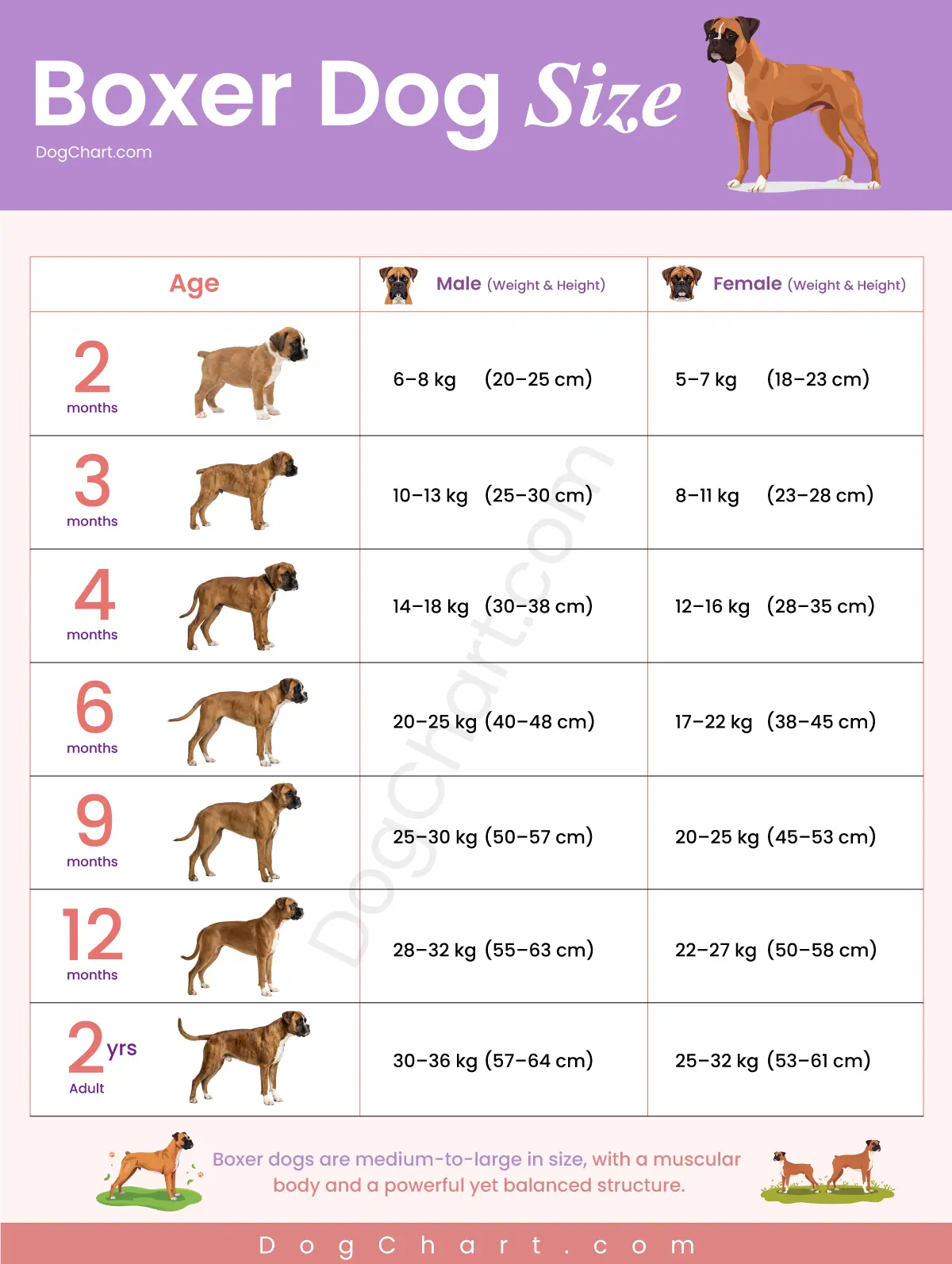
Table of Contents
Boxer Size Chart
| Category | Details |
| Male Height | 58–63 cm (23 to 25 inches) |
| Female Height | 53–61 cm (21–24 in) |
| Male Weight | 30–36 kg (65–80 lbs) |
| Female Weight | 25–32 kg (55–70 lbs) |
| Size Category | Medium-sized working breed with well developed muscles |
| Full Height | 12–14 months |
| Full Muscle | 18–24 months |
| Head | Square, proportion to the body, strong lower jaw and upper jaw |
| Origin | Developed in Germany from the Old English Bulldog |
Boxer Growth Chart by Age
Boxer puppies grow fast in the first 6 months. Growth slows after that, but muscle development continues until 18–24 months. The chart below shows male and female growth from 2 months to adulthood.
| Age | Male Weight | Female Weight | Male Height | Female Height |
| 2 months | 6–8 kg | 5–7 kg | 20–25 cm | 18–23 cm |
| 3 months | 10–13 kg | 8–11 kg | 25–30 cm | 23–28 cm |
| 4 months | 14–18 kg | 12–16 kg | 30–38 cm | 28–35 cm |
| 6 months | 20–25 kg | 17–22 kg | 40–48 cm | 38–45 cm |
| 9 months | 25–30 kg | 20–25 kg | 50–57 cm | 45–53 cm |
| 12 months | 28–32 kg | 22–27 kg | 55–63 cm | 50–58 cm |
| Adult (2 yrs) | 30–36 kg | 25–32 kg | 57–64 cm | 53–61 cm |
A male Boxer at 12 months is close to full height. Females finish slightly earlier. Both continue developing muscle mass through age 2.
Male vs Female Comparison
A male Boxer averages 3–4 cm taller and 4–5 kg heavier than a female Boxer. Males have broader chests, thicker bone, and more visible muscle. Females look leaner and slightly longer in body.
Both sexes share the same square muzzle, strong lower jaw, and athletic build. The head should be in proportion to the body, with the muzzle one-third the length of the skull. Sides of the muzzle fall vertically to the black nose.
Temperament is similar. Both are intelligent and trainable, friendly at play, and bond closely with family.
Breed Standard for the Boxer
The American Kennel Club sets the standard for the Boxer through the American Boxer Club, which is the AKC parent club official for the breed. The first Boxer breed standard was written in Germany in 1904. The AKC breed standard followed in 1915.
According to the American Kennel Club, adult males should stand 23 to 25 inches at the shoulder. Females should stand 21 to 23.5 inches. Any Boxer outside these ranges doesn’t meet the standard for show purposes.
The colors are fawn and brindle. Brindle shows black stripes on a fawn base. No other colors meet the AKC standard for show purposes, though white Boxers can be registered. The Boxer colors guide covers the full range.
The head should be square, with the upper jaw slightly undershot (the lower jaw extends past the upper jaw). This is called an undershot bite and is a defining breed feature.
Body Structure and Build
Boxers are a medium-sized working breed with a square body shape. The distance from the tip of the nose to the base of the tail is roughly equal to the height at the shoulder.
The chest is deep and reaches to the elbows. The back is short and straight. Well developed muscles cover the shoulders, chest, and hindquarters. This is a breed built for athletic work.
The tail was historically docked but many countries now prohibit docking. Modern breeders increasingly undock Boxer puppies, leaving the natural tail intact.
Boxers are brachycephalic, meaning they have a short muzzle. This affects breathing in extreme heat and requires careful exercise management in hot weather.
History and Origin
The Boxer was developed in Germany in the late 1800s. It descends from the Bullenbeisser (a mastiff-type dog) and the Old English Bulldog. The Bullenbeisser was used as a hunting dog for large game like bears and wild boar.
German breeders crossed the Bullenbeisser with the English Bulldog to create the modern Boxer. The goal was a smaller, more agile dog with the same grip strength and courage. The Boxer was bred to be a hunting companion, guard dog, and family dog.
The first German Boxer was registered in 1895. The breed reached America in the early 1900s and gained popularity after World War I. Today, Boxers are one of the most popular dog breeds in the US. See the working dog breeds page for breed history.
Boxer vs Other Medium and Large Breeds
Boxers are similar in height to Labradors but carry more muscle per pound. They’re shorter than Dobermans and smaller than Rottweilers. The table below compares common working breeds.
| Breed | Male Height | Male Weight | Type |
| Boxer | 58–63 cm | 30–36 kg | Medium-sized working |
| Bulldog | 35–40 cm | 23–25 kg | Low, stocky |
| Am Staffordshire | 43–48 cm | 25–36 kg | Muscular |
| Rottweiler | 61–69 cm | 50–61 kg | Large working |
| Doberman | 66–72 cm | 34–45 kg | Tall, lean |
| Labrador | 56–62 cm | 29–36 kg | Medium sporting |
| Mastiff | 70–76 cm | 68–91 kg | Giant |
See the biggest dog breeds guide and the dog breeds chart for full comparisons.
How to Measure Your Boxer
Measure height from the top of the shoulder blade (the withers) straight down to the ground. The dog should stand square on a flat surface.
Use a measuring stick or ruler against the wall. A flexible tape over the back gives inaccurate results.
For weight, use a pet scale or weigh yourself holding the new puppy and subtract. Track monthly during the first year.
Compare your measurements against the Boxer growth chart above. If your dog falls significantly outside the range, talk to your vet. Some variation is normal, but large deviations may signal health issues.
Boxer Temperament and Training
Boxers are intelligent and trainable. They respond well to positive reinforcement. Harsh training methods don’t work with this breed.
They can be distrustful of strangers at first but warm up quickly. Early socialization is essential. Boxers are friendly at play and bond strongly with family.
Boxers are excellent family dogs and work well as service dogs when properly trained. They enjoy dog sports like agility and obedience. For feeding guidance, see the Boxer food guide. For health concerns, see the Boxer lifespan guide.
Frequently Asked Questions
How big do Boxers get?
Male Boxers reach 58–63 cm (23 to 25 inches) and 30–36 kg (65–80 lbs). Female Boxers are smaller at 53–61 cm (21–24 in) and 25–32 kg (55–70 lbs).
When do Boxers stop growing?
Height is complete by 12–14 months. Muscle development continues until 18–24 months.
Are Boxers medium or large breeds?
Medium-sized. Boxers sit at the upper end of the medium category. Some sources list them as medium-to-large.
How much should a 6-month-old Boxer weigh?
Males: 20–25 kg (44–55 lbs). Females: 17–22 kg (37–49 lbs). See the dog weight chart for reference data.
What’s the biggest Boxer ever recorded?
Exceptional males can reach 40 kg (88 lbs) but that’s above the breed standard. Breeders aim for moderate size, not extremes. The Boxer price guide covers what to expect from show-quality lines.