
Staffy vs Pitbull – Key Differences Between These Two Breeds
I once watched a Staffy and an American Pitbull Terrier meet at a dog park. Same blocky head. Same muscular build. Same loving eyes. To most people, they looked like the same dog. They aren’t.
These two breeds – the Staffordshire Bull Terrier and the American Pit Bull Terrier – share ancestors but grew up on different continents with different goals. Understanding the key differences helps you tell them apart.
This guide compares every important trait side by side. Size, temperament, health, trainability, and which breed fits which home.
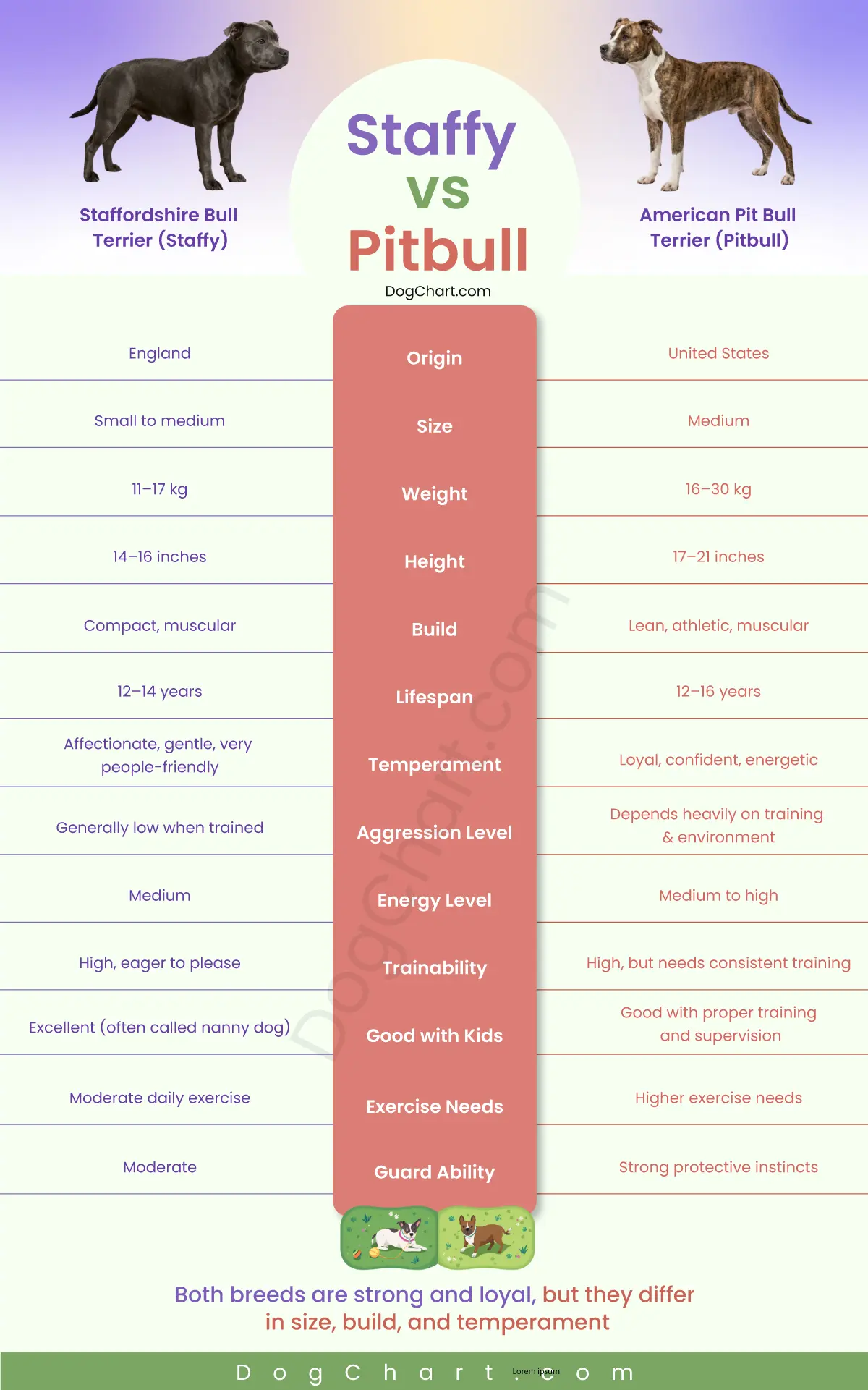
Table of Contents
Staffy vs Pitbull Chart
Here’s how the two breeds stack up across every important category:
| Category | Staffordshire Bull Terrier | American Pit Bull Terrier |
| Origin | England | United States |
| Size | Small to medium | Medium |
| Weight | 11–17 kg | 16–30 kg |
| Height | 14–16 inches | 17–21 inches |
| Build | Compact, muscular | Lean, athletic, muscular |
| Lifespan | 12–14 years | 12–16 years |
| Temperament | Affectionate, gentle, people-friendly | Loyal, confident, energetic |
| Aggression Level | Low when trained | Depends on training |
| Energy Level | Medium | Medium to high |
| Trainability | High, eager to please | High, needs consistency |
| Good with Kids | Excellent (nanny dog) | Good with training |
| Exercise Needs | Moderate daily | Higher exercise needs |
| Guard Ability | Moderate | Strong protective instincts |
Breed History and Background
The breed history of both dogs traces back to 19th century England, where bull and terrier crosses were bred for bull baiting and later dog fighting in illegal pits. Both sports are now banned. The breeds moved on.
The Staffordshire Bull Terrier stayed in England and became a beloved family dog. The Kennel Club (UK) recognized the breed in 1935. Not long after, a larger bulldog-type dog was developed in America, splitting into what became the American Pit Bull Terrier (APBT) and the American Staffordshire Terrier (Amstaff).
The American Kennel Club (AKC) didn’t recognize the American Pit Bull Terrier. Instead, they registered the breed as the American Staffordshire Terrier in 1936. Amstaffs and APBTs share a common bloodline but have been bred separately for nearly 90 years.
The United Kennel Club (UKC) recognizes the APBT directly. The American Bulldog is a separate breed entirely, though often confused with the Pitbull.
American Pit Bull Terrier vs American Staffordshire Terrier vs American Bully
Before comparing Staffy to Pitbull, it helps to understand the broader bully breeds family. When people say “Pitbull,” they usually mean one of four breeds: the APBT, the Am Staff, the Staffordshire Bull Terrier, or the American Bully.
Comparing American Pit Bull Terrier to the American Staffordshire Terrier is tricky. The pit bull terrier and american Staffordshire Terrier share DNA but differ in build. American Staffordshire Terriers tend to be slightly heavier and stockier, while APBTs are leaner and more athletic.
When looking at American Staffordshire Terrier vs the Pitbull, you’re really comparing two dogs with the same ancestors and different show standards.
The bull terrier and american Staffordshire Terrier relationship is close. The bull terrier and american Staffordshire Terrier can look nearly identical to an untrained eye.
The terrier and american Staffordshire Terrier show dogs tend to have thicker heads and more defined muscle tone.
The American Bully is the newest addition. Developed in the 1990s, they’re heavier, shorter, and bred specifically for companionship. American pitbull and American pitbull terrier owners sometimes cross their dogs with Bulldogs to create American pitbull terriers with exaggerated builds, though purists don’t consider these true APBTs.
This terrier vs bull terrier vs comparison matters because breed-specific legislation often lumps all of them together regardless of actual differences.
Physical Differences: Size, Build, and Appearance
Weight tells the story. A Staffie weighs 24–38 pounds. Pitbulls weigh 35–60 pounds, with some larger males reaching 70 pounds or more. That’s a significant gap.
Staffies stand 14–16 inches tall at the shoulder. Pit bulls stand 17 to 21 inches – up to 21 inches for larger males. The Pitbull is a larger dog overall.
The build differs too. Staffies have a stocky build with a broad head and pronounced cheek muscles. They’re stocky and compact. Pit bulls are taller and more slender, agile, and built for speed.
Both breeds have muscular builds. Both have muscular shoulders and strong jaws. American Staffordshire Terriers tend to be slightly heavier and stockier than APBTs but tend to be slightly larger than Staffies.
Both breeds come in a variety of colors – black, brown, brindle, white, blue, and fawn. For size comparisons with other breeds, the dog size chart covers every category.
Behavior and Temperament Comparison
The behavior and temperament of both breeds is similar in key ways. Both are people-oriented dogs that bond hard with their families. Both are non-aggressive towards humans when raised and socialized properly.
The Staffordshire Bull Terrier (the “Staffordshire terrier” in UK usage) is famously affectionate. Nicknamed “the nanny dog,” they’re patient with kids and want constant closeness. The Pitbull is equally loving but has more drive and energy.
Both breeds can show aggression towards other dogs if not properly socialized, especially with same-sex dogs. This is a trait from their bull-baiting and fighting past. Early training and socialization solves most issues. Socialization before 16 weeks is critical.
The fix is simple: socialize your puppy early and often. Expose them to different people, dogs, and environments. A well-socialized Staffy or Pitbull rarely shows aggression toward anyone.
These are people-oriented dogs first and foremost. The myths around aggression are covered in detail on the aggressive dog breeds page.
Staffy vs Pitbull with Kids
The Staffy has one of the best reputations for child-friendliness. “Nanny dog” isn’t marketing – it’s what British families called them decades ago because of their patience and gentleness with children.
Pit bulls can also be great with kids but require more careful supervision because of their higher energy. They can accidentally knock small children over during play. With proper training, both breeds bond strongly with kids.
No dog of any breed should be left unsupervised with young children. Supervision prevents most bite incidents regardless of breed.
Health and Lifespan Comparison
| Health Issue | Staffy | Pitbull |
| Hip Dysplasia | Moderate | Common |
| Skin Allergies | Common | Very Common |
| Heart Disease | Moderate | Moderate |
| Cataracts | Common (hereditary) | Moderate |
| L-2 HGA | Specific risk | Rare |
| Cerebellar Ataxia | Known risk | Rare |
| Average Lifespan | 12–14 years | 12–16 years |
The Pitbull lives slightly longer on average. Both are relatively healthy when bred responsibly.
The Staffy has two specific breed risks: L-2 Hydroxyglutaric Aciduria and cerebellar ataxia. Both are hereditary neurological conditions. Reputable breeders test for these before breeding.
Hip dysplasia is common in both breeds, though more common in Pitbulls due to their larger size. Joint dysplasia leads to arthritis as dogs age. Both benefit from glucosamine supplements starting around age 3–4.
For Pitbull lifespan details, the Pitbull lifespan page covers everything. For feeding, the Pitbull food guide works for both breeds.
Energy Levels and Exercise
The Staffy needs 45–60 minutes of exercise per day. Walks, play, and outdoor time. They’re happy to nap on the couch between activities.
The Pitbull needs 60–90 minutes. More drive, more stamina. A bored Pitbull will find ways to burn that energy. Running, fetch, tug, and structured play keep them balanced.
Both breeds love swimming and hiking. Both should be leash-walked or have a secure yard.
Training and Trainability
Both breeds are intelligent and eager to please. Both respond best to positive reinforcement. Harsh corrections shut both breeds down.
Staffies learn basic obedience slightly faster because of their calmer nature. Pitbulls need more consistency because of their higher energy. Once a Pitbull understands what you want, they’re incredibly reliable.
Bite Force Comparison
Both breeds have similar bite force. The Staffy bites at 220–240 PSI. The Pitbull bites at 235–250 PSI. Neither has a locking jaw – this is a myth.
For the full bite force breakdown, the dog bite force chart covers every breed. The Pitbull bite PSI page has Pitbull-specific details.
Breed Standards and Legal Status
The breed standard for the Staffordshire Bull Terrier is set by the UK Kennel Club. The breed standard for the American Pit Bull Terrier is set by the UKC. The AKC uses the American Staffordshire Terrier standard instead.
In the UK, Staffies are legal and popular. APBTs are banned under the Dangerous Dogs Act 1991. In the US, both breeds are legal federally, but some cities restrict Pitbulls.
Neither breed was bred as traditional guard dogs, though both have protective instincts. The Pitbull tends to be more naturally protective, while the Staffy is more likely to greet a stranger than challenge one.
Which Breed Is Right for You?
Choose a Staffy if: You want a calmer family dog, live in an apartment, have young children, or live in a country with Pitbull restrictions.
Choose a Pitbull if: You’re active, want 60–90 minutes of daily exercise, or want a dog with natural guarding instincts.
Either breed works for most families when trained and socialized properly.
FAQs
Is a Staffy just a smaller Pitbull?
No. They’re separate breeds with different origins. The Staffy comes from England. The Pitbull comes from the US. They share ancestors but developed independently.
Which breed is more aggressive?
Neither is inherently aggressive. Both can be safe family dogs with proper training and socialization.
Which breed is better with kids?
The Staffy has the stronger reputation. Pit bulls can also be great with kids with proper training.
Which breed lives longer?
The Pitbull, at 12–16 years versus the Staffy’s 12–14 years.
Are Staffies legal in the UK?
Yes. The APBT is banned under the Dangerous Dogs Act 1991, but the Staffy is not affected.
Can a Staffy and Pitbull live together?
Yes. Many owners have both. They get along well with proper introductions and socialization. For names that work for both breeds, the Pitbull names guide has 200+ ideas. The Pitbull service dog guide covers training principles.